






Table Of Content
Latest Update: NEET UG 2026 updated syllabus is released. Exam date: 03 May 2026.
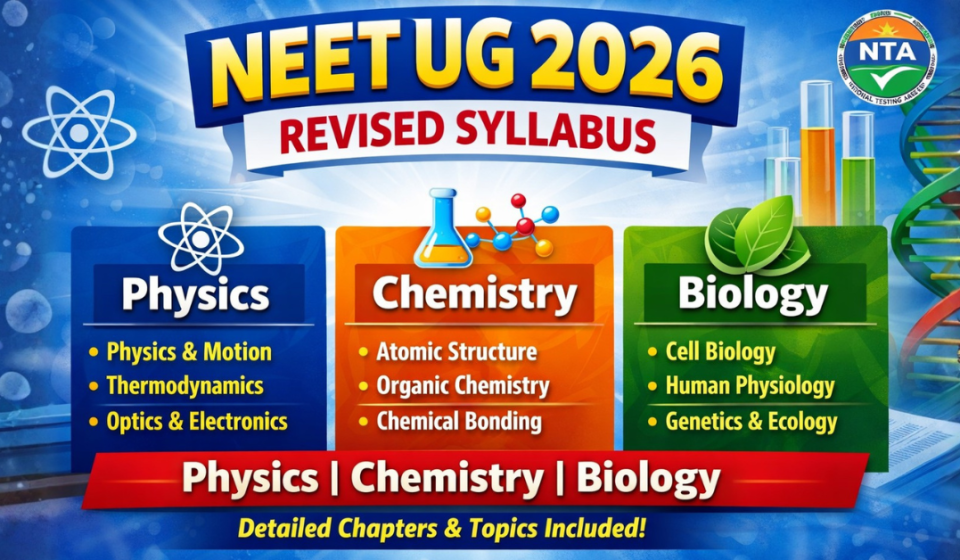
National Level Medical Admission Test (NEET) is an entry-level examination for candidates wishing to pursue a career in medicine who take their final 12th grade exams nationwide. The National Medical Council (NMC) will announce the NEET – UG 2026 examination syllabus at a later date. To perform well on the NEET exam, students should have a clearly defined syllabus from which to prepare. You may access the newest version of the syllabus from the article so you can look through the NEET exam syllabus for each individual subject area — physics, chemistry and biology.
NEET UG 2026 Syllabus PDF Subject-wise
The NMC will announce the NEET syllabus for 2026 and publish the information bulletin simultaneously, using Class 11 and 12 syllabi as their basis, with the NCERT syllabus most commonly used. This newly updated syllabus will allow students to concentrate on the most applicable material, thereby improving their odds of being successful on this next testing cycle. Other candidates applying for acceptance to undergraduate medical education programs should take care to read through the eligibility requirements to be sure that they meet the minimum qualifications for consideration.
Physics Syllabus for NEET(UG)
The NEET Physics part of the curriculum is found hard by many NEET aspirants while they prepare for it. To support a more complete and successful effort at preparing for the NEET Physics portion, chennaineet has provided this table of the NEET Physics portion, which should be helpful when you prepare for the NEET examination.
Physics Syllabus
| Chapter Name | |
| Physics and Measurements (Units and Measurements) | Electrostatics |
| Kinematics | Current Electricity |
| Laws of Motion | Magnetic Effects Of Current and Magnetism |
| Work, Energy and Power | Electromagnetic Induction And Alternating Currents |
| Rotational Motion | Electromagnetic Waves |
| Gravitation | Optics |
| Properties of Solids and Liquids | Dual Nature of Matter and Radiation |
| Thermodynamics | Atoms and Nuclei |
| Kinetic Theory of Gases | Electronic Devices |
| Oscillation and Waves | Experimental Skills |
Chemistry Syllabus for NEET UG 2026
Typically, the chemistry questions are much more theoretical than those found in other disciplines, allowing students to score higher in this section. The chemistry section in NEET 2026 has 3 sub-sections: physical chemistry, organic chemistry, and inorganic chemistry.
Below is an explanation of what is required from each of the 3 sub-sections to give students a detailed breakdown to help them prepare for the NEET exam.
Chemistry Syllabus
| Physical Chemistry | |
| Some Basic Concepts in Chemistry | Solutions (Liquid Solutions) |
| Atomic Structure | Equilibrium |
| Chemical Bonding and Molecular Structure | Redox Reaction and Electrochemistry |
| Chemical Thermodynamics | Chemical Kinetics |
| Inorganic Chemistry | |
| Classification of Elements and Periodicity in Properties (Periodic Table) | p-block Elements |
| d- and f-block Elements | Coordination Compounds |
| Organic Chemistry | |
| Purification and Characterization of Organic Compounds | Organic Compounds Containing Oxygen |
| Basic Principles of Organic Chemistry (General Organic Chemistry) | Organic Compounds Containing Nitrogen |
| Hydrocarbons | Biomolecules |
| Organic Compounds Containing Halogens(Haloalkanes and Haloarenes) | Principles Related to Practical Chemistry(Practical Organic Chemistry) |
Biology Syllabus for NEET UG 2026
The subject of NEET Biology consists of both Zoology and Botany that’s why it has to be given major importance as the syllabus is very long. The following list shows you how many chapters from various sections will be included in the part that you will study for NEET Biology in 2026.
Biology Syllabus

| Chapter Name | |
| Diversity in Living Organisms | Reproduction |
| Structural Organisation in Animals and Plants | Genetics and Evolution |
| Cell Structure and Function | Biology and Human Welfare |
| Plant Physiology | Biotechnology and its Applications |
| Human Physiology | Ecology and Environment |
Exam Pattern and Marking Scheme
It is very important to understand the NEET examination pattern and review the associated NEET examination syllabus early in the preparation. This will help to maximize your chances of scoring a very high score in the NEET examinations.
Marking Structure of NEET Exam by NTA
NTA has devised the NEET marking structure as laid out below:
- Correct Answer: + 4 for every correct answer
- Incorrect Answer: – 1 for every incorrect answer
- No Response: 0 for every unanswered question
- Multiple Responses: – 1 for every question where multiple responses are marked
There is a large amount of content covered in the NEET examination, and sometimes it makes no sense for students to create a good study plan based on this content. At chennaineet, students receive proper direction for the right studying strategy and feeilng organized by creating a timely study plan.