






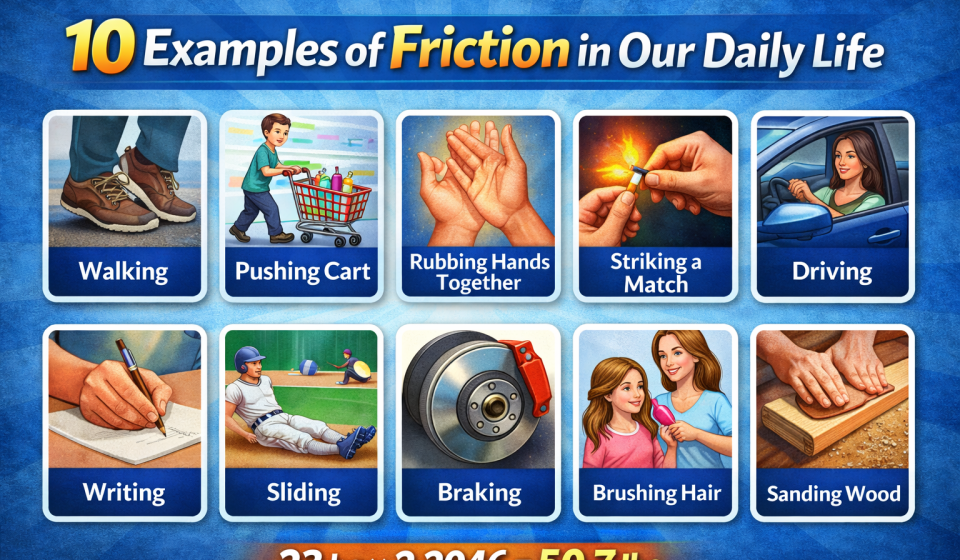

Have you ever wondered why a car stops when you press the brake or why you can walk without slipping? The answer lies in a simple but important concept in physics called friction.
Table Of Content
- What is Friction?
- Key Points about Friction
- 10 Examples of Friction in Our Daily Life
- 1. Walking on the Road
- 2. Writing with a Pen or Pencil
- 3. Braking a Car or Bicycle
- 4. Lighting a Matchstick
- 5. Holding Objects
- 6. Climbing a Hill
- 7. Tires of Vehicles
- 8. Erasing with an Eraser
- 9. Sliding a Book on a Table
- 10. Rubbing Hands Together
- Final Answer
- Additional Notes
Friction is a force that opposes the motion between two surfaces that are in contact with each other. Without friction, many everyday activities would become impossible. You would not be able to walk, write, drive vehicles, or even hold objects properly.
Friction plays a vital role in our daily lives and is widely studied in physics, especially by students preparing for science exams. If you want more clear explanations of science concepts and solved questions, you can explore helpful resources at chennaineet.
Understanding friction through real-life examples makes the concept easier to learn and remember.
What is Friction?
Friction is a resistive force that acts between two surfaces when they move or try to move relative to each other.
Key Points about Friction
- It acts opposite to the direction of motion.
- It occurs when two surfaces are in contact.
- It can slow down or stop movement.
- It can also help objects move safely, such as walking or driving.
There are different types of friction:
- Static friction
- Sliding friction
- Rolling friction
- Fluid friction
Each type plays a role in everyday activities.
10 Examples of Friction in Our Daily Life
Below are some common situations where friction helps us perform everyday tasks.
1. Walking on the Road
When you walk, friction between your shoes and the ground prevents you from slipping.
Without friction, walking would be almost impossible because your feet would slide on the surface.
2. Writing with a Pen or Pencil
When you write on paper, friction between the tip of the pen or pencil and the paper allows the ink or graphite to leave a mark.
Without friction, writing would not be possible.
3. Braking a Car or Bicycle
When brakes are applied, friction between the brake pads and the wheel slows down the vehicle.
This friction helps vehicles stop safely.
4. Lighting a Matchstick
When you strike a matchstick against the matchbox surface, friction produces heat.
This heat ignites the chemicals on the matchstick, producing a flame.
5. Holding Objects
When you hold a book, phone, or glass, friction between your hand and the object prevents it from slipping.
Without friction, objects would easily fall from your hands.
6. Climbing a Hill
When climbing hills or stairs, friction between your shoes and the surface provides grip.
This helps you move upward without sliding backward.
7. Tires of Vehicles
Friction between car tires and the road allows vehicles to move forward and change direction.
If there were no friction, vehicles would skid and lose control.
8. Erasing with an Eraser
When you rub an eraser on paper, friction helps remove the pencil marks.
The rubbing action loosens the graphite particles from the paper.
9. Sliding a Book on a Table
When you push a book across a table, friction between the book and the table surface slows down the motion.
Eventually, the book stops moving because of friction.
10. Rubbing Hands Together
When you rub your hands together quickly, friction produces heat.
This is why rubbing hands can help warm them during cold weather.
Final Answer
Friction is a force that opposes motion between two surfaces in contact.
Some common examples of friction in daily life include:
- Walking on the road
- Writing with a pen or pencil
- Braking vehicles
- Lighting a matchstick
- Holding objects
- Climbing hills
- Vehicle tires gripping the road
- Erasing pencil marks
- Sliding objects on surfaces
- Rubbing hands together
These examples show how friction plays an essential role in everyday activities.
Additional Notes
Although friction is useful in many situations, it can also have disadvantages:
- It causes wear and tear in machines.
- It can produce heat and energy loss.
- It may reduce the efficiency of mechanical systems.
To reduce unwanted friction, substances called lubricants (like oil or grease) are used.
Understanding friction is important in physics, engineering, and everyday life, which is why it is commonly taught in school science and competitive exam preparation.
For more science explanations, solved questions, and educational articles, visit chennaineet.