




In chemistry, acids are classified as strong acids or weak acids based on how they behave in water. A common question asked in exams is: “Which of the following is a weak acid?”
Table Of Content
- Question
- Bronsted–Lowry Theory of Acids and Bases
- Strong Acids vs Weak Acids
- Strong Acids
- Weak Acids
- Step-by-Step Explanation
- Step 1: Examine the options
- Step 2: Determine their strength
- Step 3: Identify the weak acid
- Final Answer
- Additional Notes
- Important Facts about Acetic Acid
- Uses of Acetic Acid
To answer this type of question, we must understand how acids dissociate (break apart) in water and how acid–base reactions work according to scientific theories like the Bronsted–Lowry theory.
In simple terms, a strong acid completely dissociates in water, releasing many hydrogen ions (H⁺), while a weak acid only partially dissociates. Because of this partial dissociation, weak acids release fewer hydrogen ions into the solution.
Students preparing for chemistry exams can find more solved questions and explanations at chennaineet.
Question
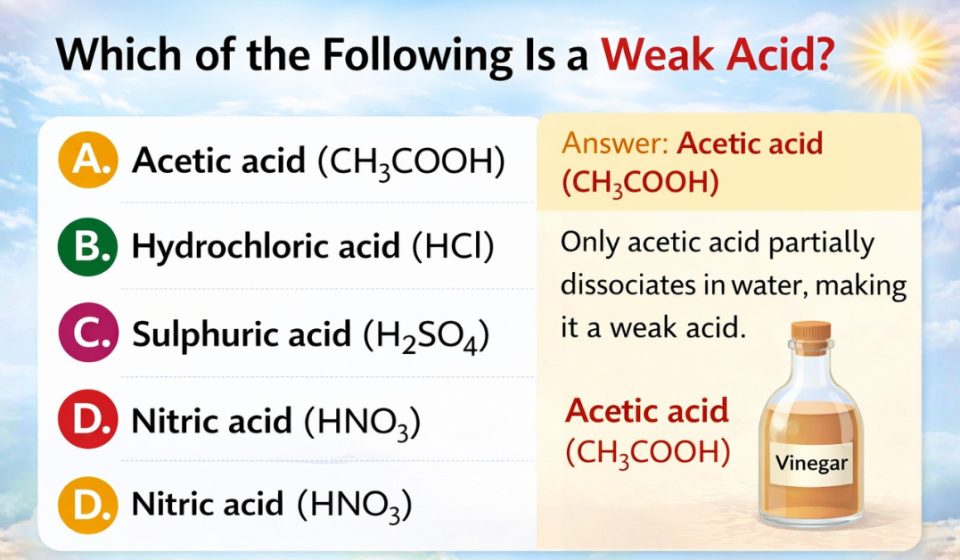
Which of the following is a weak acid?
A. Acetic acid (CH₃COOH)
B. Hydrochloric acid (HCl)
C. Sulphuric acid (H₂SO₄)
D. Nitric acid (HNO₃)
Bronsted–Lowry Theory of Acids and Bases
To understand weak acids clearly, we first look at the Bronsted–Lowry theory.
According to this theory:
- A Bronsted–Lowry acid is a substance that donates a proton (H⁺).
- A Bronsted–Lowry base is a substance that accepts a proton (H⁺).
For example, consider the reaction of acetic acid with water:
CH₃COOH + H₂O ⇌ H₃O⁺ + CH₃COO⁻
In this reaction:
- Acetic acid (CH₃COOH) donates a proton → acts as an acid
- Water (H₂O) accepts a proton → acts as a base
This reaction forms a conjugate acid–base pair.
Strong Acids vs Weak Acids
Acids are categorized based on how much they dissociate in water.
Strong Acids
Strong acids completely dissociate in water.
Examples include:
- Hydrochloric acid (HCl)
- Sulphuric acid (H₂SO₄)
- Nitric acid (HNO₃)
These acids release almost all their hydrogen ions when dissolved in water.
Weak Acids
Weak acids partially dissociate in water, meaning only some molecules release hydrogen ions.
Example:
- Acetic acid (CH₃COOH)
This partial dissociation makes acetic acid a weak acid.
Step-by-Step Explanation
Step 1: Examine the options
The given options are:
- Acetic acid (CH₃COOH)
- Hydrochloric acid (HCl)
- Sulphuric acid (H₂SO₄)
- Nitric acid (HNO₃)
Step 2: Determine their strength
- HCl → Strong acid
- H₂SO₄ → Strong acid
- HNO₃ → Strong acid
- CH₃COOH → Weak acid
Step 3: Identify the weak acid
Among the given options, acetic acid does not completely dissociate in water, so it is classified as a weak acid.
Final Answer
The correct answer is:
Option A: Acetic acid (CH₃COOH)
Acetic acid is a weak acid because it undergoes partial dissociation in water, unlike strong acids that dissociate completely.
Additional Notes
Acetic acid is commonly found in vinegar, which is widely used in cooking and food preservation.
Important Facts about Acetic Acid
- Chemical formula: CH₃COOH
- Weak organic acid
- Colourless liquid with a strong pungent smell
Uses of Acetic Acid
- Vinegar production
- Food preservation
- Chemical manufacturing
- Laboratory experiments
Understanding weak acids like acetic acid helps students learn how acid–base reactions work in chemistry.
For more chemistry explanations and exam preparation materials, visit chennaineet.