





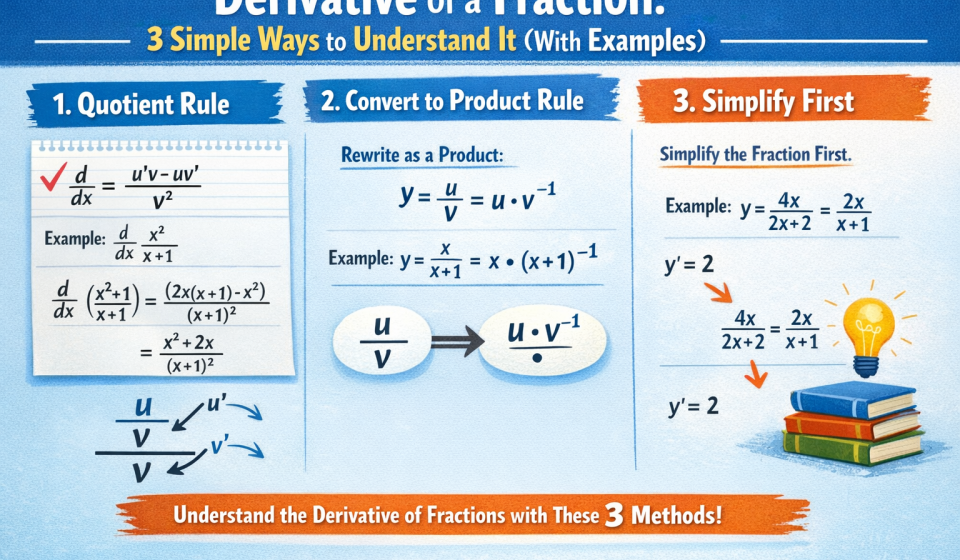

Introduction
Derivative of a fraction is one of those calculus topics that initially confuses many students. If you’ve ever stared at a fraction likeg(x)f(x)
Table Of Content
- Introduction
- Step-by-Step Formula
- Memory Trick
- Example
- Step 1: Identify numerator and denominator
- Step 2: Find derivatives
- Step 3: Apply quotient rule
- Step 4: Simplify
- 1️⃣ Physics
- 2️⃣ Engineering
- 3️⃣ Machine Learning
- ❌ Forgetting denominator squared
- ❌ Switching numerator order
- ❌ Skipping simplification
- 1️⃣ Always label numerator and denominator
- 2️⃣ Practice pattern recognition
- 3️⃣ Simplify before differentiating
- 4️⃣ Check algebra carefully
- Example
- Step 1: Identify functions
- Step 2: Derivatives
- Step 3: Apply quotient rule
- Step 4: Simplify
and wondered how to differentiate it, you’re not alone.
Most students struggle with this question: how to find derivative of a fraction quickly and correctly?
Here’s the direct answer:
The derivative of a fraction is usually calculated using the Quotient Rule.dxd(g(x)f(x))=[g(x)]2g(x)f′(x)−f(x)g′(x)
In simple words:
Derivative of numerator × denominator − numerator × derivative of denominator, divided by denominator²
Once you understand this pattern, differentiating fractions becomes surprisingly straightforward.
Students preparing for calculus exams, engineering courses, or competitive tests often practice this concept extensively. If you want more math explanations and practice problems, you can also explore Neet Chemistry NCERT.
Key Highlights 📌
Before diving deeper, here are the essential takeaways:
- The derivative of a fraction is found using the Quotient Rule
- Formula:
dxd(g(x)f(x))=[g(x)]2g(x)f′(x)−f(x)g′(x)
- Used in calculus, engineering, physics, and machine learning
- Works for any rational function
- Requires knowledge of basic derivative rules
What Does Derivative of a Fraction Mean?
In calculus, a derivative measures how fast something changes.
For example:
- Speed = derivative of position
- Acceleration = derivative of velocity
When you see a fraction function, such asxx2+1
you’re working with a rational function.
To calculate its rate of change, you must find the derivative of a fraction.
That’s where the quotient rule comes in.
How to Find Derivative of a Fraction Using the Quotient Rule
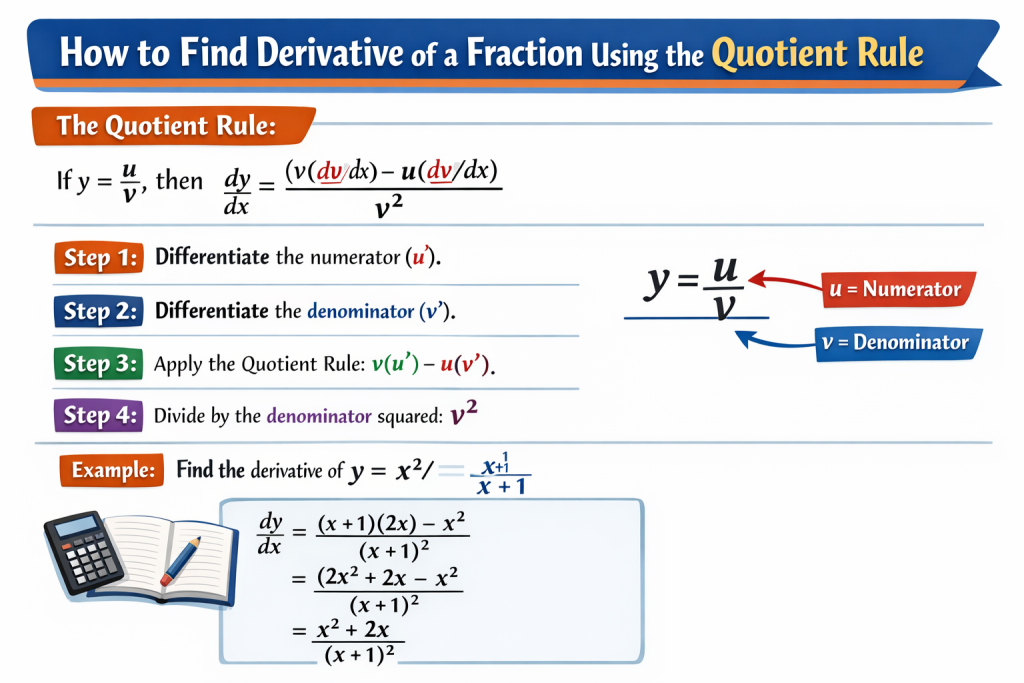
Let’s walk through the exact process for how to find derivative of a fraction.
Suppose the function is:y=g(x)f(x)
Step-by-Step Formula
y′=g(x)2g(x)f′(x)−f(x)g′(x)
Memory Trick
Many students remember the rule like this:
Low d-high minus high d-low, divided by low²
Where:
- Low = denominator
- High = numerator
This trick helps students quickly recall the formula during exams.
Example: Derivative of a Fraction Step by Step
Let’s solve a real problem.
Example
Find the derivative of a fractiony=x+1×2
Step 1: Identify numerator and denominator
- Numerator = f(x)=x2
- Denominator = g(x)=x+1
Step 2: Find derivatives
f′(x)=2x g′(x)=1
Step 3: Apply quotient rule
y′=(x+1)2(x+1)(2x)−(x2)(1)
Step 4: Simplify
y′=(x+1)22×2+2x−x2 y′=(x+1)2×2+2x
Alternative Method: Convert the Fraction First
Sometimes you don’t need the quotient rule.
You can rewrite the fraction first.
Example:xx2=x
Now differentiation becomes simple.dxd(x)=1
Good mathematicians always check if simplification makes the problem easier.
Real-World Applications of Fraction Derivatives
Students often ask:
Where is this used outside exams?
Actually, derivatives of fractions appear everywhere in science and technology.
1️⃣ Physics
Velocity formulas often involve fractions.
Example:v=timedistance
Taking derivatives helps calculate acceleration.
2️⃣ Engineering
Engineers use rational functions when analyzing:
- Electrical circuits
- Control systems
- Fluid dynamics
3️⃣ Machine Learning
Gradient-based optimization relies heavily on derivatives.
According to MIT OpenCourseWare calculus resources, derivatives form the mathematical backbone of modern AI algorithms.
Common Mistakes Students Make
When learning how to find derivative of a fraction, several mistakes occur repeatedly.
❌ Forgetting denominator squared
The denominator must always become:g(x)2
❌ Switching numerator order
Correct formula:g(x)f′(x)−f(x)g′(x)
Wrong order changes the result.
❌ Skipping simplification
After applying the quotient rule, always simplify the result.
Best Practices for Solving Fraction Derivatives
If you want to master this topic quickly, follow these strategies.
1️⃣ Always label numerator and denominator
Write:
- f(x)
- g(x)
This prevents mistakes.
2️⃣ Practice pattern recognition
Most exam questions follow similar structures.
Practice helps you recognize them instantly.
3️⃣ Simplify before differentiating
If possible, simplify the fraction first.
This often saves time.
4️⃣ Check algebra carefully
Derivative errors usually come from algebra mistakes, not calculus rules.
Another Worked Example
Let’s solve another example.
Example
Find the derivative:y=x3x+1
Step 1: Identify functions
Numerator:f(x)=3x+1
Denominator:g(x)=x
Step 2: Derivatives
f′(x)=3 g′(x)=1
Step 3: Apply quotient rule
y′=x2x(3)−(3x+1)(1)
Step 4: Simplify
y′=x23x−3x−1 y′=x2−1
Why Calculus Teachers Emphasize This Rule
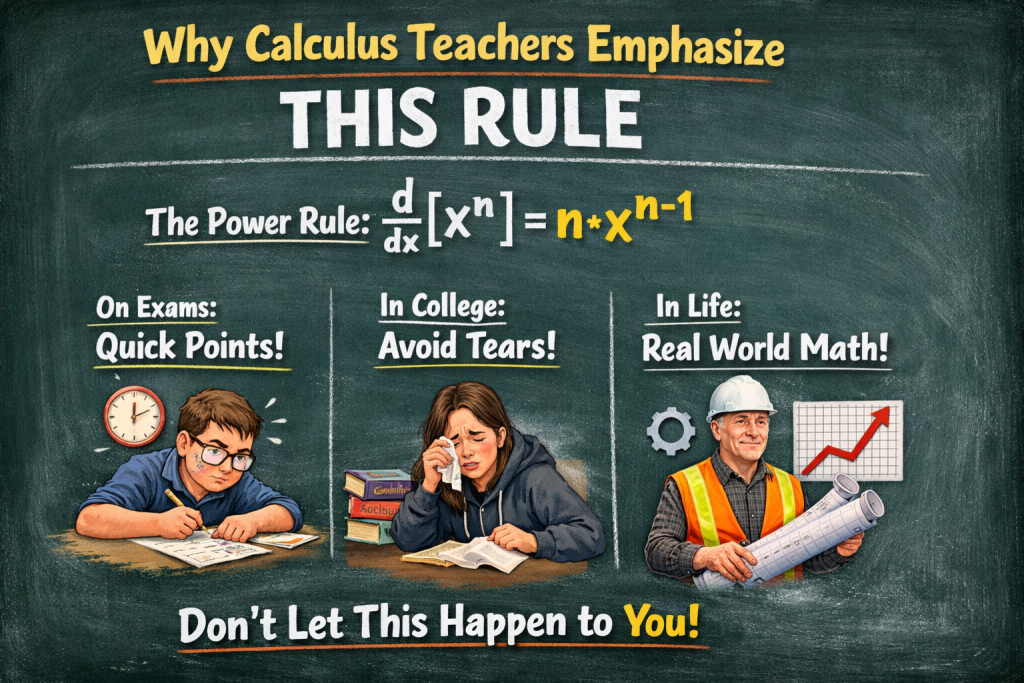
Many instructors highlight this concept because rational functions appear constantly in advanced mathematics.
According to calculus textbooks and university syllabi:
Students must master:
- Product rule
- Chain rule
- Quotient rule
These three rules form the core toolkit of differentiation.
Quick Summary Table
| Concept | Explanation |
|---|---|
| Main Rule | Quotient Rule |
| Formula | (g(x)f'(x) − f(x)g'(x)) / g(x)² |
| Used For | Rational functions |
| Common Trick | Low d-high minus high d-low |
Final Answer
To calculate the derivative of a fraction, you use the Quotient Rule:dxd(g(x)f(x))=[g(x)]2g(x)f′(x)−f(x)g′(x)
This rule allows you to differentiate any rational function by combining the derivatives of the numerator and denominator.
Conclusion
Learning the derivative of a fraction might feel tricky at first. Many students feel overwhelmed when they see fractions inside calculus problems.
But once you understand the quotient rule pattern, everything starts making sense.
With consistent practice, you’ll quickly recognize these problems and solve them confidently.
If you want more easy explanations of calculus and math topics, explore additional learning guides at chennaineet.