





Introduction
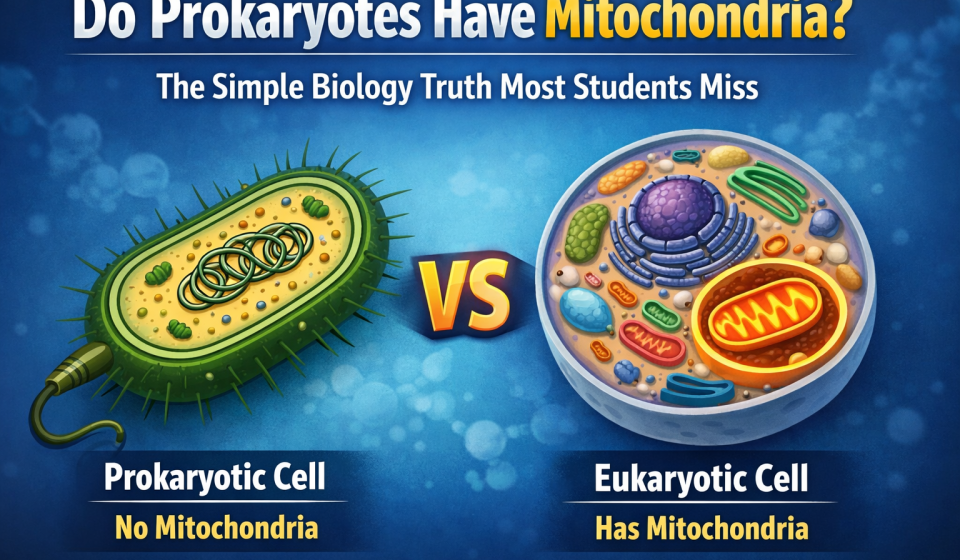
Do prokaryotes have mitochondria?
Table Of Content
Let’s answer the question immediately so you don’t waste time searching.
👉 No, prokaryotes do NOT have mitochondria.
Prokaryotic cells—like bacteria and archaea—lack membrane-bound organelles, including mitochondria. Instead, they produce energy using their cell membrane and cytoplasm.
This concept often confuses students because mitochondria are known as the “powerhouse of the cell.” So the natural question becomes: if prokaryotes don’t have mitochondria, how do they produce energy?
That’s exactly what you’ll understand in this guide.
If you’re studying biology for school exams, NEET, or competitive tests, you’ll see this concept repeatedly. It also connects to cell evolution, microbiology, and biotechnology.
Key Highlights 🔬
Here’s the quick version if you need a fast answer:
- Prokaryotes do not have mitochondria
- They lack membrane-bound organelles
- Energy production occurs in the cell membrane
- Examples of prokaryotes:
- Bacteria
- Archaea
- Mitochondria exist only in eukaryotic cells
According to biology textbooks and research from the National Center for Biotechnology Information (NCBI), prokaryotic cells rely on membrane-based respiration systems instead of mitochondria.
Source: NCBI
What Are Prokaryotes?
To understand mitochondria in prokaryotes, you must first understand what prokaryotes actually are.
Prokaryotes are simple single-celled organisms that lack a nucleus and membrane-bound organelles.
Examples include:
- Bacteria
- Archaea
These organisms are among the oldest life forms on Earth, appearing about 3.5 billion years ago, according to evolutionary studies.
Unlike complex cells, prokaryotes have a very simple internal structure.
Typical components include:
- Cell membrane
- Cytoplasm
- Ribosomes
- DNA (nucleoid region)
Notice something missing?
👉 No mitochondria.
Why Prokaryotes Do Not Have Mitochondria
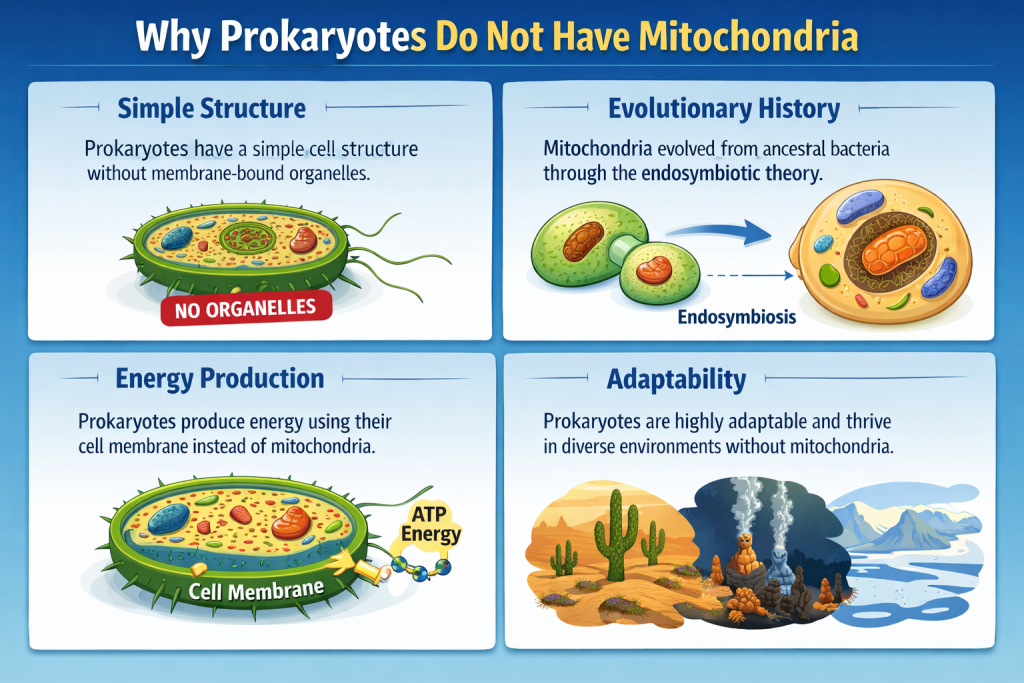
The reason prokaryotes do not have mitochondria comes down to cell complexity and evolution.
Prokaryotes evolved long before complex cells existed.
Their structure is minimal because it works efficiently for survival.
Key reason:
Prokaryotic cells do not contain membrane-bound organelles.
Mitochondria are membrane-bound structures.
So they simply cannot exist inside prokaryotic cells.
Instead, prokaryotes perform similar functions using different mechanisms.
How Prokaryotes Produce Energy Without Mitochondria
Now comes the interesting part.
If there are no mitochondria in prokaryotes, how do they generate ATP (energy)?
They use their cell membrane.
In prokaryotic cells:
- The electron transport chain occurs in the plasma membrane
- ATP is generated directly there
This process is surprisingly efficient.
Many bacteria actually produce energy very rapidly, which is why they reproduce quickly.
Some bacteria can even perform specialized metabolism such as:
- Photosynthesis
- Nitrogen fixation
- Chemosynthesis
These processes help them survive in extreme environments.
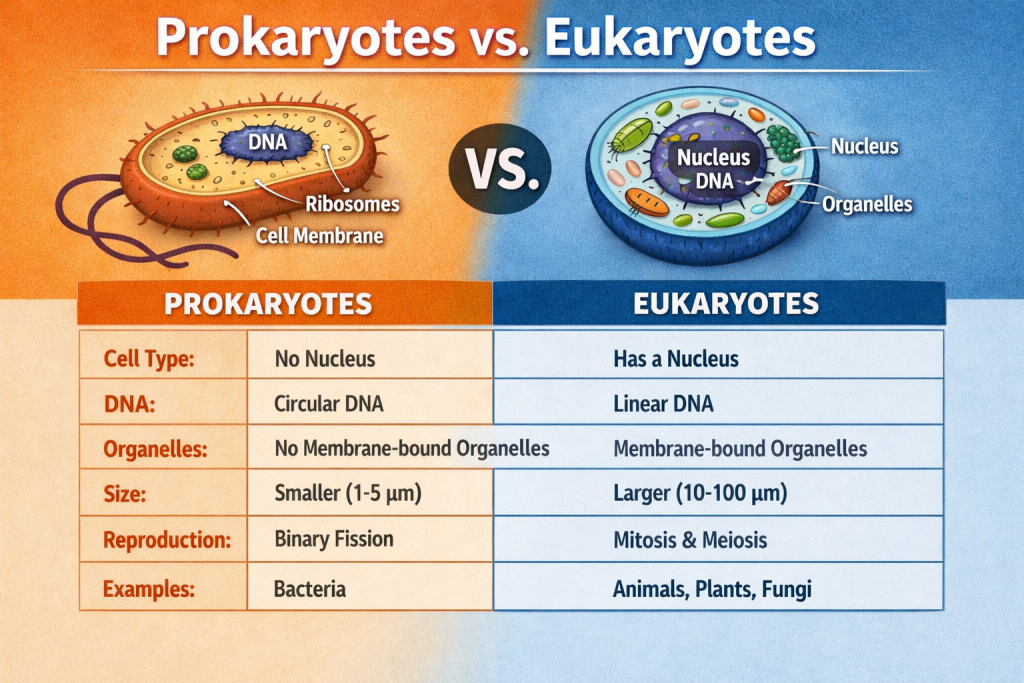
Comparing Prokaryotes and Eukaryotes
The easiest way to understand the topic “do prokaryotes have mitochondria” is by comparing them to eukaryotic cells.
| Feature | Prokaryotes | Eukaryotes |
|---|---|---|
| Nucleus | No | Yes |
| Mitochondria | No | Yes |
| Cell size | Small | Larger |
| Complexity | Simple | Complex |
| Examples | Bacteria | Animals, plants |
Eukaryotic cells include:
- Humans
- Animals
- Plants
- Fungi
These cells contain mitochondria because they require more energy to support complex processes.
The Evolutionary Story: Where Mitochondria Came From
Here’s a fascinating fact.
Scientists believe mitochondria were originally free-living bacteria.
This idea is called the Endosymbiotic Theory.
According to this theory:
- Early cells engulfed bacteria
- Instead of digesting them, they formed a partnership
- The bacteria evolved into mitochondria
Evidence supporting this includes:
- Mitochondria have their own DNA
- They reproduce independently
- They resemble bacteria in structure
Research published in Nature Reviews Microbiology supports this evolutionary explanation.
Real-World Examples of Prokaryotes
You interact with prokaryotes more often than you realize.
Example 1: Gut Bacteria
Your digestive system contains trillions of bacteria.
These bacteria help:
- Digest food
- Produce vitamins
- Protect against harmful microbes
None of them have mitochondria.
Example 2: Yogurt Production
Bacteria used in yogurt fermentation are prokaryotes.
They generate energy without mitochondria while converting lactose into lactic acid.
Example 3: Soil Bacteria
Some bacteria fix nitrogen, which helps plants grow.
This process supports agriculture worldwide.
Common Student Confusions
Students often mix up cell types.
Here are typical misunderstandings.
❌ Confusion 1
“Prokaryotes must have mitochondria because they produce energy.”
Reality:
Energy production happens in cell membranes, not mitochondria.
❌ Confusion 2
“All cells contain mitochondria.”
Reality:
Only eukaryotic cells have mitochondria.
❌ Confusion 3
“Mitochondria evolved first.”
Reality:
Prokaryotes existed long before mitochondria evolved.
Best Way to Remember This for Exams
A simple memory trick helps.
Think of it like this:
👉 Prokaryotes = Primitive cells
Primitive cells lack complex structures.
So remember:
- No nucleus
- No mitochondria
- No membrane-bound organelles
This trick helps many students answer questions instantly.
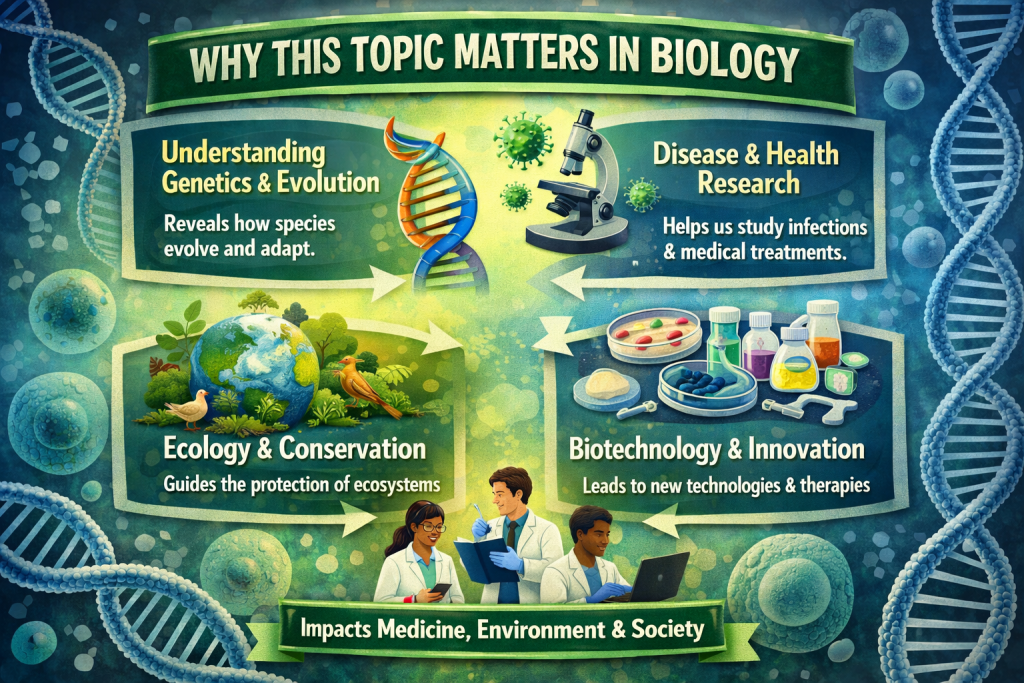
Why This Topic Matters in Biology
Understanding mitochondria in prokaryotes (or the absence of them) helps you learn key biology concepts:
- Cell evolution
- Microbiology
- Metabolism
- Biotechnology
- Antibiotic research
It also helps explain why bacteria behave differently from human cells.
For example:
Many antibiotics target bacterial cell structures, not mitochondria.
That difference allows medicine to kill bacteria without harming human cells.
Internal Learning Resources
If you’re studying related biology topics, these guides help deepen your understanding:
- Valence electrons in chemistry
- Monomers of lipids
- Lewis structures of molecules
You can find more study explanations here:
Neet Physics
Final Answer
So let’s restate the answer clearly.
Do prokaryotes have mitochondria?
👉 No, prokaryotes do not have mitochondria.
Instead, they produce energy using enzymes embedded in their cell membrane.
This structure allows them to survive and reproduce efficiently despite their simple design.
Conclusion
Cell biology can feel overwhelming at first. When you start comparing prokaryotes and eukaryotes, the differences seem complicated.
But once you realize that prokaryotes are simple cells, everything falls into place.
No nucleus.
No mitochondria.
No membrane-bound organelles.
Yet these tiny organisms have survived for billions of years, proving that simplicity can be incredibly powerful in biology.
Understanding this concept doesn’t just help you pass exams—it gives you insight into how life evolved on Earth.