





Number of Valence Electrons in Chlorine Ion: The Simple Chemistry Explanation Every Student Should Know

Number of valence electrons in chlorine ion is one of the most searched chemistry questions by students preparing for NEET, JEE, and school exams. If you’ve ever looked at the question and felt confused — you’re not alone.
Table Of Content
- Electronic Configuration of Chlorine
- The Octet Rule
- Step 1 — Find Atomic Number
- Step 2 — Write Electron Configuration
- Step 3 — Identify the Ion
- Step 4 — Add One Electron
- Step 5 — Count Valence Electrons
- Correct Answer
- A) 16 ❌
- B) 8 ✅
- C) 17 ❌
- D) 18 ❌
- 1️⃣ Remember the Halogen Rule
- 2️⃣ Practice Periodic Table Patterns
- 3️⃣ Visualize Electron Shells
Many learners mix up total electrons and valence electrons, especially when ions are involved. The good news? Once you understand how chlorine forms an ion, the answer becomes incredibly simple.
Right away, here is the correct concept:
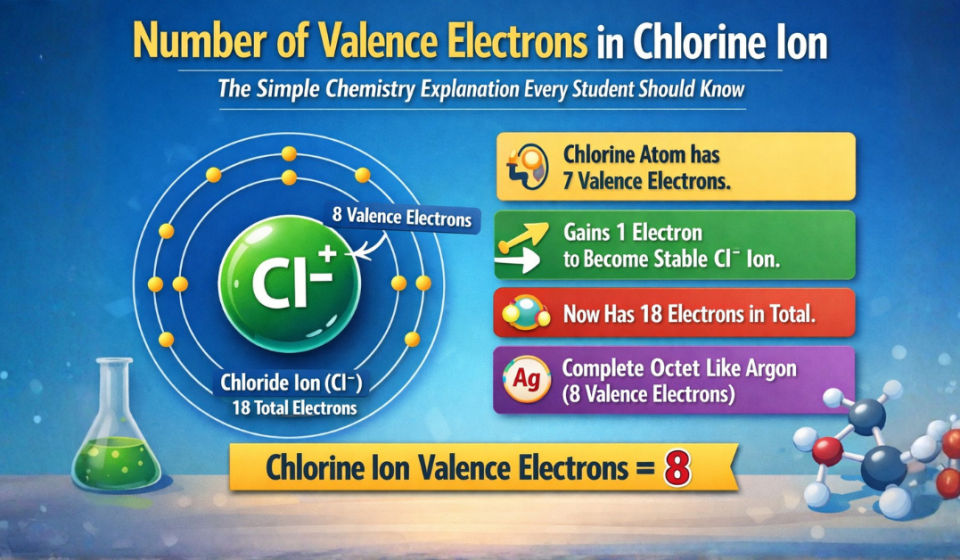
👉 The number of valence electrons in a chlorine ion (Cl⁻) is 8.
Yes — 8 valence electrons.
But why exactly 8? And why do some questions include confusing options like 17 or 18?
Let’s break it down in the simplest way possible so that the concept stays with you forever.
🔑 Key Highlights
- Primary concept: The number of valence electrons in chlorine ion is 8.
- Chlorine’s atomic number is 17.
- A neutral chlorine atom has 7 valence electrons.
- When chlorine gains 1 electron, it forms Cl⁻ (chloride ion).
- The chlorine ion now has a complete octet (8 valence electrons).
- This makes the ion stable like noble gases.
If you remember only one thing from this guide, remember this:
⭐ Chlorine ion valence electrons = 8
Understanding the Chlorine Atom
Before talking about ions, you need to understand how the chlorine atom itself is structured.
Chlorine is an element in Group 17 (Halogens) of the periodic table.
Basic properties of chlorine:
- Atomic number: 17
- Symbol: Cl
- Group: Halogens
- Period: 3
This means chlorine has 17 electrons in a neutral atom.
Electronic Configuration of Chlorine
The electron configuration is:
1s² 2s² 2p⁶ 3s² 3p⁵
Breaking this into shells:
| Shell | Electrons |
|---|---|
| K shell | 2 |
| L shell | 8 |
| M shell | 7 |
So the outermost shell contains 7 electrons.
These outermost electrons are called valence electrons.
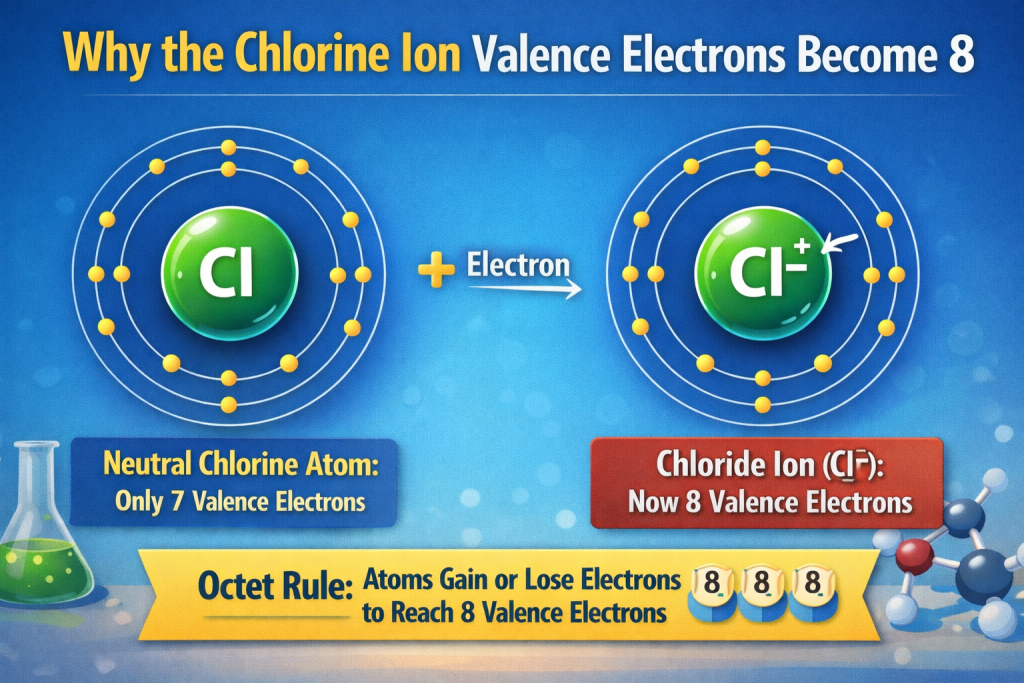
👉 Therefore, a neutral chlorine atom has 7 valence electrons.
What Is a Chlorine Ion?
Now comes the key concept.
Atoms often gain or lose electrons to become stable. Most atoms follow the octet rule, meaning they try to achieve 8 electrons in the outer shell.
Chlorine already has 7 valence electrons.
So it needs just one more electron.
Instead of losing seven electrons (which requires huge energy), chlorine simply gains one electron.
The reaction looks like this:
Cl + e⁻ → Cl⁻
The result is called a chloride ion.
Now chlorine has:
17 + 1 = 18 total electrons
This extra electron creates a negative charge, which is why the ion is written as Cl⁻.
Number of Valence Electrons in Chlorine Ion
Now we can answer the question directly.
After gaining one electron, the electron configuration becomes:
1s² 2s² 2p⁶ 3s² 3p⁶
Let’s focus on the outermost shell.
The third shell now contains:
- 3s²
- 3p⁶
Total = 8 electrons
So the number of valence electrons in chlorine ion is 8.
This configuration is identical to the noble gas argon, which explains why the ion is stable.
Why the Chlorine Ion Valence Electrons Become 8
The reason lies in one of the most important rules in chemistry.
The Octet Rule
The octet rule states that atoms tend to gain, lose, or share electrons to achieve 8 electrons in their outer shell.
Examples:
| Element | Valence Electrons | What It Does |
|---|---|---|
| Sodium | 1 | Loses 1 electron |
| Oxygen | 6 | Gains 2 electrons |
| Chlorine | 7 | Gains 1 electron |
So chlorine follows the same pattern.
It gains 1 electron → forms Cl⁻ → reaches 8 valence electrons.
Step-by-Step Method to Solve Questions Like This
When exams ask about chlorine ion valence electrons, follow this method.
Step 1 — Find Atomic Number
Chlorine atomic number = 17
So electrons = 17
Step 2 — Write Electron Configuration
1s² 2s² 2p⁶ 3s² 3p⁵
Outer shell = 7 electrons
Step 3 — Identify the Ion
Chlorine ion = Cl⁻
This means one electron is gained.
Step 4 — Add One Electron
Total electrons:
17 + 1 = 18
Step 5 — Count Valence Electrons
Outermost shell:
3s² 3p⁶
Total = 8
✔ Final answer: 8 valence electrons
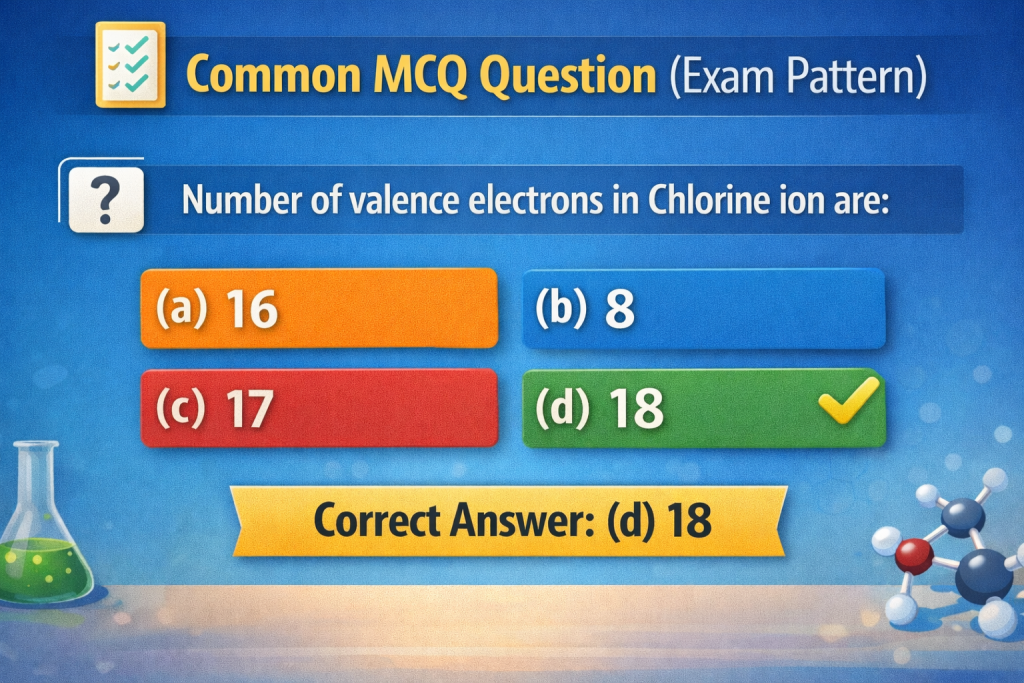
Common MCQ Question (Exam Pattern)
Question
Number of valence electrons in chlorine ion are:
A) 16
B) 8
C) 17
D) 18
Correct Answer
✅ B) 8
Explanation of Each Option
A) 16 ❌
16 electrons does not match chlorine’s electronic configuration.
The chloride ion contains 18 total electrons, not 16.
B) 8 ✅
This is correct because the outer shell of Cl⁻ contains 8 electrons, satisfying the octet rule.
C) 17 ❌
17 electrons belong to a neutral chlorine atom, not the ion.
D) 18 ❌
18 represents total electrons, not valence electrons.
This is a common trap in exams.
Real-World Example: Why Chlorine Forms Ions
Understanding chlorine ion valence electrons becomes easier when you look at real chemistry around you.
One everyday example is table salt.
Table salt is made of:
Sodium (Na⁺) + Chloride (Cl⁻)
Here’s what happens:
- Sodium loses 1 electron
- Chlorine gains 1 electron
This creates a stable ionic compound called sodium chloride (NaCl).
This simple electron transfer is why salt crystals form so easily in nature.
Why Halogens Always Gain One Electron
Chlorine belongs to the halogen group.
Halogens include:
- Fluorine
- Chlorine
- Bromine
- Iodine
- Astatine
All halogens share a common trait.
They have 7 valence electrons.
Because they need only 1 electron to complete the octet, they are extremely reactive.
That is why halogens easily form negative ions.
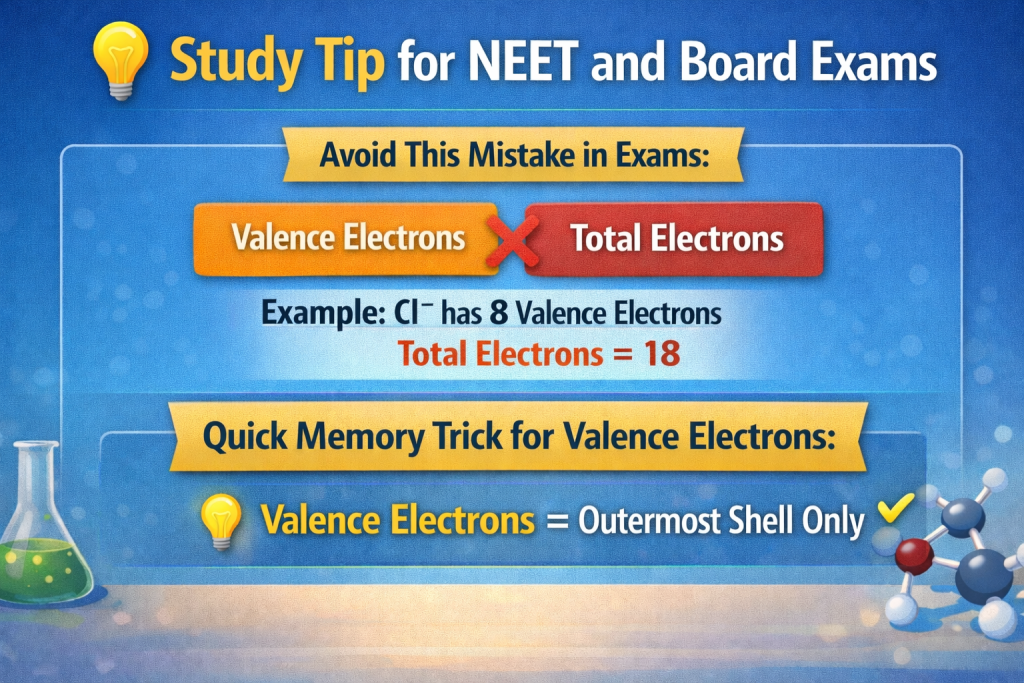
Study Tip for NEET and Board Exams
Students often lose marks because they confuse:
- Valence electrons
- Total electrons
A quick trick helps avoid mistakes.
Remember this rule:
👉 Valence electrons = electrons in the outermost shell only
Not the total number of electrons.
So even though Cl⁻ has 18 electrons, only 8 belong to the outer shell.
Best Practices to Remember This Concept
Students preparing for competitive exams benefit from using small memory tricks.
1️⃣ Remember the Halogen Rule
All halogens:
7 valence electrons → gain 1 → become 8
2️⃣ Practice Periodic Table Patterns
Group numbers help predict valence electrons.
| Group | Valence Electrons |
|---|---|
| 1 | 1 |
| 2 | 2 |
| 16 | 6 |
| 17 | 7 |
Chlorine belongs to Group 17.
3️⃣ Visualize Electron Shells
Imagine electrons filling layers around the nucleus.
When chlorine gains one electron, the outer layer becomes complete and stable.
Useful Resources to Learn More
For deeper chemistry learning, these sources explain atomic structure clearly:
External references:
These platforms provide visual explanations and atomic models that make concepts easier.
For related chemistry topics, readers often explore:
- Electronic configuration explained
- Octet rule in chemistry
- Ionic bonding examples
- Periodic table trends
Quick Summary
Let’s recap everything clearly.
- Chlorine atomic number = 17
- Neutral chlorine valence electrons = 7
- Chlorine gains 1 electron
- Forms Cl⁻ ion
- New outer shell electrons = 8
✅ Number of valence electrons in chlorine ion = 8
Final Thoughts
At first, Chemistry may be confusing to you. You may look at a Chemistry problem (ex. number of valance electrons in chlorine ion) and think it looks complicated.
But actually, once you learn what electron configuration and octet rule are, this concept will make complete sense.
Once you know that when chlorine gets 1 electron to become stable, then you will find it to be so obvious in the future.
Therefore, if you see this type of problem on your next NEET mock test, school exam or any other competitive tests-you will be ready!
You’ll instantly know:
⭐ Chlorine ion valence electrons = 8