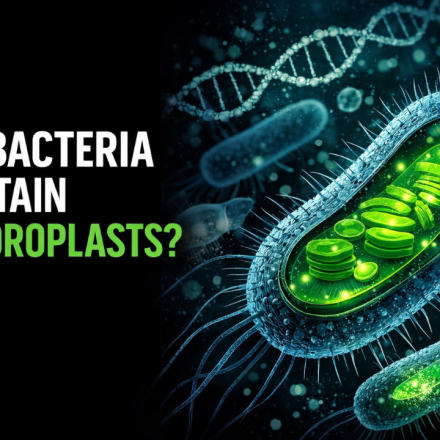




Why don’t animal cells have chloroplasts?
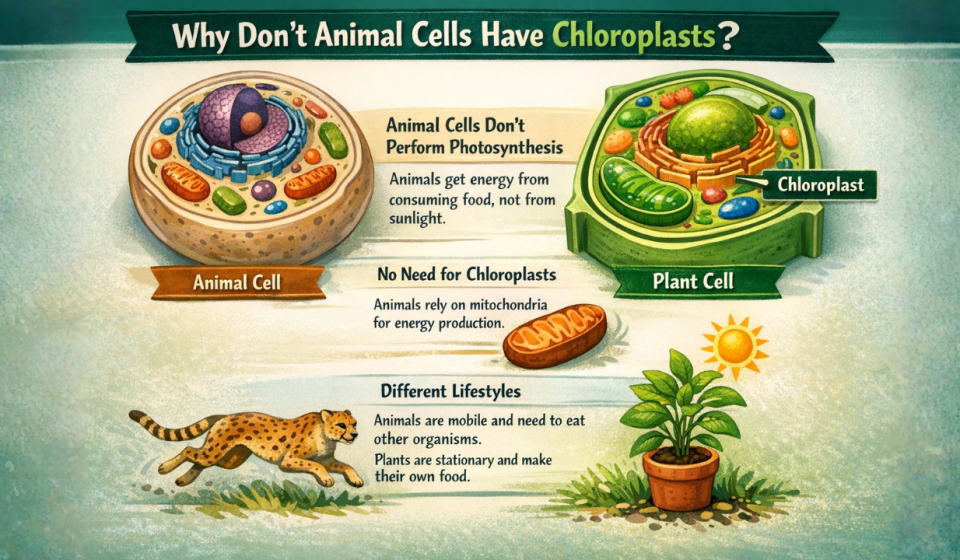
Why don’t animal cells have chloroplasts? — because animal cells don’t perform photosynthesis. That’s the straightforward, no-nonsense answer that brings you to this page.
Table Of Content
- 📚 NCERT Question and Answer
- 🔑 Key Highlights
- 🌱 Why Don’t Animal Cells Have Chloroplasts? (Straight Answer First)
- 🧬 The Real Reason (Explained Like a Pro)
- 1.Energy Strategy Is Different ⚡
- 2.No Photosynthesis in Animals ☀️
- 3.Evolution Made It This Way 🧠
- 4.Chloroplasts Take Space (And Energy)
- 5.Animals Already Have Mitochondria 🔋
- 🌿 Difference Between Plant and Animal Cells (You Must Know This)
- 🧪 Major Differences
- 💡 Real-Life Analogy
- 🧠 Real-World Example (This Makes It Click)
- 📊 Scientific Fact (For Exams & Interviews)
- 📚 Neet Crash Course
- ⚠️ Common Mistakes Students Make
- ❌ Mistake 1: “Animals don’t have mitochondria”
- ❌ Mistake 2: “Chloroplasts are useless in animals”
- ❌ Mistake 3: Confusion between plant and animal energy production
- 🎯 Best Way to Remember (Exam Tricks)
- 🧪 Advanced Insight (For Curious Minds)
- 🔗 Internal Learning (Continue Your Journey)
- 💬 Final Thoughts (Let’s Be Honest)
But if you’re still confused (and honestly, most students are at this point), then worry not because you’re about to understand this in a way that makes sense, not just for the exam but for actual understanding.
📚 NCERT Question and Answer
- NCERT Physics Question and Answer
- NCERT Chemistry Question and Answer
- NCERT Biology Question and Answer
🔑 Key Highlights
- Chloroplasts are found in the cells of plants but not in the cells of animals.
- Animal cells make energy by consuming food.
- Chloroplasts are used by cells to make photosynthesis.
- But the cells of animals make energy by using mitochondria.
- This is the basic difference between the cells of plants and animals.
- Evolution made the cells of plants and animals different from each other.
- This knowledge is useful in the biology exam and NEET.
🌱 Why Don’t Animal Cells Have Chloroplasts? (Straight Answer First)
You need to understand one core idea:
👉 Chloroplasts are found only in cells of living beings that make their own food with sunlight.
This is done by plants through photosynthesis. Animals do not.
Instead:
Plants = Autotrophs (make their own food)
Animals = Heterotrophs (eat food made by others)
Therefore, animal cells do not need chloroplasts.
🧬 The Real Reason (Explained Like a Pro)
Let’s break it down deeper — the way your teacher should have explained it.
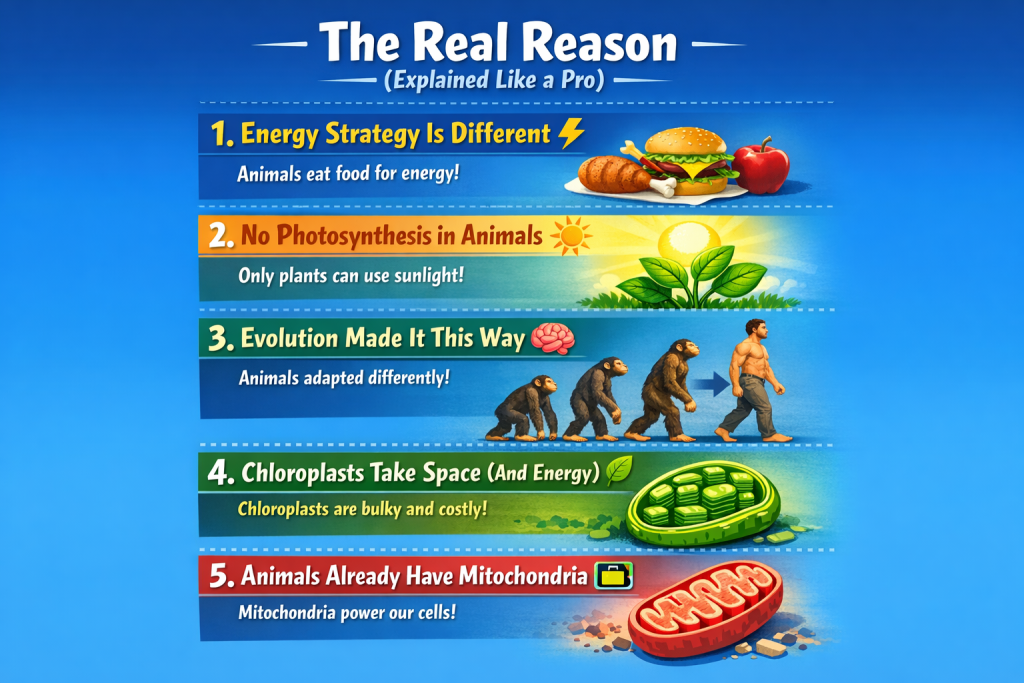
1.Energy Strategy Is Different ⚡
Plants make food from the sun using chloroplasts
Animals eat food and make energy using mitochondria
👉 So, chloroplasts would be useless in the cells of animals.
2.No Photosynthesis in Animals ☀️
Photosynthesis needs:
Sunlight
Carbon dioxide
Water
👉 Animals are not set up to photosynthesize.
👉 So, no chloroplasts.
3.Evolution Made It This Way 🧠
Millions of years ago:
Plants evolved to stay still and make food
Animals evolved to roam the earth and eat food
👉 Different survival strategies mean different cell structures.
4.Chloroplasts Take Space (And Energy)
Chloroplasts are not small organelles:
They take up space in the cell.
They take energy from the cell.
They can only work when the sun is out.
👉 So, chloroplasts would be very inefficient in the cells of animals that roam the earth.
5.Animals Already Have Mitochondria 🔋
Here are the key differences:
Plants: Have chloroplasts and mitochondria.
Animals: Have only mitochondria.
Mitochondria make energy from the food.
👉 So, no need for chloroplasts in the cells of animals.
🌿 Difference Between Plant and Animal Cells (You Must Know This)
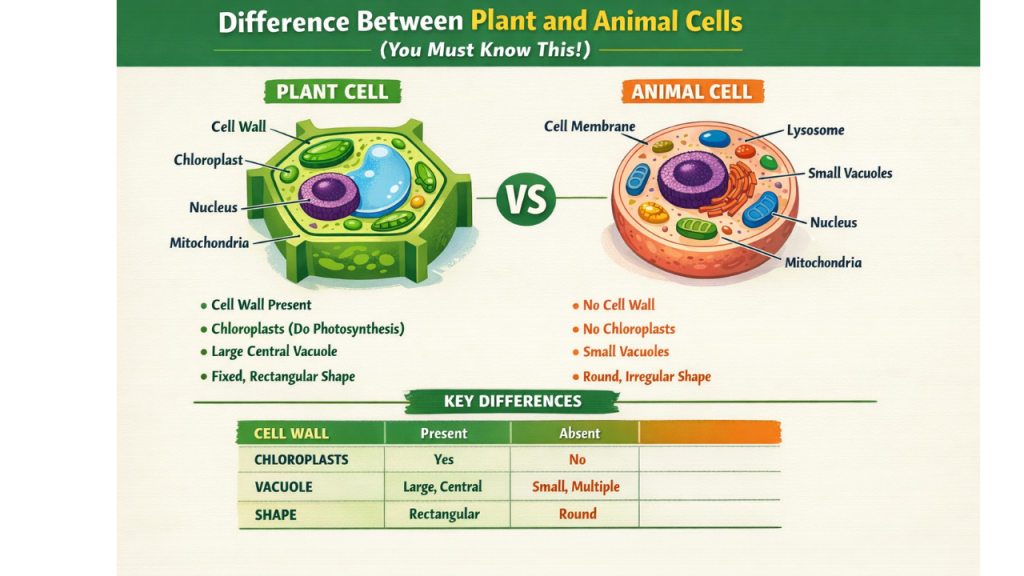
Understanding the difference between plant and animal cells makes everything clearer.
🧪 Major Differences
| Feature | Plant Cells 🌱 | Animal Cells 🐾 |
|---|---|---|
| Chloroplast | ✅ Present | ❌ Absent |
| Cell Wall | ✅ Present | ❌ Absent |
| Vacuole | Large | Small or none |
| Shape | Fixed | Flexible |
| Energy Source | Sunlight | Food |
💡 Real-Life Analogy
Think of it this way:
Plant cell = Solar-powered factory ☀️
Animal cell = Food-powered machine 🍔
👉 Both are energy-producing cells, just not in the same way.
🧠 Real-World Example (This Makes It Click)
You’re stuck in the middle of a forest.
A plant makes its own food with the sun
You make your own food by eating fruits or animals
👉 You cannot suddenly make food with the sun, as that is not what your cells are meant to do.
That is exactly the reason animal cells do not contain chloroplasts.
📊 Scientific Fact (For Exams & Interviews)
- Photosynthesis occurs in chloroplasts using chlorophyll
- Reaction:
CO₂ + H₂O + Light → Glucose + O₂ - According to biology research, only autotrophic organisms have chloroplasts
📚 Neet Crash Course
⚠️ Common Mistakes Students Make
Let’s clear these – because they cost marks.
❌ Mistake 1: “Animals don’t have mitochondria”
👉 Wrong. They DO. That is how they make energy.
❌ Mistake 2: “Chloroplasts are useless in animals”
👉 Not useless, but simply not required for them.
❌ Mistake 3: Confusion between plant and animal energy production
👉 Plant = Make Food
👉 Animal = Eat Food
🎯 Best Way to Remember (Exam Tricks)
To clear all these, we can make a shortcut:
👉 “Plants produce, animals consume.”
👉 Produce = Chloroplast
👉 Consume = Mitochondria
Simple. Easy. Effective.
🧪 Advanced Insight (For Curious Minds)
Something interesting:
Some animals, like certain sea slugs, can make use of chloroplasts for a while.
😲 Yes, it is called kleptoplasty.
But:
These animals don’t really own these chloroplasts
This is not photosynthesis
👉 Hence, animals don’t really have chloroplasts.
🔗 Internal Learning (Continue Your Journey)
If you are studying biology or are preparing for your examinations, then the following are also relevant:
Cell structure and its functions
Comparison between mitochondria and chloroplasts
Explanation of the photosynthesis process
Types of cells: prokaryotic or eukaryotic cells
💬 Final Thoughts (Let’s Be Honest)
This subject seems complicated at first, but then you ask yourself:
“Why can’t the cells of animals also have chloroplasts?”
But then you realize that everything is logical once you grasp the concept of the energy system.
Biology is not about memorizing facts; it is about understanding the reason behind the existence of things.
And now you know:
👉 Why don’t the cells of animals have chloroplasts?
Because they don’t need to make their own food; they are made to eat it