




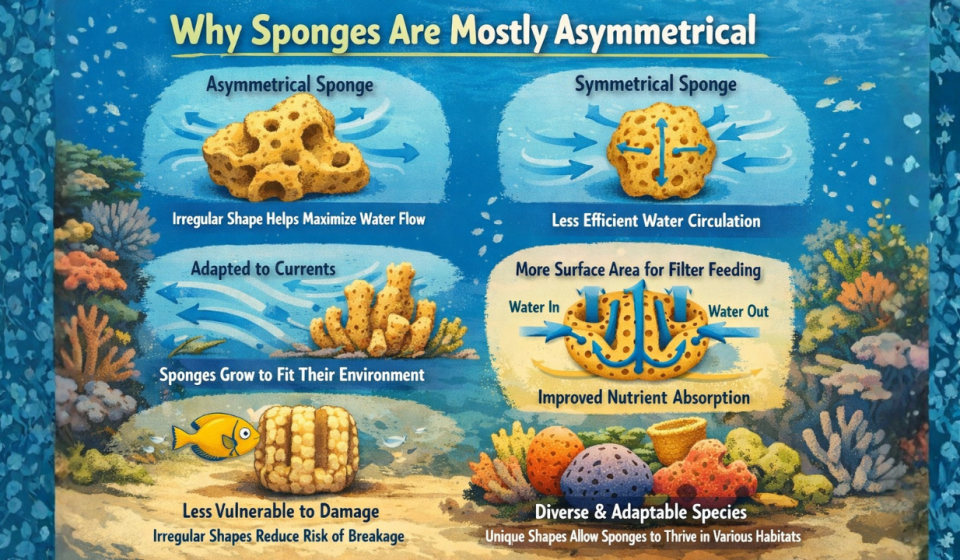

👉 Sponges are mostly asymmetrical – that’s the exact answer you need to give in this NEET question.
👉 Yes, sponges are mostly asymmetrical, and when you understand this, you’ll never get confused again.
Table Of Content
- 🔑 Key Highlights (Quick Revision 🚀)
- 🧠 Sponges Are Mostly Asymmetrical – What Does It Mean?
- 🧬 Why Sponges Are Mostly Asymmetrical (Core Concept)
- 1️⃣ No True Tissues or Organs
- 2️⃣ Body Depends on Water Flow 🌊
- 3️⃣ Irregular Growth Pattern
- 4️⃣ Simple Body Design (Porifera Symmetry Insight)
- 5️⃣ Environmental Influence
- ⚠️ Common Confusion (NEET Trap)
- ✔️ Reality
- 📊 Types of Symmetry (Quick Comparison)
- 🎯 NEET Exam Insight (Score Booster)
- 👉 NEET questions on this topic usually ask
- 💡 Best Way to Remember (Exam Trick)
- 🧪 Real Biology Insight (Not Just Theory)
- 🔗 Related Topics You Should Study
- 📌 Real-World Example (Makes It Stick)
- 🏁 Final Answer (Crystal Clear)
- 🎯 Conclusion
If you’ve ever found yourself wondering whether sponges are radial or bilateral, then trust me, you’re not alone. Many NEET aspirants get confused with this question. But let’s tell you a secret – this is one of the simplest questions that can get you maximum marks if you understand the logic behind it.
Let’s understand this with a mentor’s perspective rather than just reading it from a book.
🔑 Key Highlights (Quick Revision 🚀)
✔️ Sponges are mostly asymmetrical
✔️ Sponges belong to phylum Porifera
✔️ Sponges do not possess true tissues or organs
✔️ Sponges possess a body full of pores and canals
✔️ Sponges possess water flow that controls all life functions
✔️ Sponges possess radial symmetry (in some cases, but this is rare)
✔️ Sponges are part of the animal kingdom
🧠 Sponges Are Mostly Asymmetrical – What Does It Mean?
Let’s keep it simple.
What is Porifera Symmetry?
When we ask: What is Porifera Symmetry?
We are essentially asking:
👉 Can we divide the organism in half?
What is the answer?
For Sponges: Mostly NO.
Why is that?
👉 Sponges are mostly asymmetrical.
What is the reason?
No fixed body form.
No fixed axis.
No fixed halves.
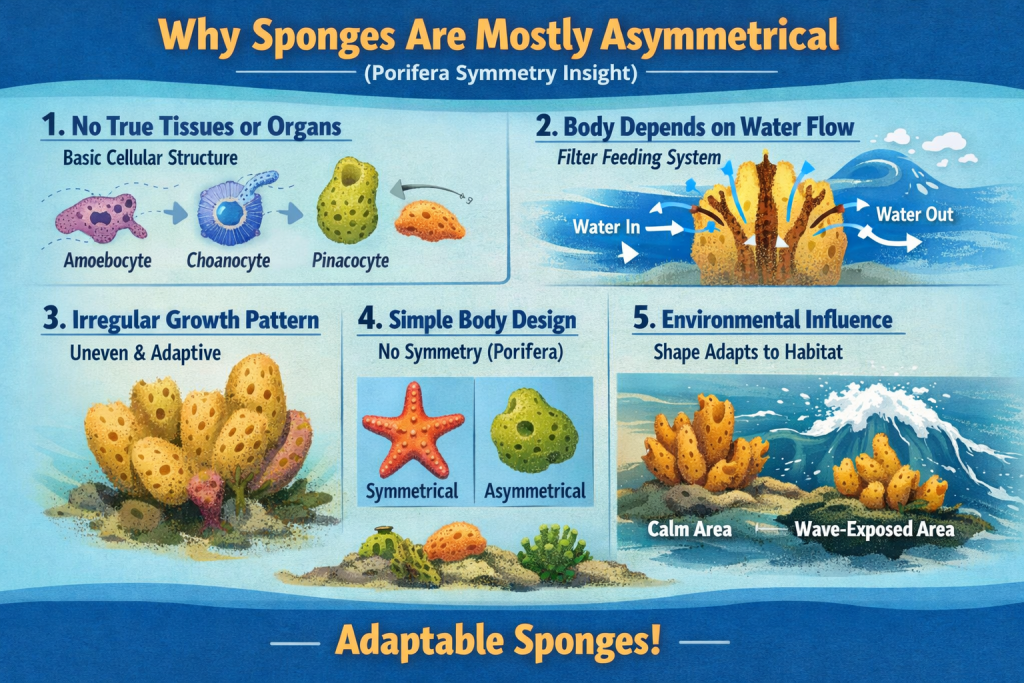
🧬 Why Sponges Are Mostly Asymmetrical (Core Concept)
Instead of memorizing, understand these 5 reasons 👇
1️⃣ No True Tissues or Organs
Sponges are one of the simplest animals.
No digestive system
No nervous system
No circulatory system
👉 Therefore, no symmetry.
2️⃣ Body Depends on Water Flow 🌊
Water circulation helps them survive.
Water enters through pores (called ostia)
Leaves through the osculum
Carries food, oxygen, and waste
👉 Therefore, the shape of the sponge depends on the flow of water, not symmetry.
3️⃣ Irregular Growth Pattern
Unlike other animals, the growth of a sponge does not follow a particular direction.
Therefore, no control over symmetry.
Growth occurs randomly.
This leads to asymmetry.
4️⃣ Simple Body Design (Porifera Symmetry Insight)
The symmetry of the Porifera group of animals cannot be clearly described.
Only two layers of cells.
Outer and Inner cells.
👉 No structure = no symmetry.
5️⃣ Environmental Influence
A sponge lives on rocks.
Or on coral reefs.
Or on the ocean floor.
👉 The shape of the sponge changes according to the surroundings.
⚠️ Common Confusion (NEET Trap)
Many students think:
❌ Some sponges are symmetrical, i.e., they show radial symmetry, hence the answer would be radial.
❌ All animals must be symmetrical.
✔️ Reality:
Sponges are mostly asymmetrical.
Few sponges may show some kind of symmetry, but that does not alter the basic fact.
👉 Always look for the word ‘mostly
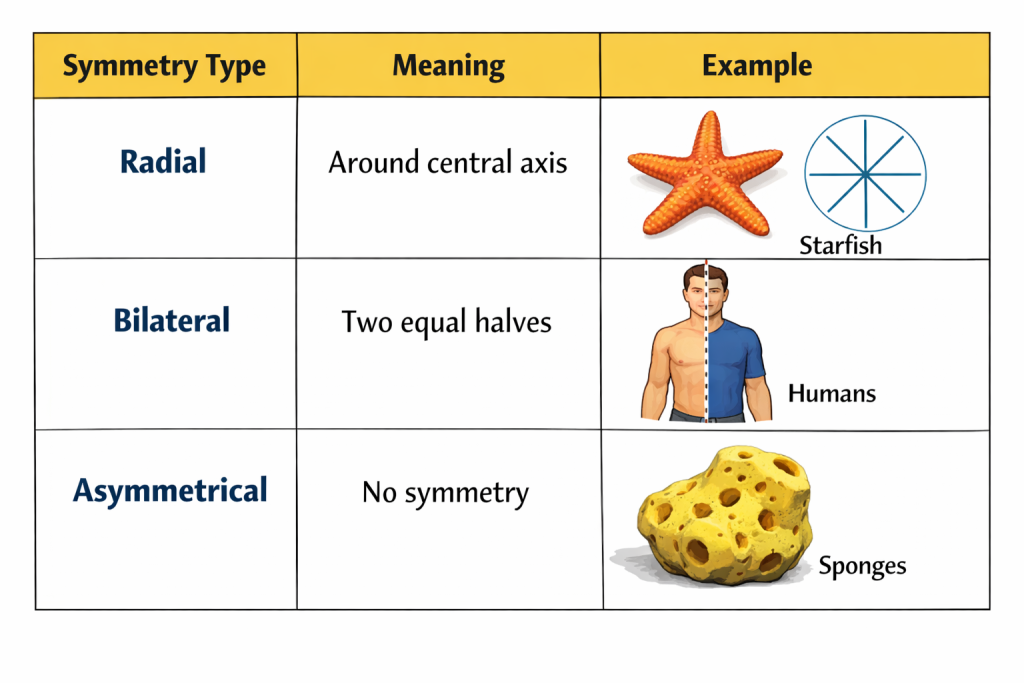
📊 Types of Symmetry (Quick Comparison)
| Symmetry Type | Meaning | Example |
|---|---|---|
| Radial | Around central axis | Starfish |
| Bilateral | Two equal halves | Humans |
| Asymmetrical | No symmetry | Sponges |
🎯 NEET Exam Insight (Score Booster)
This topic is:
Frequently repeated
Concept-based
Easy marks
👉 NEET questions on this topic usually ask:
Definition of symmetry
Examples
Exceptions
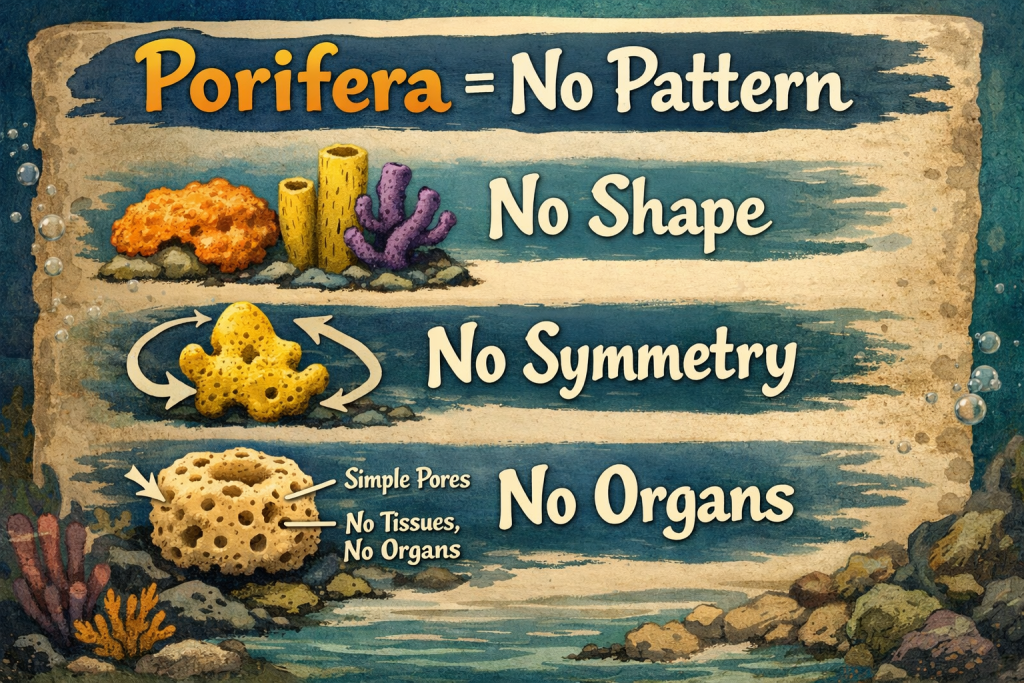
💡 Best Way to Remember (Exam Trick)
👉 Memorize this trick:
“Porifera = No Pattern”
No shape
No symmetry
No organs
🧪 Real Biology Insight (Not Just Theory)
According to standard biology sources:
Sponges are classified as asymmetrical animals due to their irregular structure and lack of body organization.
🔗 Related Topics You Should Study
To completely grasp this concept, you should:
👉 Animal Kingdom classification
👉 Canal system in sponges
👉 Reproduction in Porifera
👉 Levels of organization
(Internal linking tip: Link to NEET biology notes)
😓 Feeling Confused? That’s Normal
Let’s be honest.
Biology is all about:
Too many terms
Too many exceptions
Too many MCQs
But when you grasp the reason for:
👉 Sponges being mostly asymmetrical
Everything becomes so simple.
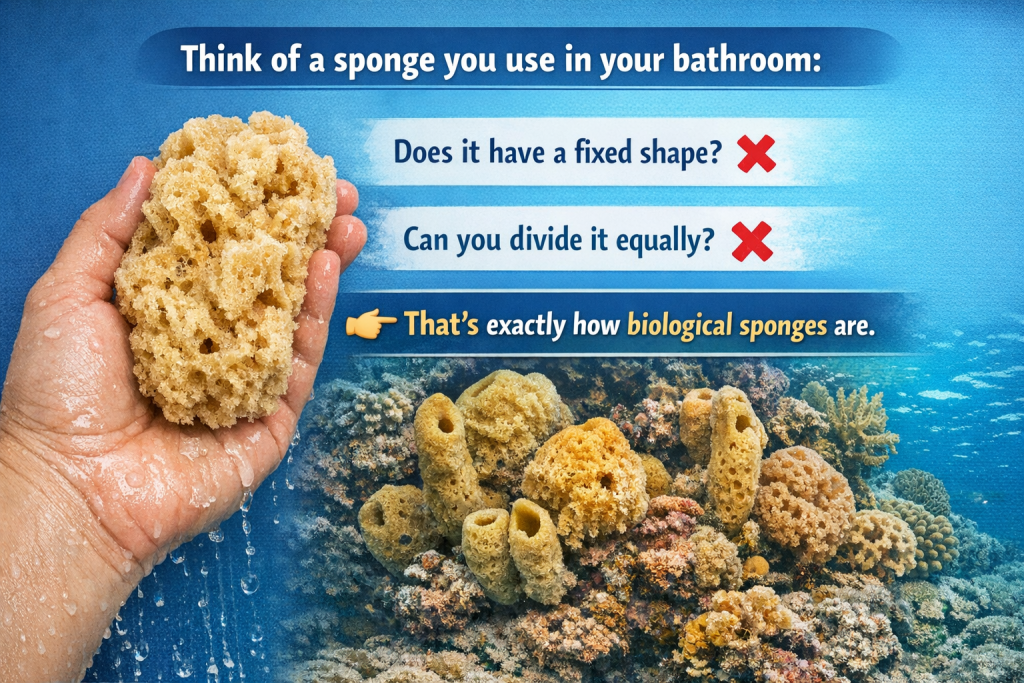
📌 Real-World Example (Makes It Stick)
Think of a sponge you use in your bathroom:
Does it have a fixed shape? ❌
Can you divide it equally? ❌
👉 That’s exactly how biological sponges are.
🏁 Final Answer (Crystal Clear)
👉 Sponges are mostly asymmetrical
✔️ Correct Option: (c)
🎯 Conclusion
Honestly, once you get this concept, you will never forget it.
Sponges are mostly asymmetrical because of their lack of structure, organization, and growth patterns.
If you are preparing for NEET, do not try to memorize. Instead, try to understand.
That’s how you get all your questions right.
And trust me, once you start thinking this way, biology becomes so easy for you. 😊