






Monomers and polymers of carbohydrates: Here’s the direct solution so you don’t need to look elsewhere:
Table Of Content
- 🧪 What Are Polymers and monomers of carbohydrates?
- 🔹 Monomer (Basic Unit)
- 🔹 Polymer (Chain of Units)
- 💡 Think of it like LEGO
- 🔬 What Are Carbohydride Monomers?
- ✅ Definition
- 🧾 Common Examples
- 🌍 Real-Life Insight
- Monomers and polymers of carbohydrates
- 🔗 formation of Polymers (Glycosidic Bond) by Monomers.
- Monosaccharides combine into
- 💡 Why this matters
- 🔷 1. Disaccharides (2 Monomers)
- 🔷 2. Many monomers- polysaccharides.
- 🧠 Why This Topic Is Important (Real-World Use Cases)
- 🧬 1. Human Body
- 🌱 2. Plants
- 🍽️ 3. Food & Nutrition
- Honestly speaking, such are quite widespread
- 💡 Best Practice to Remember
- 🔁 Shortcut Trick
- 🔗 Helpful Resources
- 🌐 External Links
- 🤔 Quick Self-Test
- 🎯 Final Thoughts
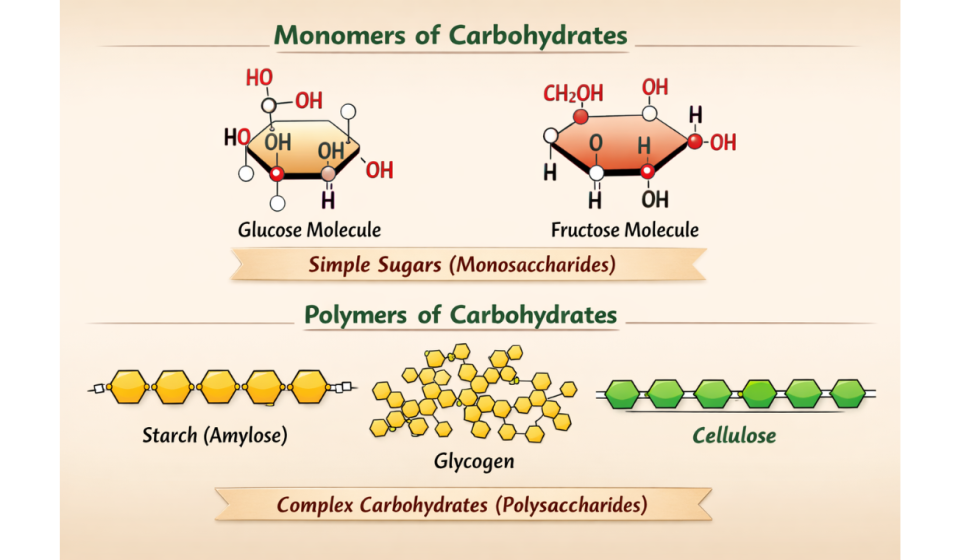
👉Monosaccharides (such as glucose and fructose) are monomers of carbohydrates.
👉Carbohydrate polymers include disaccharides and polysaccharides (such as cellulose, sucrose, and starch).
Yes, that is the main concept. However, this is where most students get confused, so continue reading if you want to fully comprehend what monomers of carbohydrates are and how they join to form complex structures.
🧪 What Are Polymers and monomers of carbohydrates?
Let’s simplify this.
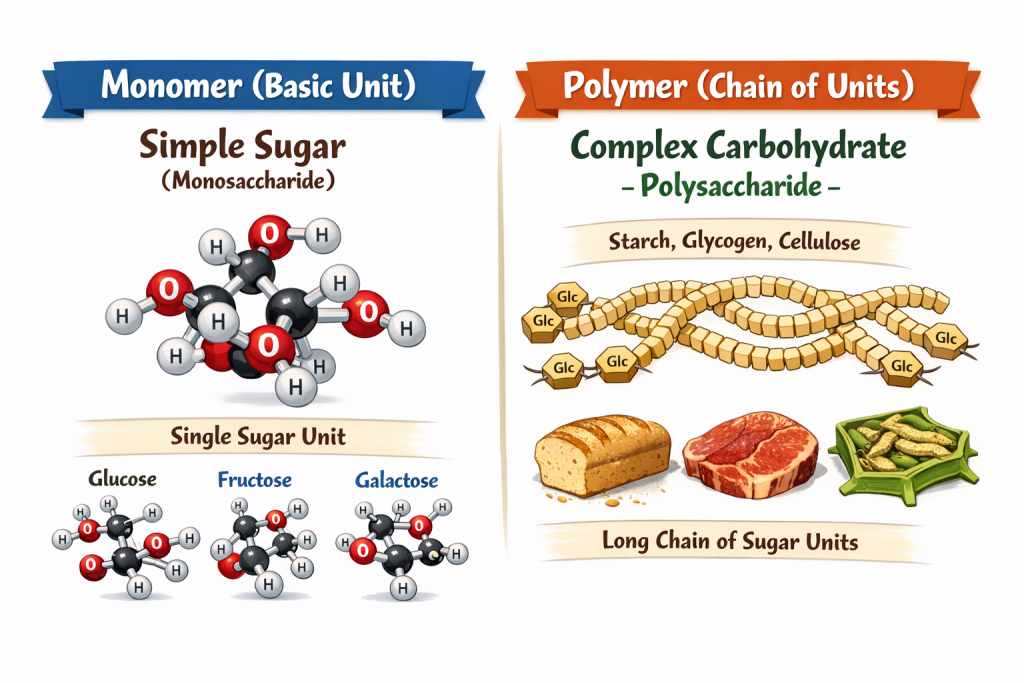
🔹 Monomer (Basic Unit)
👉 The smallest building block is a monomer.
In carbohydrates:
👉 Monosaccharides = Monomers
🔹 Polymer (Chain of Units)
👉 Polymer is a chain of repeating monomers.
In carbohydrates:
Disaccharides and Polysaccharides = Polymers.
💡 Think of it like LEGO:
- One block → Monomer
- Many blocks joined → Polymer
🔬 What Are Carbohydride Monomers?
✅ Definition
The easiest carbs are the monosaccharides.
They are not decomposed into small sugars.
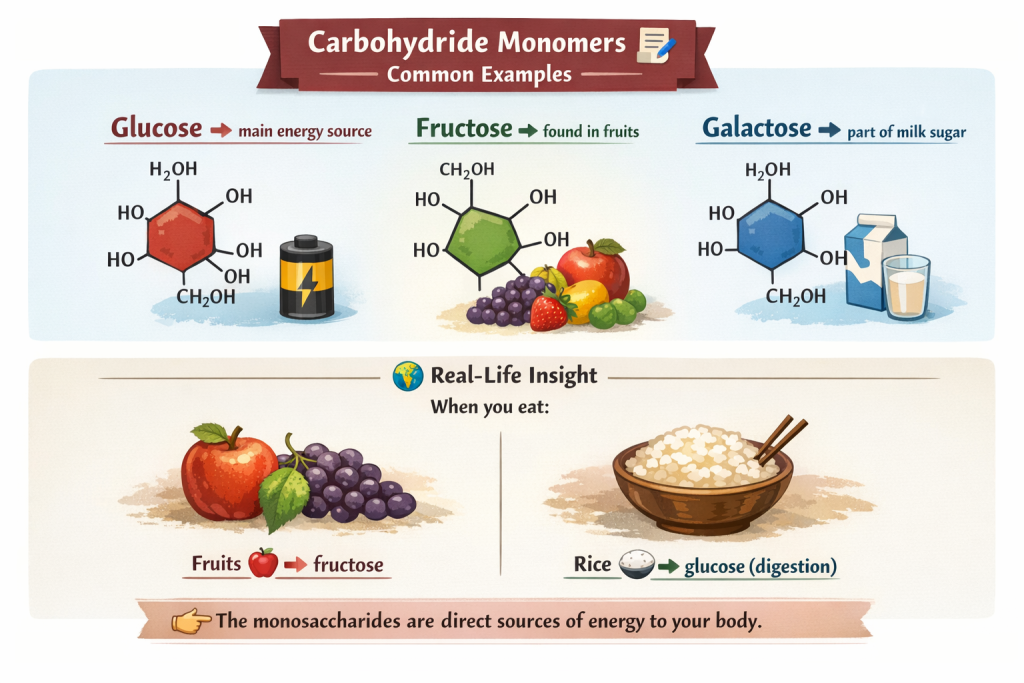
🧾 Common Examples
- Glucose → main energy source
- Fructose → found in fruits
- Galactose → part of milk sugar
🌍 Real-Life Insight
When you eat:
Fruits 🍎 → fructose
Rice 🍚 → glucose (digestion)
👉 The monosaccharides are direct sources of energy to your body.
Monomers and polymers of carbohydrates
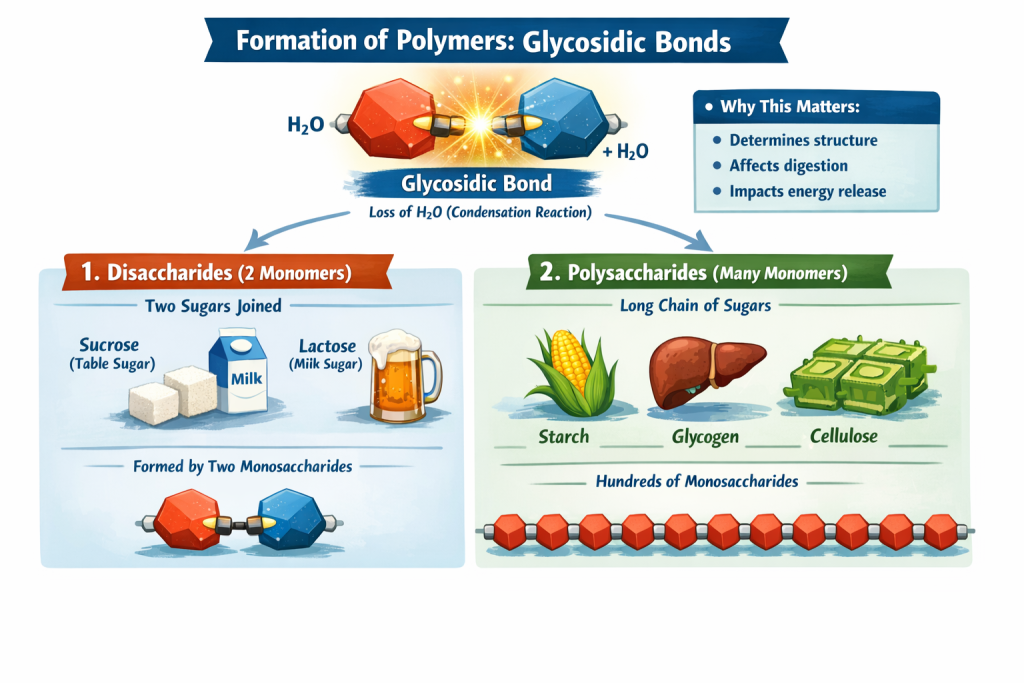
🔗 formation of Polymers (Glycosidic Bond) by Monomers.
This is where magic occurs.
Monosaccharides combine into:
- Glycosidic Bond
- A type of covalent bond
- Formed after the combination of two sugars.
- Losses a water molecule (condensation reaction)
💡 Why this matters:
- Determines structure
- Affects digestion
- Impacts energy release
Carbohydrate Polymers: Explained.
🔷 1. Disaccharides (2 Monomers)
Examples:
- Sucrose (table sugar)
- Lactose (milk sugar)
- Maltose
👉 Brought about by the combination of two monosaccharides.
🔷 2. Many monomers- polysaccharides.
Examples:
- Starch (stored energy in plants).
- Glycogen to energy storage in animals.
- Plant cell wall structure is produced out of cellulose.
👉 Formed of hundreds or thousands of monosaccharides.
🧠 Why This Topic Is Important (Real-World Use Cases)
The knowledge of monomers and polymers of carbohydrates is not merely an imaginary one.
🧬 1. Human Body
- Glucose is an immediate boost of energy.
- Glycogen holds additional energy.
🌱 2. Plants
- Store energy as starch
- Construct building with cellulose.
🍽️ 3. Food & Nutrition
- Carbs = primary energy source
- Complicated carbohydrates = gradual energy production.
- Facts: Carbohydrates have 4 calories per gram (WHO nutrition data).
- Caution: What Students Most Often Get wrong.
Honestly speaking, such are quite widespread:
❌ Believing in disaccharides as monomers.
❌ Mixing glycosidic bond with peptide bond.
❌ Ignoring real-life examples
❌ Learning by heart and not comprehension.
💡 Best Practice to Remember
Use this simple flow:
👉 Monosaccharide to Disaccharate to Polysaccharate.
🔁 Shortcut Trick
👉 “Mono → Di → Poly”
- Mono = 1
- Di = 2
- Poly = many
📊 Quick Comparison Table
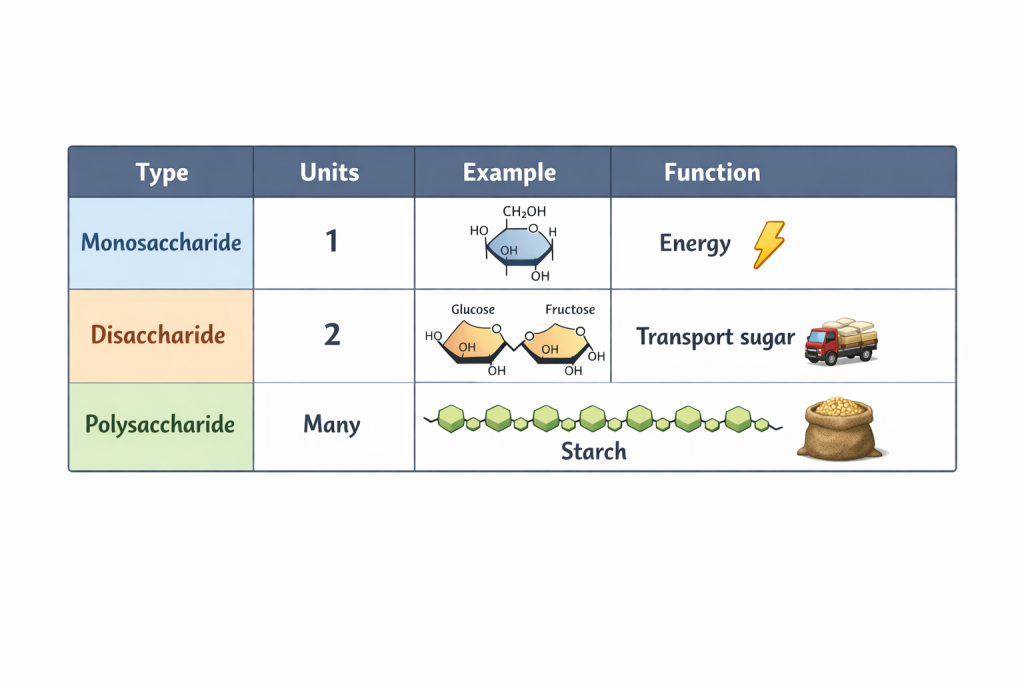
| Type | Units | Example | Function |
|---|---|---|---|
| Monosaccharide | 1 | Glucose | Energy |
| Disaccharide | 2 | Sucrose | Transport sugar |
| Polysaccharide | Many | Starch | Storage |
🔗 Helpful Resources
🌐 External Links
🤔 Quick Self-Test
What are carbohydrates monomers?
How is a connection established between monosaccharides?
Why is starch a polymer?
👉 Attempt to answer – That is what you really learn.
🎯 Final Thoughts
Carbohydrates monomers and polymers might appear to be a memorization subject at first.
- But once you understand:
- Building blocks
- Bond formation
- Real-life applications
- Monomers and polymers of carbohydrates
👉 Everything becomes clear.
At first, it feels confusing. Too many terms. Too many structures.
But once you connect the dots…
👉 It is made one of the simplest biology subjects.