






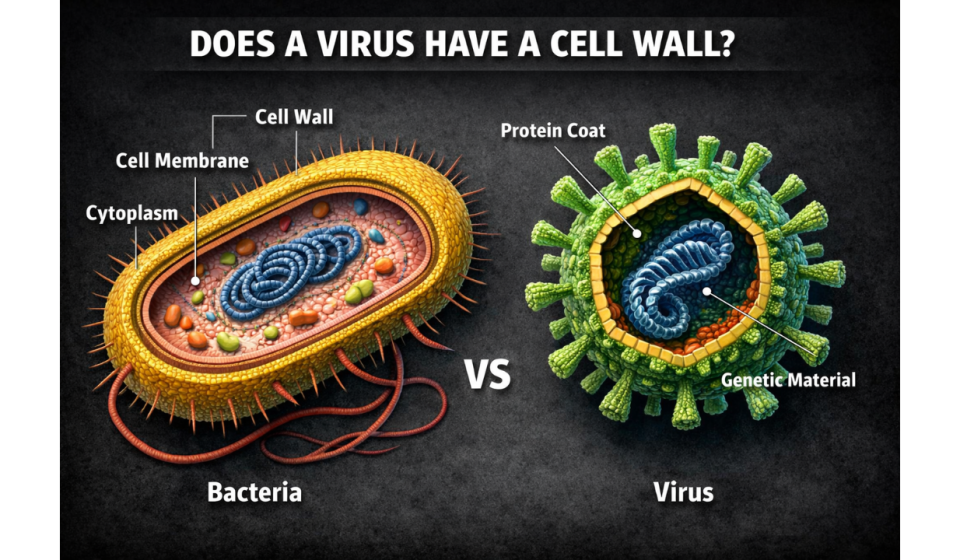

🧪 Introduction
Does virus have a cell wall?
This is one of those questions which may sound simple…but may seriously confuse you, especially in exams or interviews.
Table Of Content
- 🧪 Introduction
- ⚡ Key Highlights
- ❓ Does Virus Have a Cell Wall or Not? (Direct Answer)
- 🧬 What Constitutes a Virus?
- 🧩 1. Capsid (Viral Protein Coat)
- 🧩 2. Genetic Material
- 🧩 3. Envelope (Optional Component)
- 🔍 Why Don’t Viruses Need a Cell Wall?
- 🦠 How Viruses Infect Without a Cell Wall
- 🧠 Real-Life Example You Can Relate To
- 📊 Virus vs Cell (Quick Comparison)
- 🧪 Types of Viruses (Structure Insight)
- 1.Helical Viruses
- 2.Icosahedral Viruses
- Complex Viruses
- 📚 Real Data & Scientific Insight
- 💡 Best Way to Remember This (Exam Trick)
- ⚠️ Common Mistakes Students Make
- 🎯 Why This Topic Matters (Career Insight)
- For example
- 🧾 Conclusion
Does virus have a cell wall?
👉 The simple and quick answer: No, viruses don’t have a cell wall
But that’s not the end of it, and if you don’t move a step further, you may never get the actual understanding of this topic, and that’s exactly where most students go wrong.
Let’s move a step further and discuss it in a way that a mentor would explain it to you before an exam, and you’ll never be confused.
NCERT Biology Question and Answer
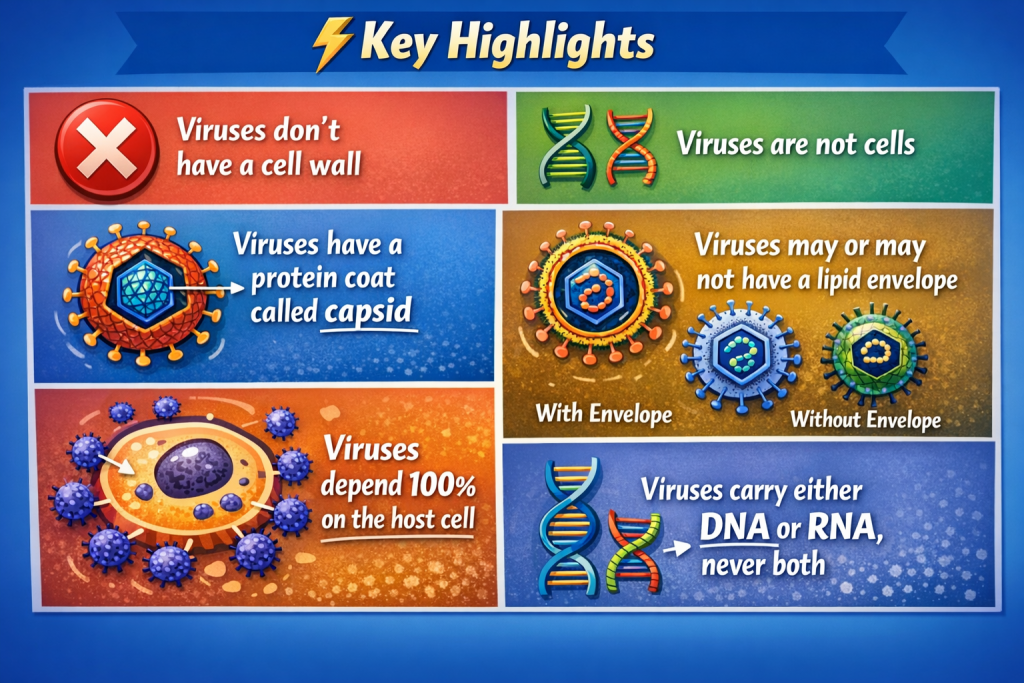
⚡ Key Highlights
- ❌ Viruses don’t have a cell wall
- 🧬 Viruses are not cells
- 🛡️ Viruses have a protein coat called capsi
- 🧫 Viruses may or may not have a lipid envelope
- 🔄 Viruses depend 100% on the host cell
- 🧠 Viruses carry either DNA or RNA, never both
❓ Does Virus Have a Cell Wall or Not? (Direct Answer)
If you want a direct answer to does virus have a cell wall?
👉 Virus cell wall or no cell wall?
➡️ No, virus does not have a cell wall.
Virus is different from plants, bacteria, and fungi. The differences are as follows:
- Virus does not have a cell wall.
- Virus does not have internal pressure.
- Virus does not have independent activity.
So, it is called an acellular organism.
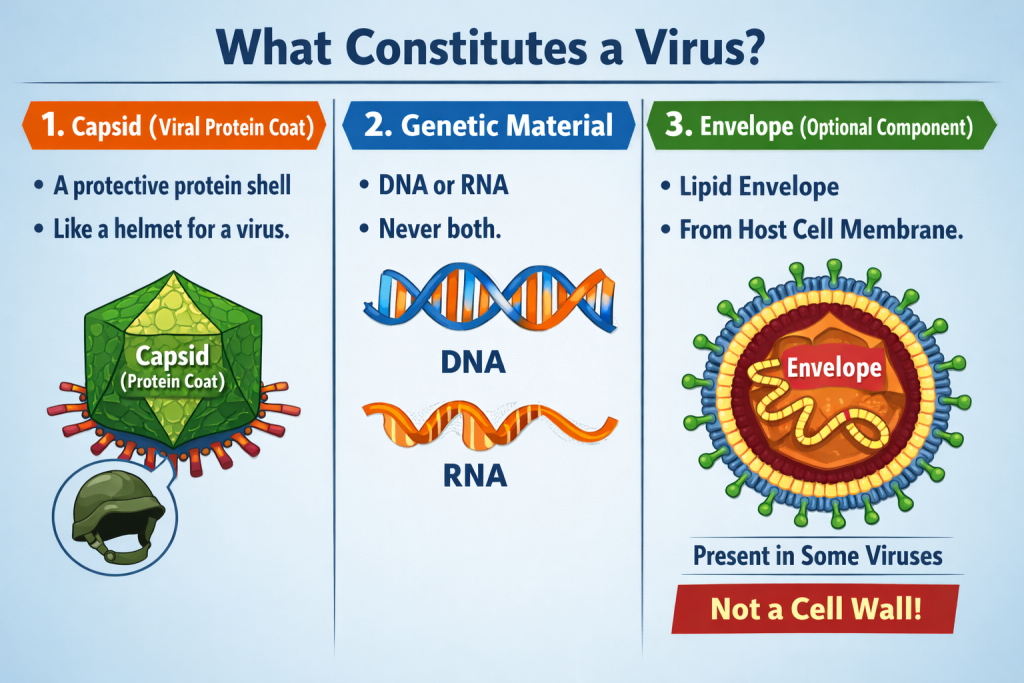
🧬 What Constitutes a Virus?
Having established that does virus have a cell wall is a no, let’s move on to what constitutes a virus.
👉 Then what does a virus have?
🧩 1. Capsid (Viral Protein Coat)
All viruses have:
- A capsid, which is a protein coat.
- It is for protection.
Think of it as a helmet for a virus. 🪖
🧩 2. Genetic Material
All viruses have:
- Either DNA or RNA.
- But never both.
This is an important part of your examination.
🧩 3. Envelope (Optional Component)
Some viruses, for example, HIV and influenza, have:
- A lipid envelope.
- It is derived from host cells.
Note:
👉 This is not a cell wall.
🔍 Why Don’t Viruses Need a Cell Wall?
Okay, here’s where the actual understanding begins.
A cell needs a cell wall because:
- Protection
- Shape
- Regulation of internal pressure
But what about viruses? They don’t need a cell wall because:
They don’t:
- Grow
- Multiply
- Regulate internal pressure
👉 They simply invade and use the cells
Analogy:
- A virus is like a hacker script, not a computer system.
- It doesn’t need protection; it only needs access.
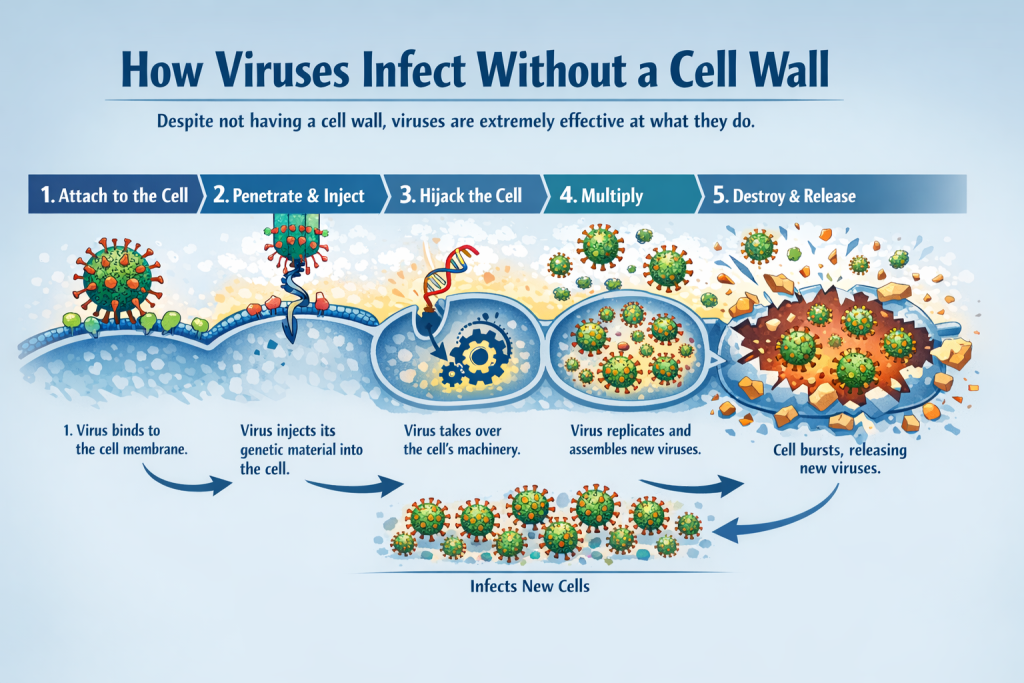
🦠 How Viruses Infect Without a Cell Wall
Despite not having a cell wall, viruses are extremely effective at what they do.
Infection Process:
- Attach to the cell
- Penetrate the cell and inject the genetic material
- Take over the cell’s machinery
- Multiply
- Destroy the cell and exit
Some viruses use a structure called spikes to attach to the cell, like a key and a lock.
🧠 Real-Life Example You Can Relate To
Let’s take a real-life example that you can relate to:
- Your phone = Host cell
- Virus = Malicious app
The app:
- Doesn’t have hardware
- Doesn’t run independently
- Uses your phone to function
Same concept.
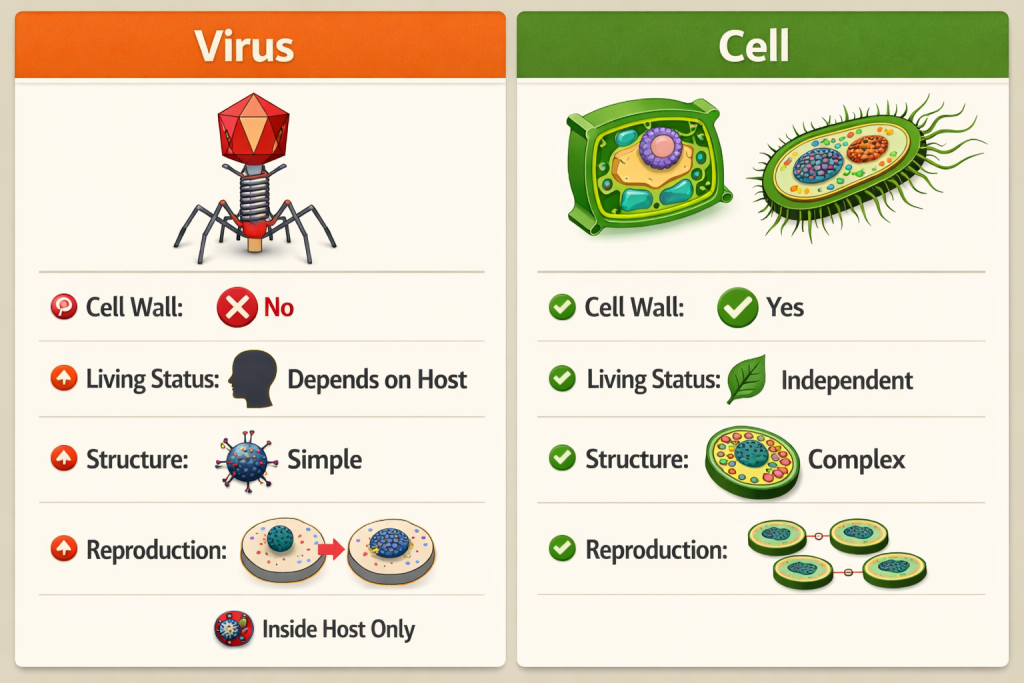
📊 Virus vs Cell (Quick Comparison)
| Feature | Virus | Cell (Plant/Bacteria) |
|---|---|---|
| Cell wall | ❌ No | ✅ Yes |
| Living status | Depends on host | Independent |
| Structure | Simple | Complex |
| Reproduction | Inside host only | Independent |
🧪 Types of Viruses (Structure Insight)
This helps in understanding how the answer to the question of whether viruses have a cell wall or not is always a firm ‘no’.
1.Helical Viruses
- Example: Tobacco Mosaic Virus
- Has a rod structure
2.Icosahedral Viruses
- Example: Adenovirus
- Has a spherical structure
Complex Viruses
- Example: Bacteriophage
- Has a head and tail structure
👉 None of these viruses has a cell wall
📚 Real Data & Scientific Insight
- As per NCBI (National Center for Biotechnology Information), viruses are classified as ‘non-cellular infectious agents’
- As per WHO, viruses rely totally on the host cells for their replication
- Studies show that viruses do not have a metabolic system, thus confirming that they are not cells
💡 Best Way to Remember This (Exam Trick)
Confused during exams? Here’s the trick:
👉 “No cell = No cell wall”
Viruses are not made of cells, hence no cell wall.
That’s it. Done. Easy marks.
⚠️ Common Mistakes Students Make
Students lose marks because of these common mistakes:
- ❌ Envelope and cell wall mixed up
- ❌ Viruses are not living
- ❌ DNA and RNA forgotten
- ❌ Bacteria and viruses mixed up
Don’t make these mistakes, and you’re already ahead of the rest.
🎯 Why This Topic Matters (Career Insight)
This topic matters if your future plans include:
- 🧬 Biotechnology
- 🧪 Microbiology
- 🧠 AI and health
- 🔐 Biosecurity
Understanding the structure of viruses is crucial.
For example:
Vaccine research and development involve the capsid
AI models identify viruses based on structure
🧾 Conclusion
The question “does the virus have a cell wall?” might seem like a basic question. However, once you understand the concept, it’s connected to everything.
Here’s the takeaway:
👉 Does the virus have a cell wall?
➡️ No, the virus does not have a cell wall.
However, the virus has a capsid and sometimes an envelope, and it completely depends on the host cell.