





Introduction
What is the difference between homogeneous and heterogeneous mixture – This is one of those questions that you think you know the answer to… until you get a tricky question in your exam.
Table Of Content
- Introduction
- Key Highlights
- A homogeneous mixture is a mixture that
- Heterogeneous Mixture (Simple Definition)
- Difference Between Homogeneous and Heterogeneous Mixture (Table)
- Homogeneous and Heterogeneous Mixture Examples (Real Life)
- Homogeneous Mixture Examples
- Heterogeneous Mixture Examples
- Why Homogeneous and Heterogeneous Mixture Examples Matter (Real Life)
- Industry Examples
- Tech and Career Insight
- Particle Size & Behavior (Deep Understanding)
- Homogeneous Mixture
- Heterogeneous Mixture
- Special Case: Colloids (Tricky Concept)
- Common Mistakes Students Make
- Best Trick to Remember
- Scientific Insight
- Quick Revision Points
- Practice Questions
- Conclusion
Difference between homogeneous mixture and heterogeneous mixture
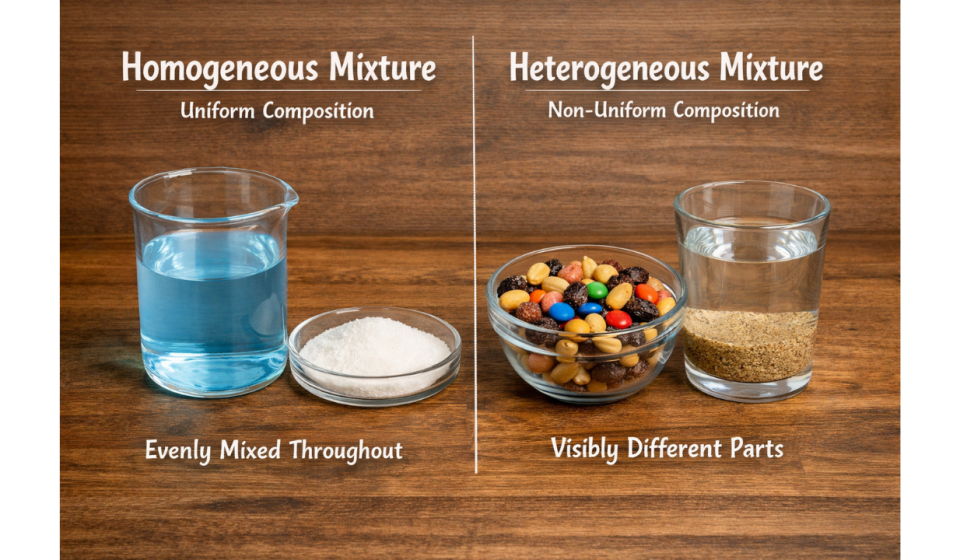
The simple answer to this question is as follows:
Homogeneous mixture: Uniform composition
Heterogeneous mixture: Non-uniform composition
But, of course, questions are tricky, so let’s clarify everything step by step so that you don’t just memorize, but also understand.
NCERT Chemistry Question and Answer
Key Highlights
- Uniform composition of homogeneous mixture
- Non-uniform composition of heterogeneous mixture
- Components of homogeneous mixture are not visible
- Components of heterogeneous mixture are visible
- Particle size of homogeneous mixture: very small
- Particle size of heterogeneous mixture: large
- What is the Difference Between Homogeneous and Heterogeneous Mixture?
- Homogeneous Mixture (Simple Definition)
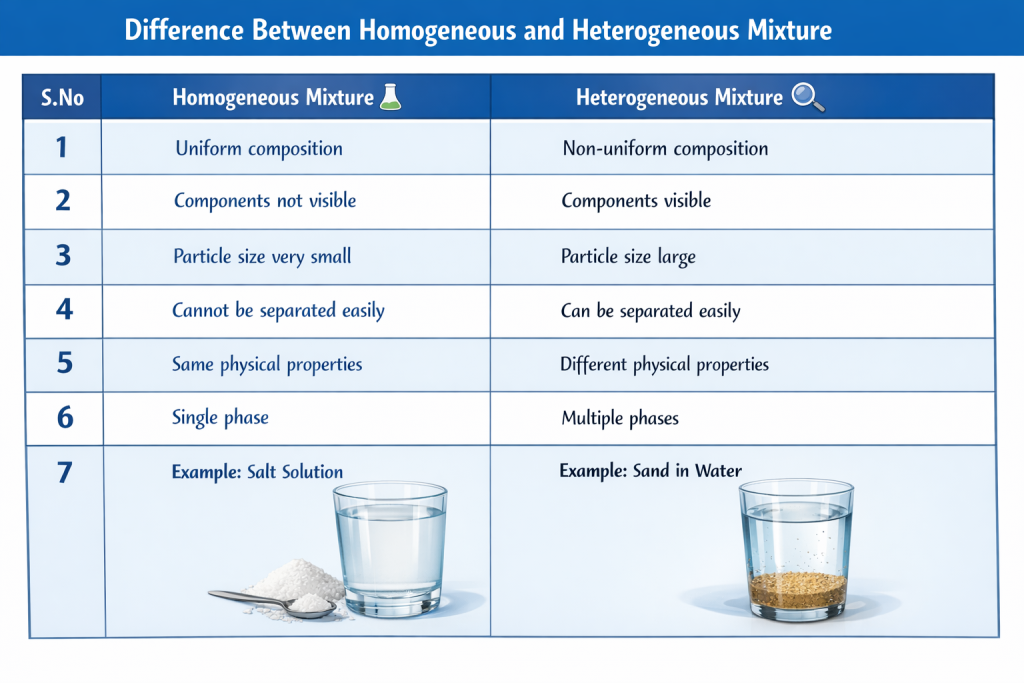
A homogeneous mixture is a mixture that:
- Has uniform composition
- Has components that cannot be seen
- Looks like a single substance
Example: Salt water
Heterogeneous Mixture (Simple Definition)
A heterogeneous mixture is a mixture that:
- Does not have uniform composition
- Has components that can be seen
- Has multiple phases
Example: Oil water mixture
Difference Between Homogeneous and Heterogeneous Mixture (Table)
| S.No | Homogeneous Mixture 🧪 | Heterogeneous Mixture 🔍 |
|---|---|---|
| 1 | Uniform composition | Non-uniform composition |
| 2 | Components not visible | Components visible |
| 3 | Particle size very small | Particle size large |
| 4 | Cannot be separated easily | Can be separated easily |
| 5 | Same physical properties | Different physical properties |
| 6 | Single phase | Multiple phases |
| 7 | Example: salt solution | Example: sand in water |
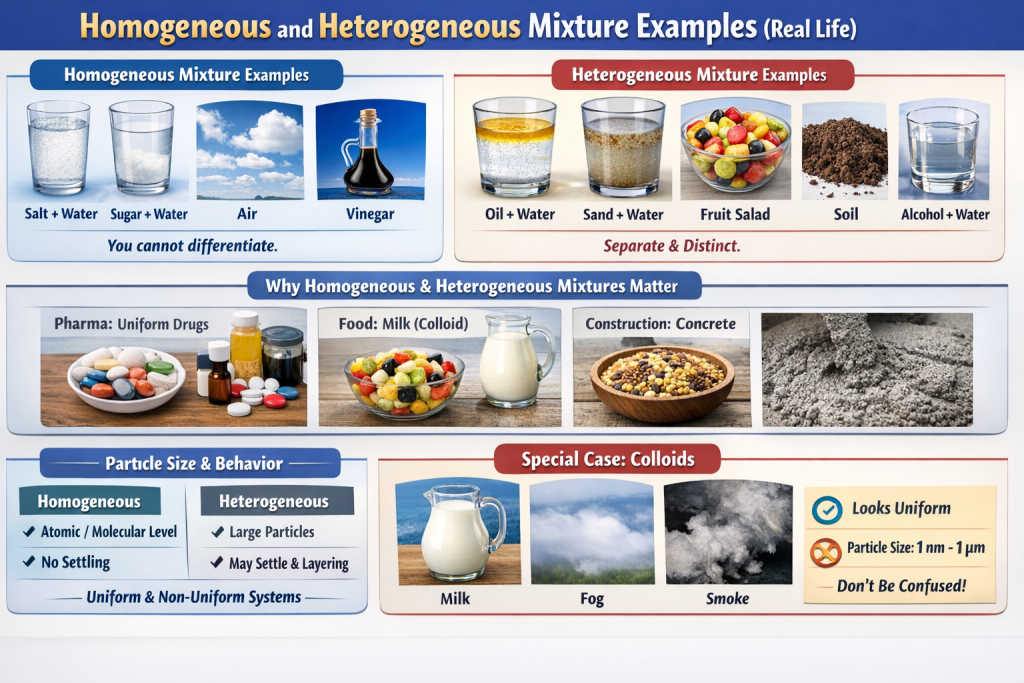
Homogeneous and Heterogeneous Mixture Examples (Real Life)
Homogeneous and heterogeneous mixture examples are a way to understand things easily.
Homogeneous Mixture Examples
You encounter these every day:
- Salt + water
- Sugar + water
- Air
- Vinegar
- Alcohol + water
You are unable to differentiate between them.
Heterogeneous Mixture Examples
You can easily see these:
- Oil + water
- Sand + water
- Fruit salad
- Soil
- Mixed grains
The components are separate and distinct.
Why Homogeneous and Heterogeneous Mixture Examples Matter (Real Life)
This is not a theory. This is used in our daily lives.
Industry Examples:
- Medicinal industry: Drugs need to be homogeneous.
- Food industry: Milk is a colloid.
- Construction industry: Concrete is a heterogeneous mixture.
Tech and Career Insight
If you are planning a career in:
- Data Science
- Material Science
- Chemical Engineering
You will encounter uniform and non-uniform systems.
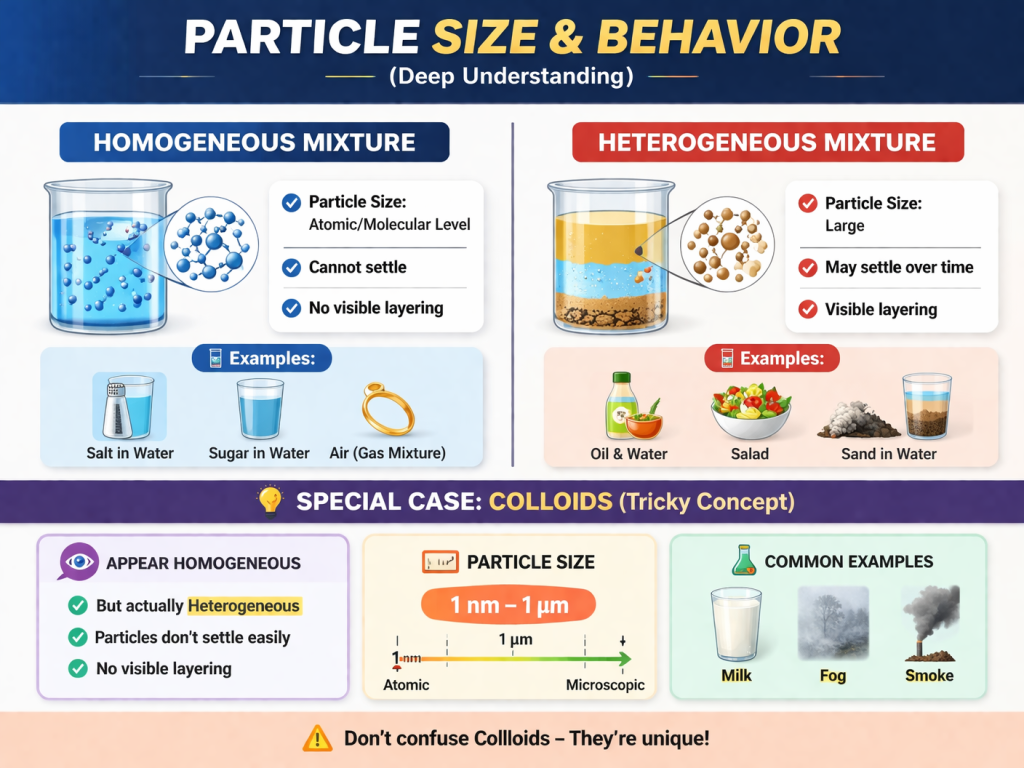
Particle Size & Behavior (Deep Understanding)
This is where the majority of students go wrong.
Homogeneous Mixture:
- Particle Size: Atomic/Molecular Level
- Cannot settle
- No visible layering
Heterogeneous Mixture:
- Particle Size: Large
- May settle after a while
- Visible layering is there
Special Case: Colloids (Tricky Concept)
This is where the majority of students go wrong.
Colloids are heterogeneous mixtures, but:
- Appear homogeneous
- Particle Size: 1 nm – 1 µm
- Examples:
- Milk
- Fog
- Smoke
Don’t confuse them with anything else.
Common Mistakes Students Make
Don’t make these mistakes:
- Don’t think that all transparent liquids are homogeneous
- Don’t confuse colloids with solutions
- Don’t forget the concept of particle size
- Don’t forget the visibility concept
Best Trick to Remember
Use this trick:
“See = Heterogeneous, Not see = Homogeneous”
Scientific Insight
- Homogeneous mixtures are called solutions
- Heterogeneous mixtures:
- Suspension
- Colloids
Quick Revision Points
- Homogeneous = Uniform
- Heterogeneous = Non-uniform
- Visibility is the key
- Particle size is the key
- Examples make it simple
Practice Questions
- Is the mixture of gases in air homogeneous or heterogeneous?
- Is milk a homogeneous mixture?
- Why is the mixture of oil and water heterogeneous?
- Try answering these questions on your own
Conclusion
- At first glance, the difference between homogeneous and heterogeneous mixture is a basic concept. But when you go deeper into the concept, you realize how important it is.
Final takeaway:
- Homogeneous mixture = Not uniform, cannot see
- Heterogeneous mixture = Not uniform, can see
- When you memorize this concept, you’ll be able to solve any mixture-related problem in a flash!