






Quick Answer (No Confusion!)
Past tense of raise is… “raised”
Not “rose” as many people think.
Table Of Content
- Quick Answer (No Confusion!)
- Key Highlights
- Why Do People Confuse Raised and Rose?
- Understanding the Past Tense of Raise
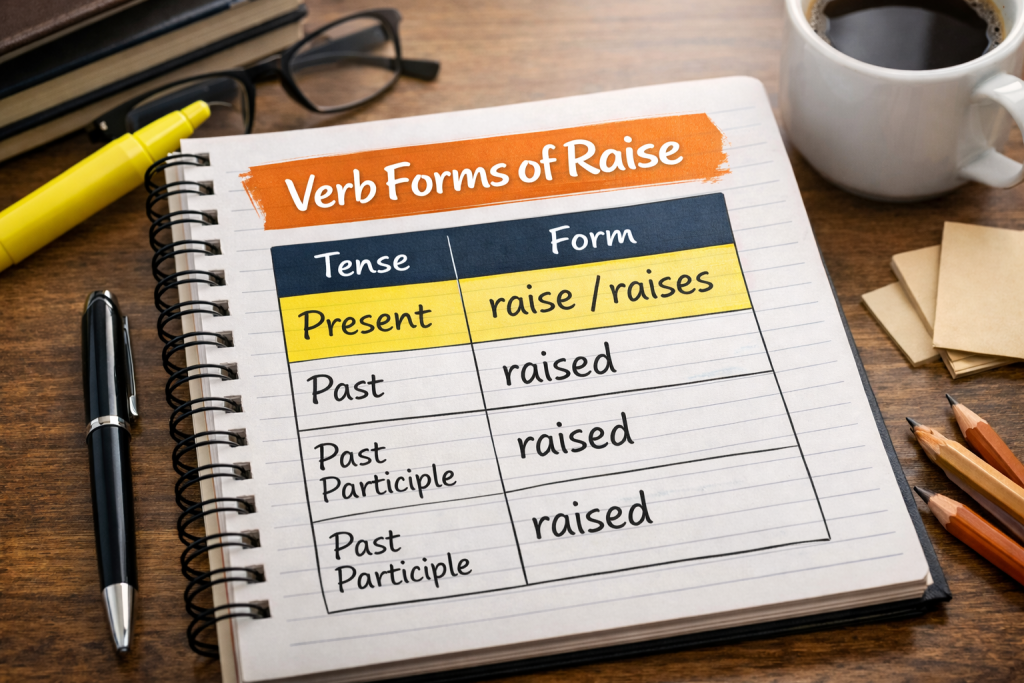
- Verb Forms of Raise
- Important Rule
- Difference Between Raised and Rose (Clear Explanation)
- Raise (Transitive Verb)
- Rise (Intransitive Verb)
- Side-by-Side Comparison
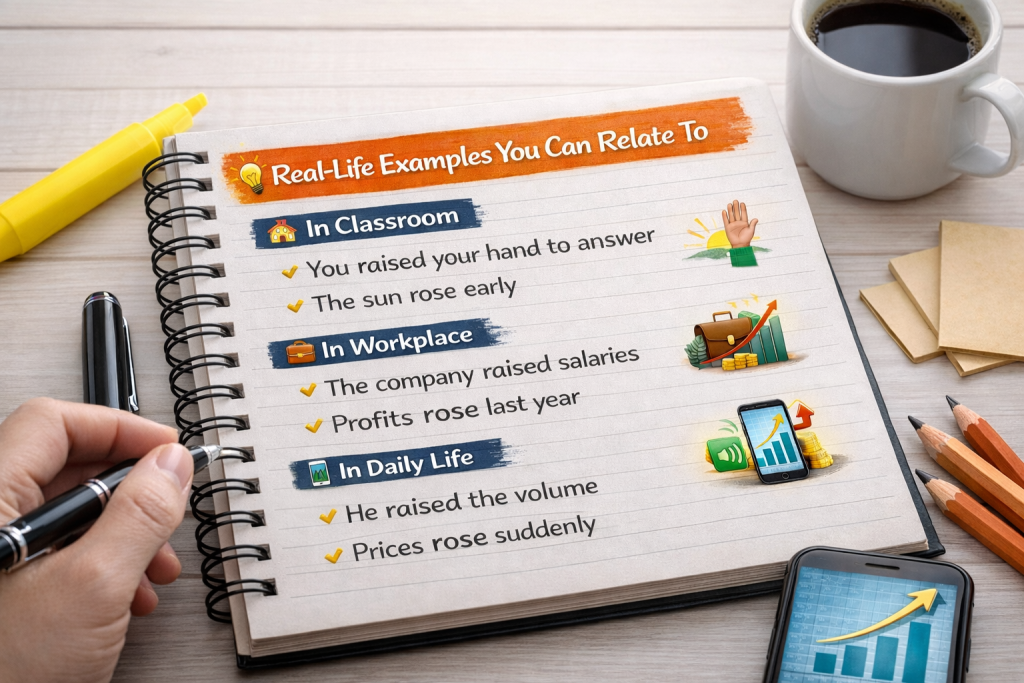
- Real-Life Examples You Can Relate To
- In Classroom
- In Workplace
- In Daily Life
- Common Mistakes (Avoid These!)
- Best Trick to Remember Forever
- Example
- 🧠 Advanced Insight (Career + Exams)
- Real Data Insight
- Practice Questions (Test Yourself!)
- Still Confused? Think Like This
- Why This Matters in Real Life
- Conclusion
✔️ Raise → Raised → Raised
✔️ Rise → Rose → Risen
So, the answer to the question… “past tense of raise?” is… “raised”
Key Highlights
- “Raise” is a Transitive Verb, meaning it needs an object.
- “Raised” is the past tense of the verb “raise.”
- “Rose” is the past tense of the verb “Rise,” not “raise.”
- “Raise” and “Rise” – One of the Most Common Grammar Confusions!
- This is a must-know topic for exams, interviews, emails, and communication.
Why Do People Confuse Raised and Rose?
Let’s be real.
You’ve probably seen sentences like:
- “He raised up quickly”
- “She rose her hand”
But why does this happen?
Because:
- They sound similar
- They both have something to do with “going up”
- They have different grammar rules
Understanding the Past Tense of Raise
Verb Forms of Raise
| Tense | Form |
|---|---|
| Present | raise / raises |
| Past | raised |
| Past Participle | raised |
Important Rule
Raise always needs an object
This means there is always something receiving the action.
Examples:
- You raised your hand
- She raised the question
- They raised the price
Notice something?
There is always an object (hand, question, price)
Difference Between Raised and Rose (Clear Explanation)
This is where the majority of learners go wrong.
Raise (Transitive Verb)
- Needs an object
- Someone/something causes the action
Example:
He raised the flag
Rise (Intransitive Verb)
- Doesn’t need an object
- The action happens on its own
Example:
The sun rose
Side-by-Side Comparison
| Feature | Raise | Rise |
|---|---|---|
| Type | Transitive | Intransitive |
| Past Tense | Raised | Rose |
| Needs Object | Yes | No |
| Example | She raised her voice | The sun rose |
Real-Life Examples You Can Relate To
In Classroom
- You raised your hand to answer
- The sun rose early
In Workplace
- The company raised salaries
- Profits rose last year
In Daily Life
- He raised the volume
- Prices rose suddenly
Common Mistakes (Avoid These!)
You may be making these mistakes without even knowing:
- “She rose her hand”
- “He raised up early”
- “The sun raised”
Correct versions:
- She raised her hand
- He rose early
- The sun rose
Best Trick to Remember Forever
Just ask yourself this simple question:
Is there an object?
YES → use ‘raised’
NO → use ‘rose’
Example:
“He _ his hand” → Is ‘hand’ an object? Yes, so use ‘raised’
“He _ quickly” → Is there an object? No, so use ‘rose’

🧠 Advanced Insight (Career + Exams)
If you’re preparing for:
- Competitive exams (SSC, UPSC, GRE)
- Job interviews
- Email writing
This concept is more important than you think.
Employers usually evaluate your communication skills based on your command of grammar basics.
Real Data Insight
According to language studies on grammar for language learners:
Over 60% of language learners get this verb form wrong – ‘raise’ and ‘rise’
It ranks within the top 20 grammar mistakes worldwide
Get this right, and you’re ahead of the game.
NCERT Physics Question & Answer
NCERT Chemistry Question & Answer
NCERT Biology Question & Answer
Practice Questions (Test Yourself!)
Fill in the blanks:
She _ her voice during the meeting The sun at 6 AM
They the issue yesterday Prices _ last month
Answers:
- raised
- rose
- raised
- rose
Still Confused? Think Like This
Let’s think this through:
If ‘raise’ is a verb, think of what you do when you ‘raise’ something. You ‘lift’ it, right?
Now, think of ‘rise’. What does ‘rise’ do? It ‘lifts’ itself!
That’s the difference.
Why This Matters in Real Life
Grammar is not just for exams.
It helps you:
- Speak confidently
- Write professional emails
- Avoid embarrassing mistakes
- Stand out in job interviews
Conclusion
So, at first glance, the verb ‘raise’ in the past tense might sound a bit confusing. But once you get to know the difference between ‘raised’ and ‘rose,’ you will understand it all
Just remember:
Raised → needs an object
Rose → no object needed
That’s it.
Simple. Practical. Powerful.
And once you get it right, your English will get sharper right away.