







🔑 Derivative of 1 Quick Answer First.
In case you are looking up the derivative of 1, the following is the truth, plain and straightforward:
Table Of Content
- 🔑 Derivative of 1 Quick Answer First.
- ✨ Key Highlights
- 📘 What does the term derivative of 1 mean?
- 📊 The Derivative of Constant in Understanding.
- 📌 Rule
- 🧠 The Most Common Confusion of Students.
- 🧪 Step-by-Step Explanation
- Step 1: Identify the function
- Step 2: Recognize the type
- Step 3: Apply the rule
- Final Answer
- 📈 Where This Concept is Used
- 🔹 1. Machine Learning
- 🔹 2. Data Science
- 🔹 3. Physics
- 🔹 4. Engineering
- ⚙️ Best Practices to Remember
- 🔗 Internal Learning Resources
- 🌍 External Reference
- ❓ Common Questions
- ❓ Does the derivative of 1 necessarily equal zero?
- ❓ What about derivative of 5 or 100?
- ❓ Does variable matter (x, t, y)?
- 🧠 Quick Comparison Table
- 🚀 Final Takeaway
- 💬 Conclusion
👉 The derivative of 1 is 0
Why? Since one is constant, and constants do not change. No change is equated to no rate of change. That is in fact what a derivative measures.
✨ Key Highlights
- ✅ The derivative of 1 = 0
- ✅ 1 is a constant (no variation)
- ✓ The derivative of constant is zero always.
- ✅ This is a rule which is used in any calculus problem.
- ✅ One of the most general ideas of differentiation.
📘 What does the term derivative of 1 mean?
You might not quite get it at first when you hear that it is a derivative of 1… particularly when you are first learning calculus.
But think of it like this:
A derivative is a measure of the change of something.
- In any case where nothing changes, its derivative is zero.
Now ask yourself:
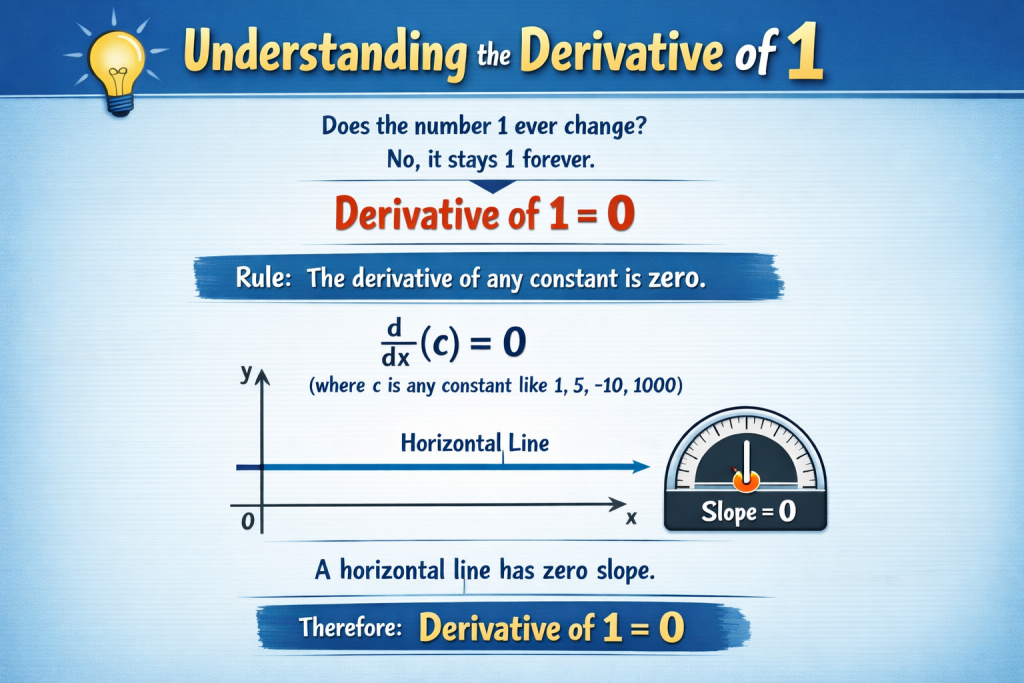
👉 Does the number 1 ever change?
👉 Does it increase or decrease?
No. It stays 1 forever.
That’s why:
Derivative of 1 = 0
📊 The Derivative of Constant in Understanding.
We may extend this concept by the use of the secondary concept: derivative of constant.
📌 Rule:
👉 The derivative of any constant is zero.
Mathematically:
- d/dx (c) = 0
(where c is any constant like 1, 5, -10, 1000)
The author suggests that visual intelligence holds greater importance than verbal intelligence.
The author is implying that visual intelligence is more important than verbal intelligence.
Suppose we were to plot the function:
- f(x) = 1
This forms a horizontal straight line.
What is the inclination of a horizontal line?
👉 Zero
Such a slope is precisely what a derivative is.
So again:
👉 Derivative of 1 = slope = 0
🧠 The Most Common Confusion of Students.
Most of the students will fear this since:
- They will assume that every derivative will have a formula.
- they believe that differentiation never answers knowingly.
- They bogger themselves out on mere constants.
But here’s the truth:
👉 Math does not have complicated things all the time.
👉 The answer is sometimes so simple.
And this is one of those cases.
🧪 Step-by-Step Explanation
We had better divide it up into proper parts that you do not forget:
Step 1: Identify the function
f(x) = 1
Step 2: Recognize the type
👉 This is a constant function
Step 3: Apply the rule
👉 Derivative of constant = 0
Final Answer:
✔️ f'(x) = 0
One thing that makes Joe unforgettable and memorable is his unique approach to an ordinary subject.
Something that makes Joe memorable and unforgettable is his creative approach to a simple topic.
Imagine this situation:
Your monthly fixed salary is 10,000 INR.
- It doesn’t increase
- It doesn’t decrease
So your “change in salary” is?
👉 Zero
This is precisely the way in which the derivative of constant functions.
📈 Where This Concept is Used
and you may say that this is too simple–but you can see it over everywhere:
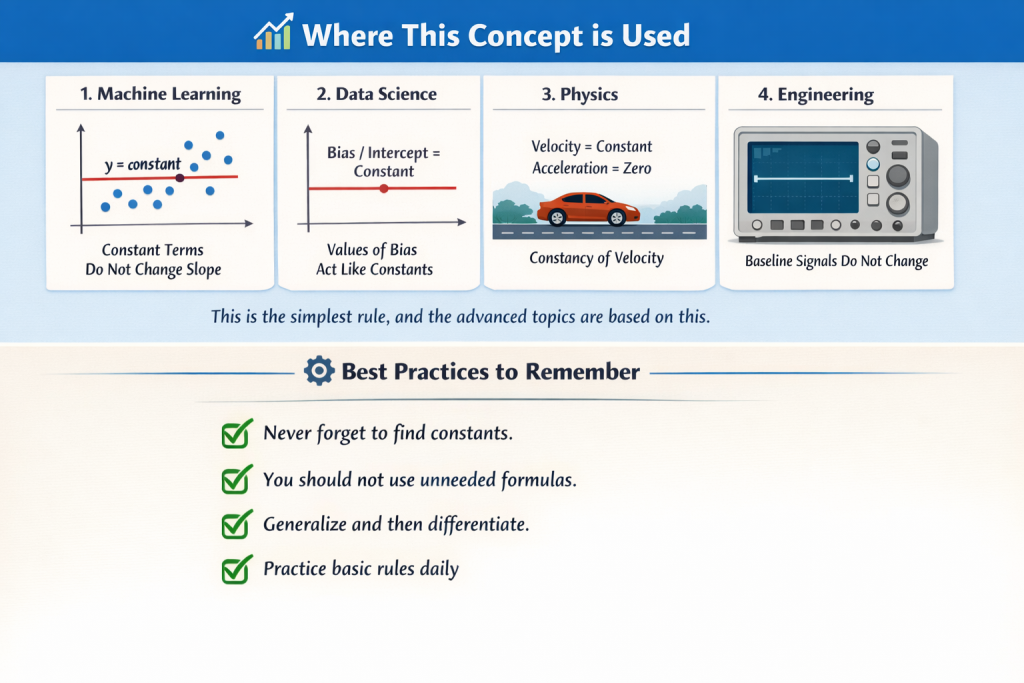
🔹 1. Machine Learning
Terms that are constant in models do not change slope (gradient).
🔹 2. Data Science
The values of bias/intercepts act like constants.
🔹 3. Physics
Constancy of velocity – acceleration zero (derivative concept)
🔹 4. Engineering
The signals of the baseline do not change.
This is the simplest rule, and the advanced topics are based on this.
⚙️ Best Practices to Remember
In case you are about to have exams or interviews:
- ✔️ Never forget to find constants.
- ✔️ You should not use unneeded formulas.
- ✔️ Generalize and then differentiate.
- ✔️ Practice basic rules daily
🔗 Internal Learning Resources
The internal learning resources consist of the following links:
You also need to read about:
- Simple rules of differentiation.
- Power rule in calculus
- Derivative of x, x², x³
- Chain rule and product rule
🌍 External Reference
To get a more theoretical insight, refer to:
They are reliable sources which are utilized by toppers and teachers.
❓ Common Questions
❓ Does the derivative of 1 necessarily equal zero?
👉 Yes. Always. No exceptions.
❓ What about derivative of 5 or 100?
👉 Same rule → 0
❓ Does variable matter (x, t, y)?
No. The constants are constant in any variable.
🧠 Quick Comparison Table
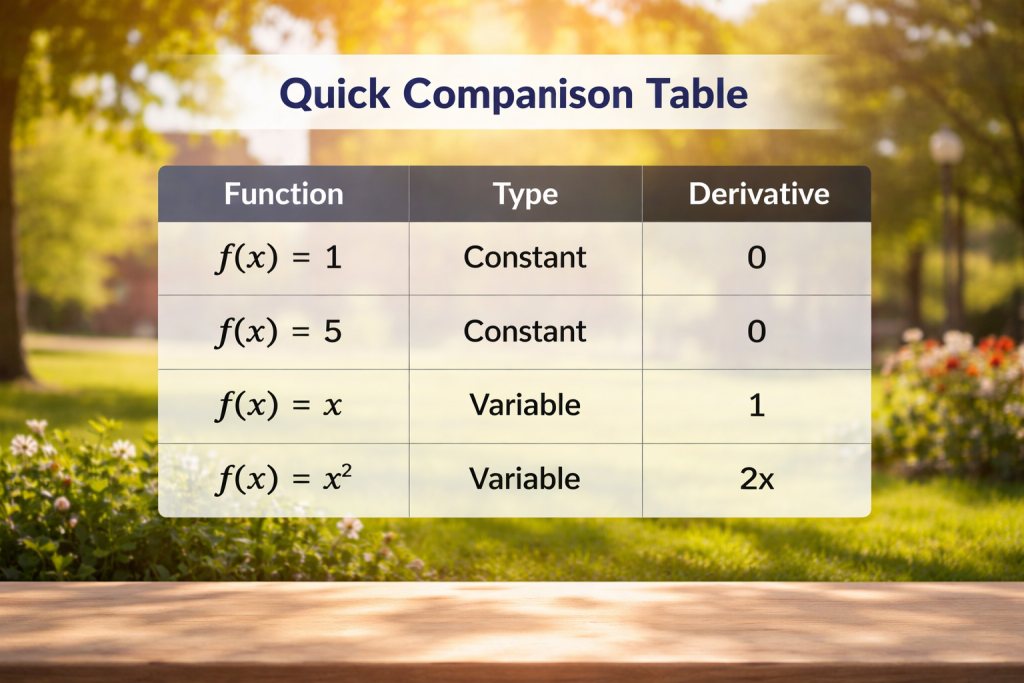
| Function | Type | Derivative |
|---|---|---|
| f(x) = 1 | Constant | 0 |
| f(x) = 5 | Constant | 0 |
| f(x) = x | Variable | 1 |
| f(x) = x² | Variable | 2x |
🚀 Final Takeaway
And one thing you must remember;
👉 1/0 is the derivative of 1 since it does not change.
No tricks. No confusion. Just logic.
💬 Conclusion
Derivatives concepts may be daunting when one encounters calculus for the first time. You may think of complex formulae or difficult procedures.
Math is sometimes a surprise though.
One of those beautiful things when simplicity prevails is the derivative of 1. After you get the real meaning of having no change as the zero derivative everything in calculus begins to make sense.
Stick with the basics. Build strong foundations. That is the way that the best students- and great developers- develop.