








“factorial of 5” is one of the most common queries students face in math.
“factorial of 5” is equal to 120, but if you’re interested in knowing why “factorial of 5” is equal to 120, then you’re at the right place.
Table Of Content
- 🔑 Key Highlights
- ✅ What is 5 Factorial? (Straight Answer First)
- 🧠 Why Factorial Works This Way
- ✍️ Step-by-Step Breakdown of Factorial of 5
- 📌 The Formula Behind Factorials
- ⚠️ Important Rule You Must Know
- 📊 Factorial Table (Quick Reference)
- 🧠 Real-Life Examples You Can Relate To
- 🎯 1. Arranging Objects
- 🎲 2. Probability
- 💻 3. Programming & Tech
- 📊 4. Permutations & Combinations
- ⚠️ Common Mistakes Students Make
- ❌ Mistake 1: Stopping Too Early
- ❌ Mistake 2: Using Zero
- ❌ Mistake 3: Skipping Steps
- 🧠 Best Practices to Learn Factorials Fast
- ✔️ 1. Memorize Small Factorials
- ✔️ 2. Use Patterns
- ✔️ 3. Practice Every Day
- 🔗NCERT Question and Answer
- 🔗 Internal Learning Suggestions
- 📈 Why Learning Factorials Will Boost Your Career
- 🤔 Quick Self-Test
- 🧾 Summary
- 🎯 Final Thought
Now, let’s make it super clear, super practical, and super easy to remember!
🔑 Key Highlights
- factorial of 5 = 120 ✔
- Written as 5!
- Multiply numbers from 5 down to 1
- Used in probability, coding, and real-life calculations
- Important for exams and logical thinking
✅ What is 5 Factorial? (Straight Answer First)
Now, let’s get straight to the point and provide you with an immediate answer to your query:
👉 what is 5 factorial?
It means:
5! = 5 × 4 × 3 × 2 × 1
👉 Final Answer: 120
🧠 Why Factorial Works This Way
If you’re thinking, “Wait a minute, I don’t get it,” don’t worry! That’s totally normal. Many students get confused at first because they think it’s a new idea, but it’s just repeated multiplication.
Factorial means:
👉 Multiply a number by all the numbers below it until you reach 1
That’s it! No tricks involved.
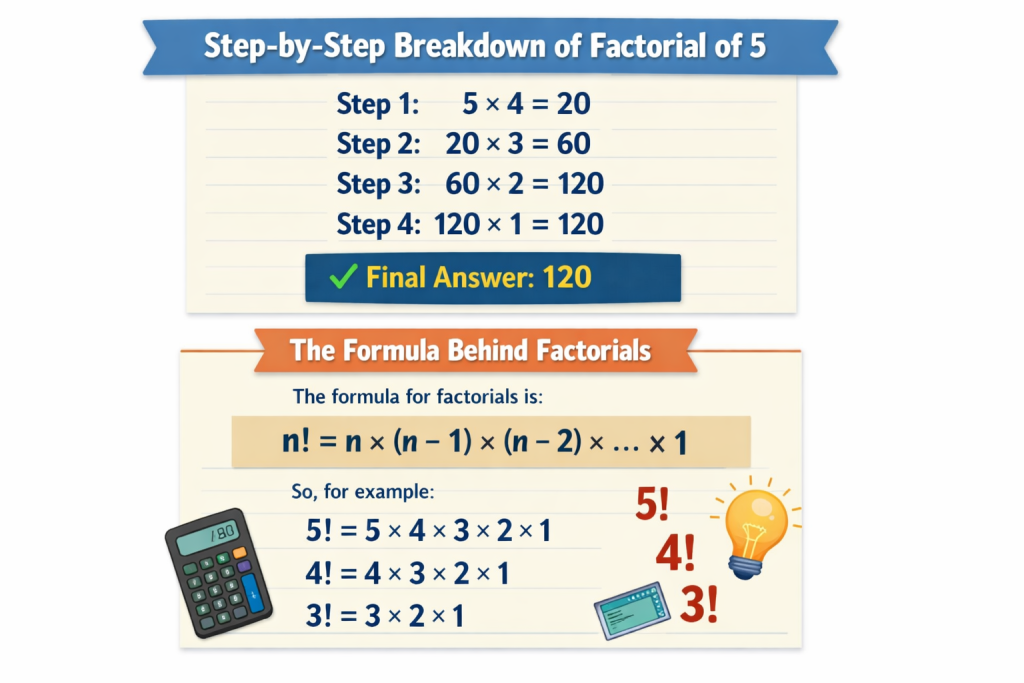
✍️ Step-by-Step Breakdown of Factorial of 5
Let’s take it slow and do the math together:
Step 1
5 × 4 = 20
Step 2
20 × 3 = 60
Step 3
60 × 2 = 120
Step 4
120 × 1 = 120
✔ Final Answer: 120
📌 The Formula Behind Factorials
The formula for factorials is:
n! = n × (n – 1) × (n – 2) × … × 1
So, for example:
- 5! = 5 × 4 × 3 × 2 × 1
- 4! = 4 × 3 × 2 × 1
- 3! = 3 × 2 × 1
⚠️ Important Rule You Must Know
👉 0! = 1
Yes, it seems weird, but it is a mathematical principle used in complex calculations.
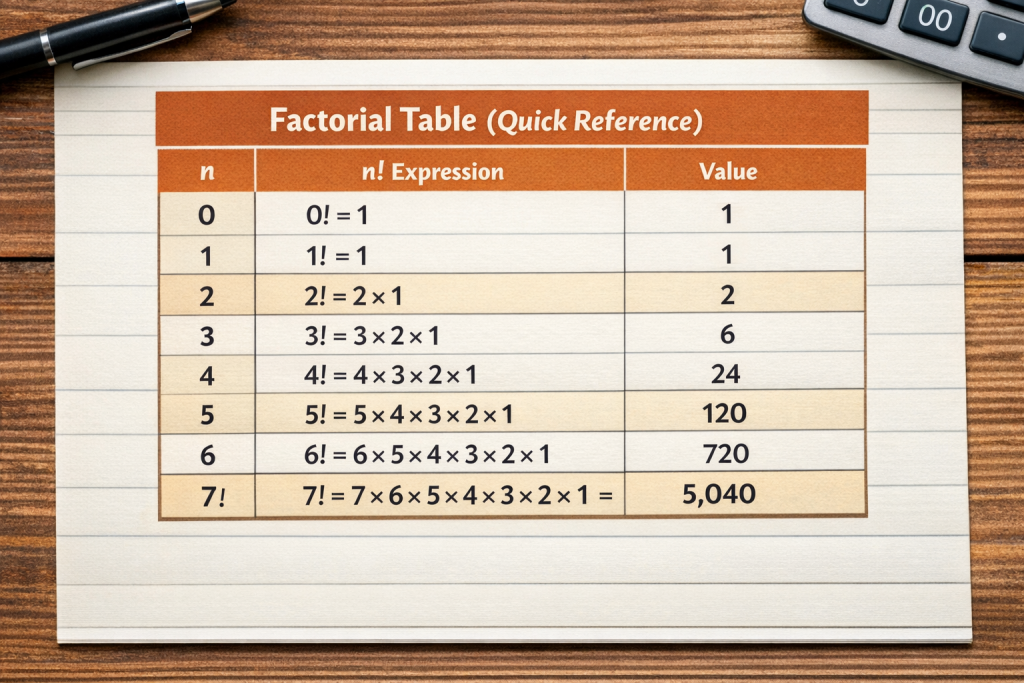
📊 Factorial Table (Quick Reference)
| Number (n) | Factorial Expression | Value (n!) |
|---|---|---|
| 0 | 0! = 1 | 1 |
| 1 | 1! = 1 | 1 |
| 2 | 2! = 2 × 1 | 2 |
| 3 | 3! = 3 × 2 × 1 | 6 |
| 4 | 4! = 4 × 3 × 2 × 1 | 24 |
| 5 | 5! = 5 × 4 × 3 × 2 × 1 | 120 |
| 6 | 6! = 6 × 5 × 4 × 3 × 2 × 1 | 720 |
| 7 | 7! = 7 × 6 × 5 × 4 × 3 × 2 × 1 | 5040 |
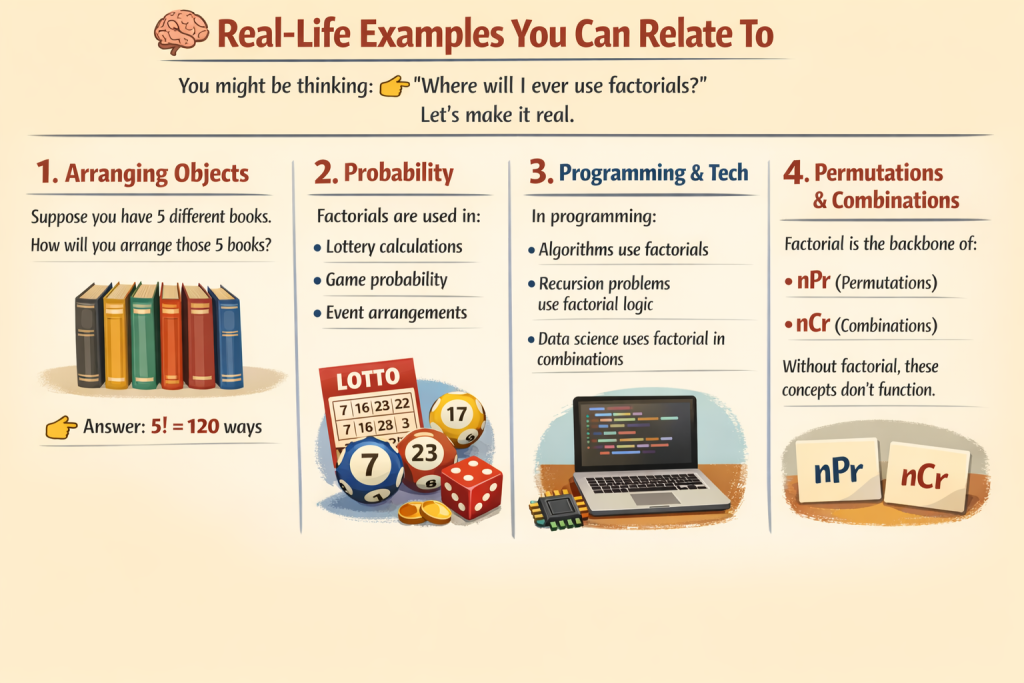
🧠 Real-Life Examples You Can Relate To
You might be thinking:
👉 “Where will I ever use factorials?”
Let’s make it real.
🎯 1. Arranging Objects
- Suppose you have 5 different books.
- How will you arrange those 5 books?
👉 Answer = 5! = 120 ways
🎲 2. Probability
Factorials are used in:
- Lottery calculations
- Game probability
- Event arrangements
💻 3. Programming & Tech
In programming:
- Algorithms use factorials
- Recursion problems use factorial logic
- Data science uses factorial in combinations
📊 4. Permutations & Combinations
Factorial is the backbone of:
- nPr (Permutations)
- nCr (Combinations)
Without factorial, these concepts don’t function.
⚠️ Common Mistakes Students Make
Time to get these right!
❌ Mistake 1: Stopping Too Early
Wrong Calculation:
5! = 5 × 4 × 3
👉 Missing numbers
Correct Calculation:
5 × 4 × 3 × 2 × 1
❌ Mistake 2: Using Zero
👉 Never multiply by zero
Factorial always ends at 1, not zero
❌ Mistake 3: Skipping Steps
Factorial always takes steps:
5 -> 4 -> 3 -> 2 -> 1

🧠 Best Practices to Learn Factorials Fast
To learn factorials fast, use these steps:
✔️ 1. Memorize Small Factorials
- 1! = 1
- 2! = 2
- 3! = 6
- 4! = 24
- 5! = 120
✔️ 2. Use Patterns
See this:
👉 5! = 5 * 4!
Hence:
👉 If 4! = 24
👉 5! = 5 * 24 = 120
✔️ 3. Practice Every Day
Practice:
- 6!
- 7!
- 8!
You can learn fast.
🔗NCERT Question and Answer
NCERT Physics Question and Answer
NCERT Chemistry Question and Answer
NCERT Biology Question and Answer
🔗 Internal Learning Suggestions
You may want to look at similar topics such as:
- Permutations and Combinations
- Algebra Basics
- Number System Basics
📈 Why Learning Factorials Will Boost Your Career
- You might not expect this!
- Factorials are used in:
- Data Science
- Machine Learning
- Cryptography
- Software Development
- According to industry reports, analytical thinking and problem-solving are the two skills that employers are looking for the most.
Factorials lay the foundation for these skills.
🤔 Quick Self-Test
You can try the following:
👉 What is 4 factorial?
Answer:
4! = 4 x 3 x 2 x 1 = 24
👉 What is 6 factorial?
6! = 6 x 5 x 4 x 3 x 2 x 1 = 720
🧾 Summary
Factorial of 5 = 120
Multiply numbers ranging from 5 to 1
Also written as 5!
Used in mathematics, coding, and real-life situations
🎯 Final Thought
Factorials might take you a while to get used to at first. You might take time to think and confirm what you are doing.
But once you get the hang of it, it becomes the easiest thing you will learn in mathematics.
The next time someone asks you:
👉 What is 5 factorial?
You will know the answer immediately! 120! With confidence! 🚀