






Introduction
- how does amoeba reproduce This is one of those questions that looks simple… but somehow still confuses a lot of students before exams.
- And honestly, that confusion makes a lot of sense.
- Why? Because you are told things like nucleus, cytoplasm, division, and before you know it, it is all getting a bit too much for something as simple as a single cell.
- So let’s get it all out of the way in the simplest, most practical way possible.
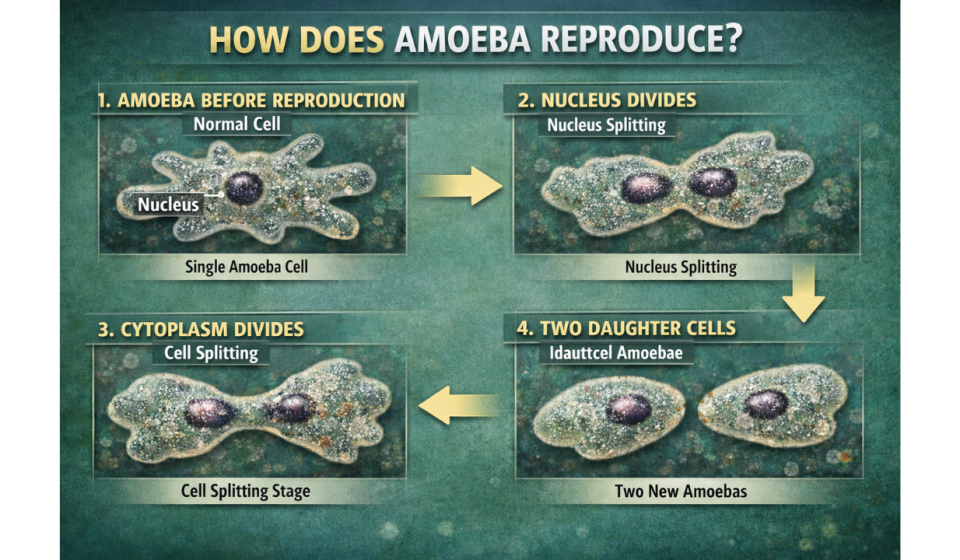
- How does an amoeba reproduce? An amoeba reproduces by a method called binary fission in an amoeba. One cell splits into two identical cells. Simple.
But it is in the detail that the magic lies. Magic, as in, you will never forget it.
Table Of Content
- Introduction
- Key Highlights
- What Does “How Does Amoeba Reproduce” Actually Mean?
- The Process of Binary Fission in an Amoeba: The Core Reproduction Process
- Step 1: The Growth Phase
- Step 2: Nuclear Division (Karyokinesis)
- Step 3: Cytoplasm Division (Cytokinesis)
- Finally
- Real-World Insight (Why This Matters More Than You Think)
- Key Features of Binary Fission in Amoeba
- Common Doubts Students Have (Cleared Instantly)
- Types of Binary Fission
- Best Way to Remember for Exams
- 💡 Best Practices to Remember This Topic
- FAQ Section
- Conclusion
Key Highlights
- Amoeba reproduces in an asexual manner
- Process: Binary Fission in Amoeba
- One Cell → Two Identical Cells
- First, nucleus divides. Then, cytoplasm divides.
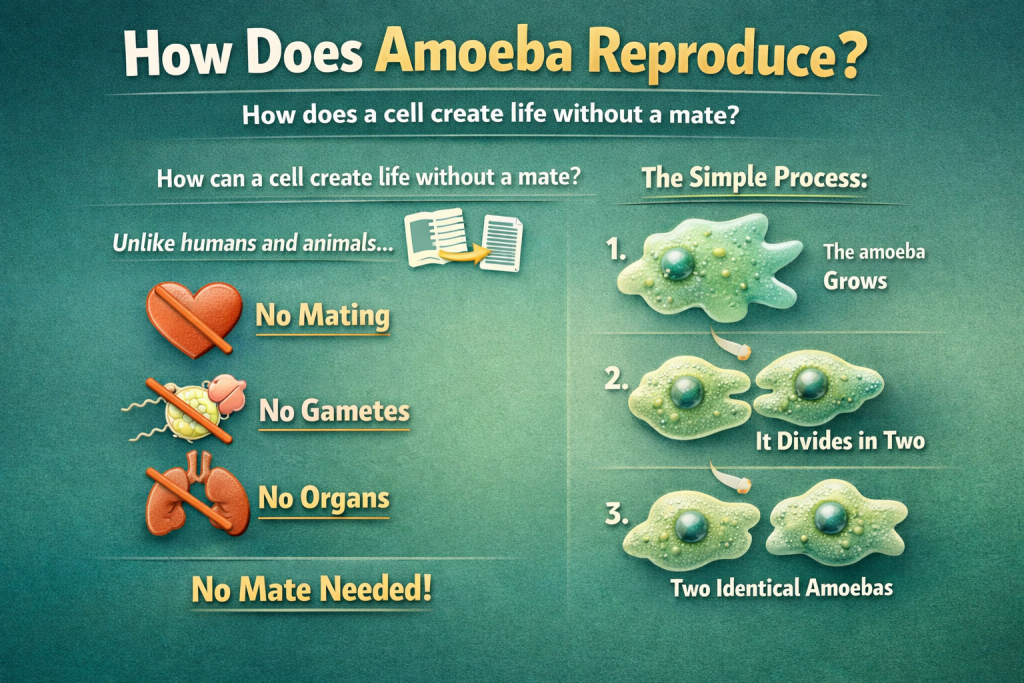
What Does “How Does Amoeba Reproduce” Actually Mean?
When you enter a query like “how does amoeba reproduce,” you are actually asking:
How does a cell create life without a mate?
And that’s exactly the question that makes an amoeba so fascinating.
Unlike human beings or animals, an amoeba does not require:
- mating
- gametes
- organs
It’s a very simple process, almost like copying and pasting a document.
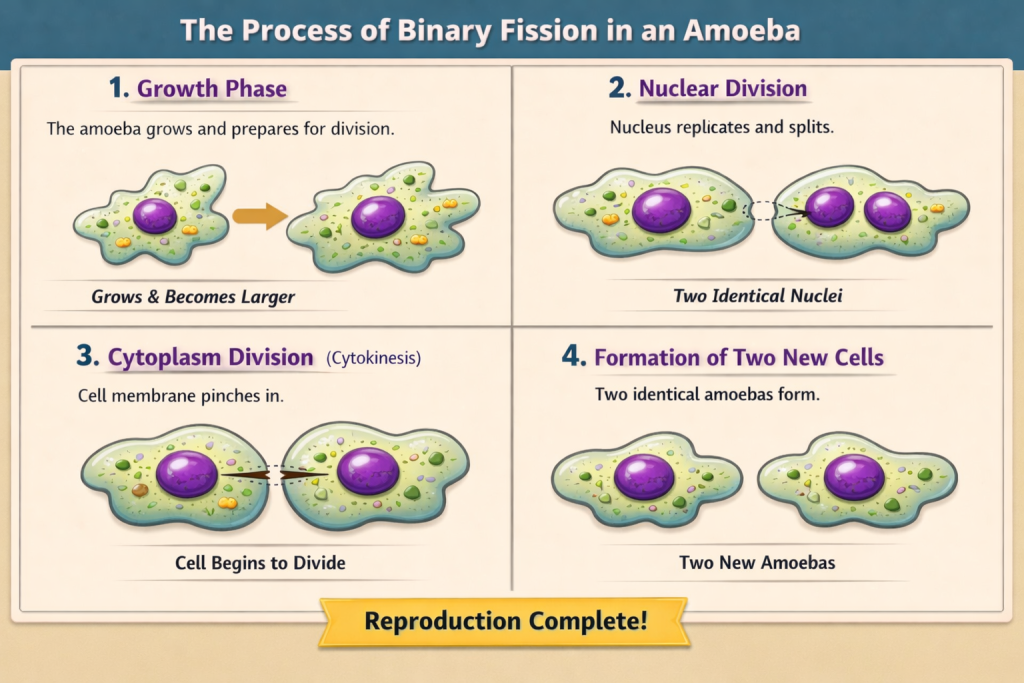
The Process of Binary Fission in an Amoeba: The Core Reproduction Process
Now, let’s get to the actual process of binary fission in an amoeba in a way that sticks.
It’s quite simple, really.
You copy your phone data, splitting it into two phones, which function exactly the same.
And that’s exactly what an amoeba does.
Step 1: The Growth Phase
- Before reproduction, an amoeba prepares itself.
- It takes in nutrients, grows, and becomes bigger.
- The internal structures of the cell also get activated.
The real insight here is that cells don’t divide randomly.
Cells only divide if the conditions are right.
Step 2: Nuclear Division (Karyokinesis)
- And that’s exactly where the reproduction process begins.
- The nucleus creates a copy of its genetic material.
- It divides into two nuclei.
And thus, two cells have exactly the same DNA.
Step 3: Cytoplasm Division (Cytokinesis)
After the nucleus has divided:
- The division of the cytoplasm begins
- The cell membrane starts pinching inward
- The cell starts separating
- Step 4: Formation of Two New Cells
Finally:
Two new cells of the amoeba have formed
Each has:
- One nucleus
- Its own cytoplasm
And with that – the reproduction is complete.
Real-World Insight (Why This Matters More Than You Think)
You might be thinking…
“Why should you care about how does amoeba reproduce?”
Well, the reason is this:
- This process is more than 3.5 billion years old
- This is one of the oldest reproductions of life on Earth
- Even today, this is how many living organisms reproduce
This is the reason bacteria reproduce at such a high rate – because of the rapid division of cells.
Key Features of Binary Fission in Amoeba
It is easy to grasp the concept of binary fission in amoeba if you recall the following key features:
- No partner required
- Fast and efficient
- Produces offspring identical to the parent cell
- Takes place in a favorable environment
- Follows a simple step-by-step procedure
Common Doubts Students Have (Cleared Instantly)
- Is amoeba a prokaryote or eukaryote?
- Amoeba is a eukaryote, as it has a true nucleus.
- Why does binary fission occur in amoeba?
Although binary fission is a common phenomenon in bacteria, binary fission in amoeba also occurs, provided a nucleus is present.
Does the parent cell die?
No.
This is a common confusion, as the cell divides completely, and hence it is said that the cell no longer exists as a single cell.
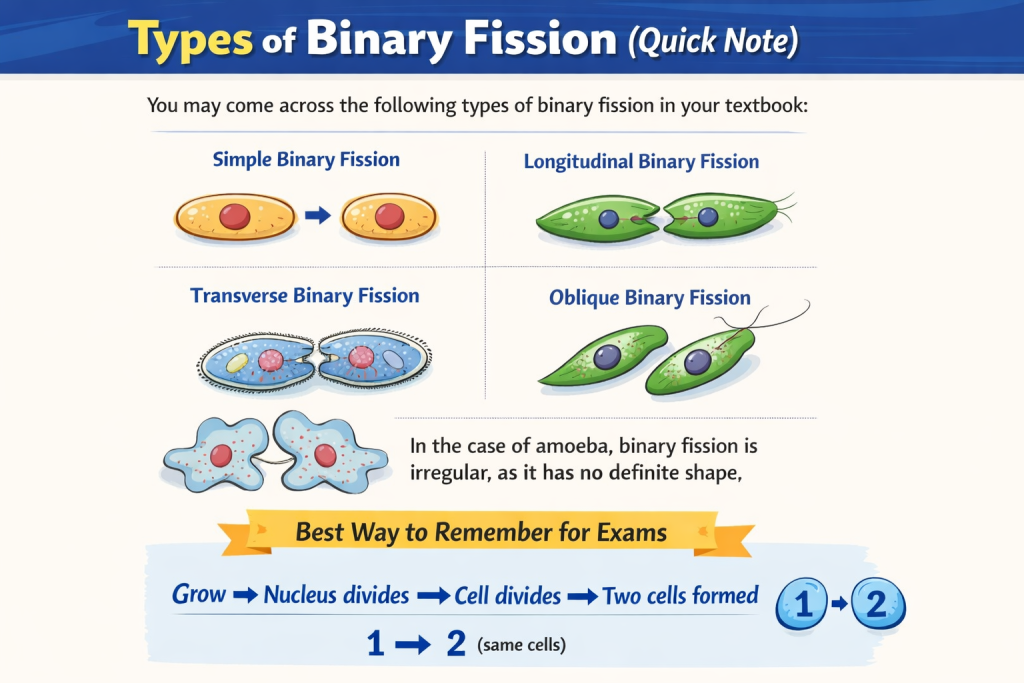
Types of Binary Fission
You may come across the following types of binary fission in your textbook:
- Simple binary fission
- Longitudinal binary fission
- Transverse binary fission
- Oblique binary fission
👉 In the case of amoeba, binary fission is irregular, as it has no definite shape.
Best Way to Remember for Exams
If you are studying for an exam, you can remember it by:
👉 Grow → Nucleus divides → Cell divides → Two cells formed
Or
👉 1 → 2 (same cells)
💡 Best Practices to Remember This Topic
- If you are finding it difficult to remember how does amoeba reproduce, here are some tips for you:
- Visualize the process of reproduction
- Draw diagrams while studying
- Connect it with real-life duplication (copy-paste)
- Use short keywords
FAQ Section
- How does amoeba reproduce?
- Amoeba reproduces asexually by a process called binary fission in amoeba, where one cell divides into two identical daughter cells.
- What is binary fission in amoeba?
- Binary fission in amoeba is a process by which a single cell of amoeba divides into two new cells of amoeba.
- How many daughter cells are formed?
- Two daughter cells are formed.
- Is reproduction in amoeba fast?
- Yes, reproduction in amoeba is fast.
Conclusion
So, now you not only know the answer to the question “How does amoeba reproduce?” but also understand it.
It might seem like a tiny subject, but when we start to explore it, it’s actually one of the easiest and most logical processes in the world of biology.
Honestly, when we start to connect it to basic terms like duplication and splitting, it’s not going anywhere!