






Introduction
Longest phase of mitosis — if you’re searching for this, you probably want the quick answer first.
Table Of Content
- Introduction
- 1. Prophase
- 2. Metaphase
- 3. Anaphase
- 4. Telophase
- Several processes happen simultaneously
- 1. Healing Injuries
- 2. Growth in Children
- 3. Cancer Research
- Mistake 1: Choosing Metaphase
- Mistake 2: Forgetting Interphase
- Mistake 3: Confusing Anaphase
- 1️⃣ Focus on process understanding
- 2️⃣ Use diagrams
- 3️⃣ Practice MCQs
👉 The longest phase of mitosis is Prophase.
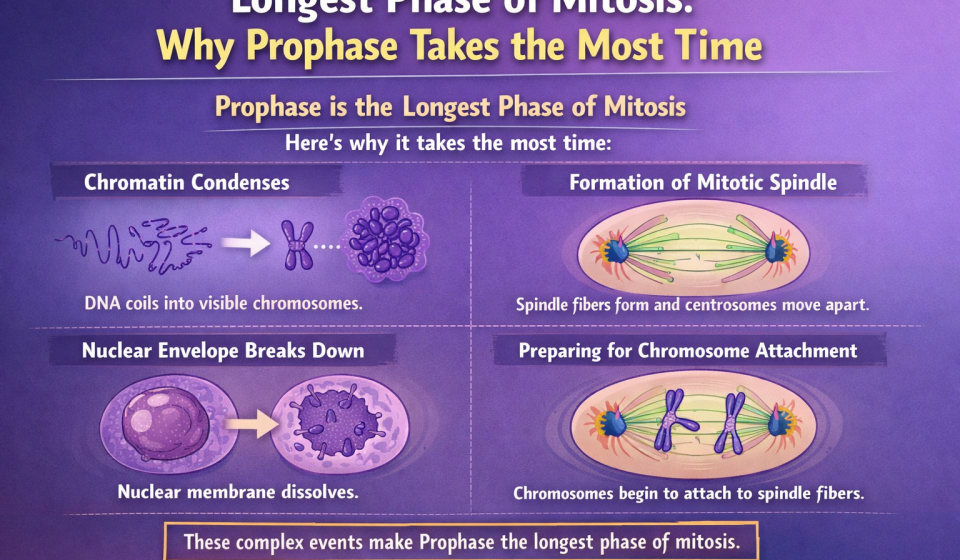
Yes, prophase is the stage where the cell spends the most time during mitosis. During this phase, chromosomes condense, the nuclear membrane begins to break down, and spindle fibers start forming to prepare the cell for division.
But here’s the interesting part. Many students memorize the answer without truly understanding why prophase takes the longest. That confusion shows up in exams, biology quizzes, and competitive tests.
If you’re preparing for school biology, NEET, or basic life science courses, understanding the stages of mitosis explained clearly will help you remember the concept forever—not just for one test.
Key Highlights 🔬
Here’s the quick overview you should remember:
- Longest phase of mitosis: Prophase
- Mitosis has four main stages
- Stages include:
- Prophase
- Metaphase
- Anaphase
- Telophase
- Prophase takes the longest time because the cell prepares chromosomes for separation.
- It involves complex processes like chromosome condensation and spindle formation.
According to cell biology research from the National Center for Biotechnology Information (NCBI), mitosis is one of the most tightly regulated processes in living organisms.
Source: NCBI
What Is Mitosis?
Before diving deeper into the longest phase of mitosis, you need to understand what mitosis actually is.
Mitosis is the process of cell division where one cell divides into two identical daughter cells.
This process is essential for:
- Growth
- Tissue repair
- Cell replacement
- Development in multicellular organisms
For example:
- When you get a cut on your skin, mitosis helps repair damaged cells.
- During childhood growth, billions of cells divide through mitosis.
Without mitosis, organisms simply could not grow or heal.
Stages of Mitosis Explained
To understand why prophase is the longest phase of mitosis, you must first know the stages of mitosis explained step by step.
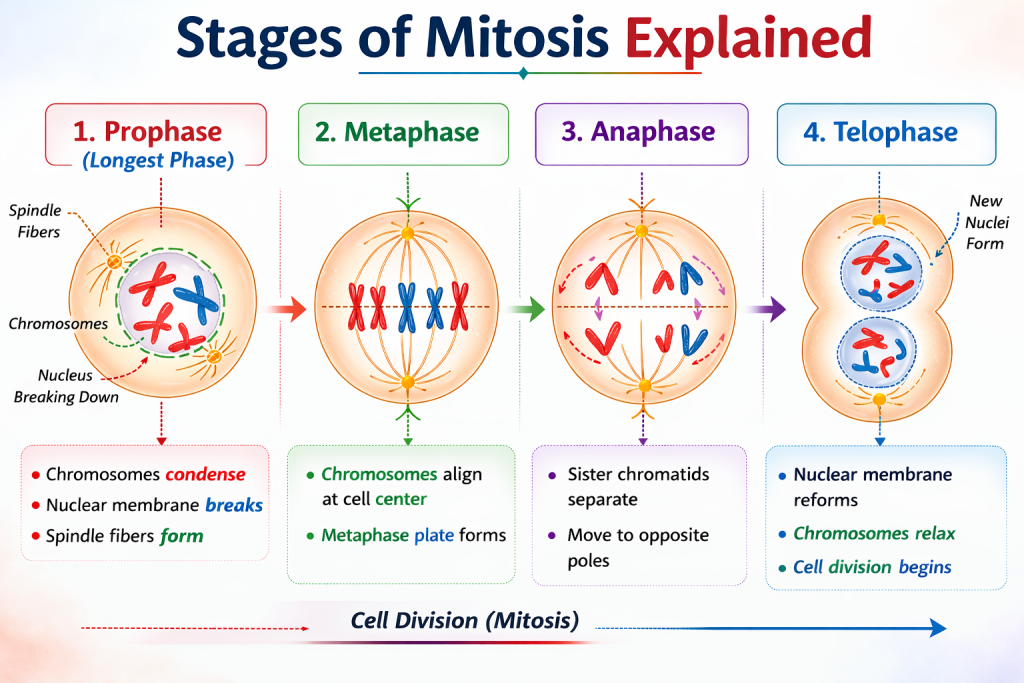
Mitosis consists of four main stages.
1. Prophase
This is the longest phase of mitosis.
Key events:
- Chromatin condenses into visible chromosomes
- Nuclear membrane starts breaking down
- Spindle fibers begin forming
- Centrosomes move to opposite poles
This stage prepares the chromosomes for separation.
Because several processes occur simultaneously, it takes the most time.
2. Metaphase
In metaphase:
- Chromosomes align at the center of the cell
- This region is called the metaphase plate
Spindle fibers attach to chromosomes to prepare them for separation.
This stage is shorter but extremely important because incorrect alignment can cause genetic errors.
3. Anaphase
During anaphase:
- Sister chromatids separate
- Chromatids move to opposite poles of the cell
This stage happens surprisingly quickly.
The cell rapidly pulls chromosomes apart using spindle fibers.
4. Telophase
Telophase is the final stage of mitosis.
During telophase:
- Nuclear membranes reform
- Chromosomes begin to relax
- The cell prepares for cytokinesis
Cytokinesis divides the cytoplasm and completes cell division.
Why Prophase Is the Longest Phase of Mitosis
Now that you understand the stages, let’s answer the real question:
👉 Why is prophase the longest phase of mitosis?
The answer lies in the complexity of events occurring in this stage.
Several processes happen simultaneously:
- Chromosomes condense from chromatin
- Nuclear membrane begins to disintegrate
- Centrosomes move to opposite poles
- Mitotic spindle starts forming
- Microtubules attach to chromosomes
Each of these steps requires careful regulation.
Cells must ensure chromosomes are properly prepared for division to prevent genetic mistakes.
Real-Life Importance of Mitosis
The stages of mitosis explained are not just textbook concepts.
They play a critical role in everyday biology.
1. Healing Injuries
When you cut your skin, cells divide rapidly to replace damaged tissue.
This happens through mitosis.
2. Growth in Children
Human bodies grow from a single fertilized egg into trillions of cells.
Every new cell comes from mitosis.
3. Cancer Research
Scientists study mitosis carefully because uncontrolled cell division leads to cancer.
Many cancer drugs target mitotic processes to stop tumor growth.
According to the National Cancer Institute, abnormal mitosis is one of the key drivers of tumor development.
Source: NCI
Memory Trick for Mitosis Stages
Students often struggle to remember the stages of mitosis.
A simple trick helps.
Remember:
PMAT
- P – Prophase
- M – Metaphase
- A – Anaphase
- T – Telophase
This abbreviation appears in many biology textbooks and exams.
Common Mistakes Students Make
Many exam questions focus on the longest phase of mitosis, but students often get confused.
Here are common mistakes.
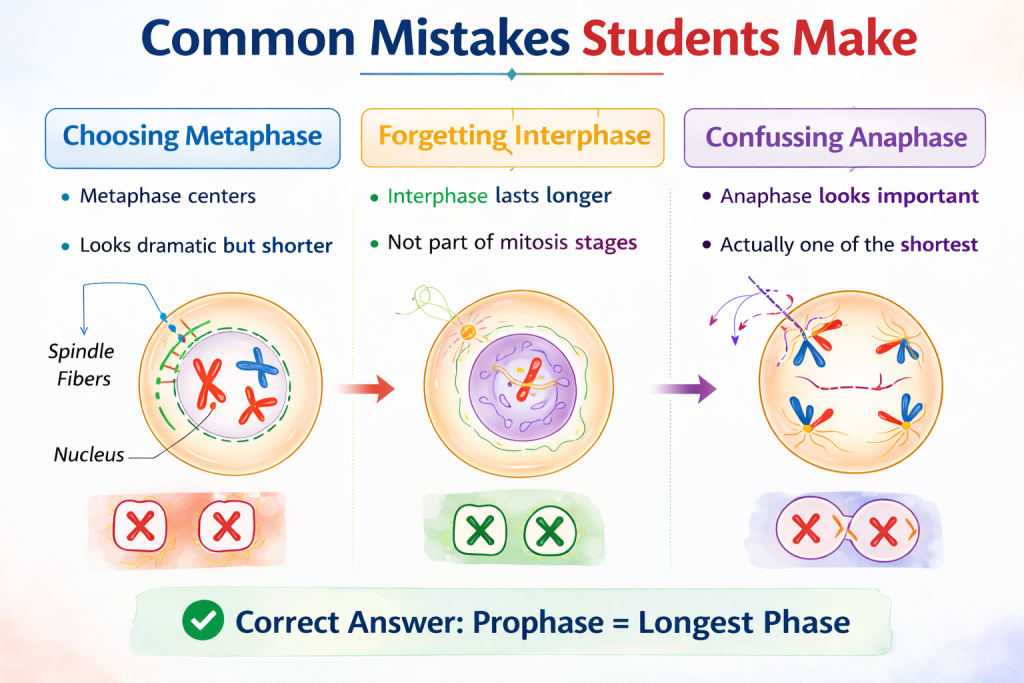
Mistake 1: Choosing Metaphase
Metaphase is visually dramatic, so students assume it lasts longer.
But it’s actually shorter.
Mistake 2: Forgetting Interphase
Interphase occurs before mitosis and lasts longer than all mitotic stages combined.
However, interphase is not part of mitosis, so it’s not the correct answer.
Mistake 3: Confusing Anaphase
Anaphase looks important, but it’s one of the shortest phases.
Chromosome separation happens quickly.
Best Study Tips for Mitosis Questions
If you’re preparing for biology exams, these strategies help.
1️⃣ Focus on process understanding
Instead of memorizing answers, understand why prophase is longest.
2️⃣ Use diagrams
Visualizing chromosome movement helps you remember stages faster.
3️⃣ Practice MCQs
Many exams ask questions like:
- Longest phase of mitosis
- Order of mitosis stages
- Functions of spindle fibers
Practicing these questions improves recall.
Internal Learning Resources
If you’re studying related biology topics, these guides can help you understand cell biology better:
- Do prokaryotes have mitochondria
- Monomers of lipids
- Lewis structure of carbonate ion
You can explore more explanations here: chennaineet
Final Answer
The longest phase of mitosis is:
✅ Prophase
This stage takes the most time because several critical processes occur, including chromosome condensation, spindle formation, and nuclear membrane breakdown.
Conclusion
At first, mitosis can feel like a list of confusing biological terms.
Prophase. Metaphase. Anaphase. Telophase.
But once you understand how each stage works, the logic becomes clear.
Prophase takes the longest because the cell prepares everything needed for chromosome separation.
Understanding this process doesn’t just help you pass exams. It also gives insight into how life grows, heals, and evolves at the cellular level.
And when you see the question again — “What is the longest phase of mitosis?” — you’ll answer it confidently.