




Milk Is an Example of a Type of Matter Called? The Simple Chemistry Explanation Every Student Should Know

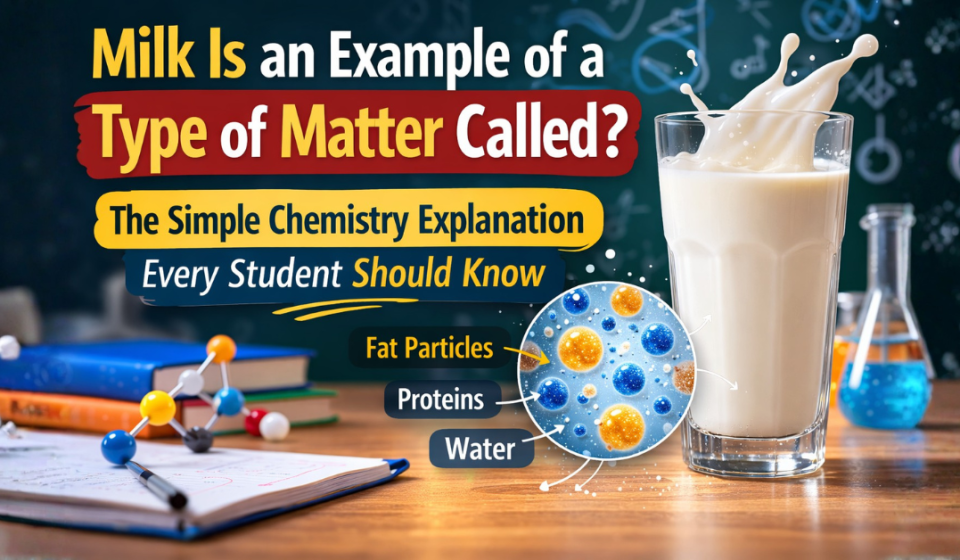
Milk is an example of a type of matter called a heterogeneous mixture.
Yes, the correct classification in chemistry is heterogeneous mixture, specifically a colloid.
Table Of Content
Students often see this question in school exams, NEET preparation, and basic chemistry quizzes:
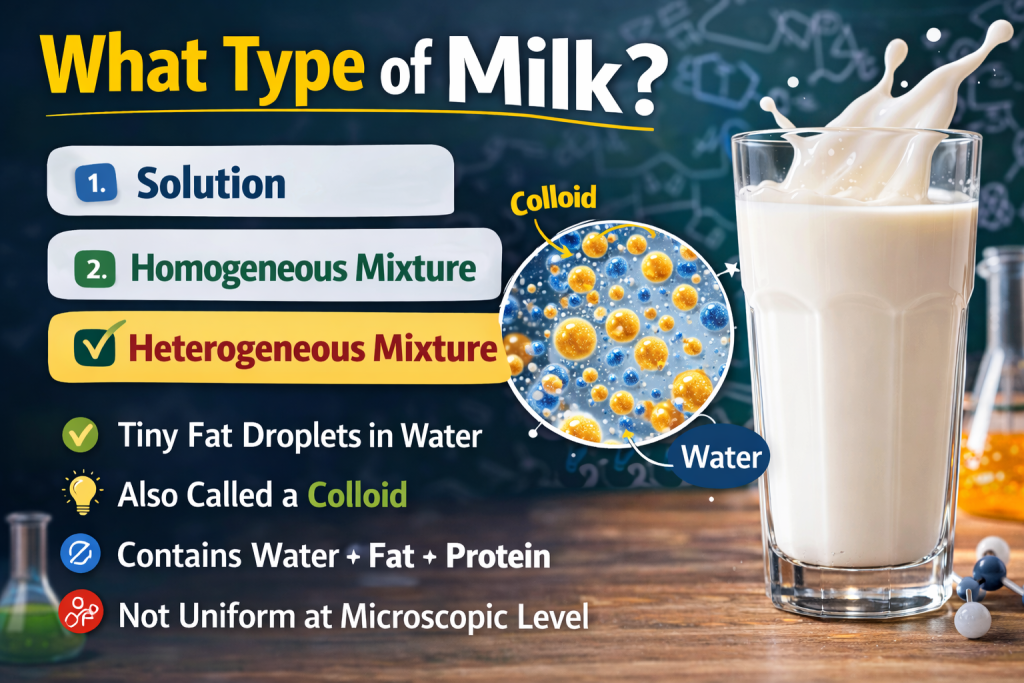
- Solution
- Homogeneous mixture
- Heterogeneous mixture
✅ Correct Answer: Heterogeneous mixture
The first thing we see about milk is that it is all one color, smooth, and seems mixed equally; however, when you look under a microscope at the molecular level, you will see a different story.
To help you understand, let’s explore the structure of Milk by breaking it down into individual particles or molecules.
🔑 Key Highlights
- Milk is an example of a type of matter called a heterogeneous mixture
- Milk is technically a colloid
- A colloid contains tiny particles dispersed in another substance
- Milk contains fat droplets, proteins, minerals, and water
- Even though milk looks uniform, it is not truly homogeneous
- This concept is important for school exams, NEET, and basic chemistry tests
What Type of Matter Is Milk?
Let’s answer the question clearly.
👉 Milk is an example of a type of matter called a heterogeneous mixture.
Why?
Because milk contains different particles that are physically mixed but not chemically combined.
Milk includes:
- Water
- Fat globules
- Proteins (casein)
- Lactose (milk sugar)
- Minerals
These components do not form a single uniform phase at the microscopic level.
Instead, tiny fat droplets remain suspended in water, creating a colloidal mixture.
Understanding the Classification of Matter
Before going deeper, it helps to understand how scientists classify matter.
Matter generally falls into two main categories:
1. Pure Substances
These contain only one type of particle.
Examples:
- Oxygen
- Gold
- Distilled water
Pure substances have fixed composition and properties.
2. Mixtures
Mixtures contain two or more substances physically combined.
Examples:
- Air
- Soil
- Milk
- Saltwater
Mixtures can be further divided into:
- Homogeneous mixtures
- Heterogeneous mixtures
Milk belongs to the second category.
Why Milk Is a Heterogeneous Mixture
Even though milk looks smooth and uniform, its internal structure tells another story.
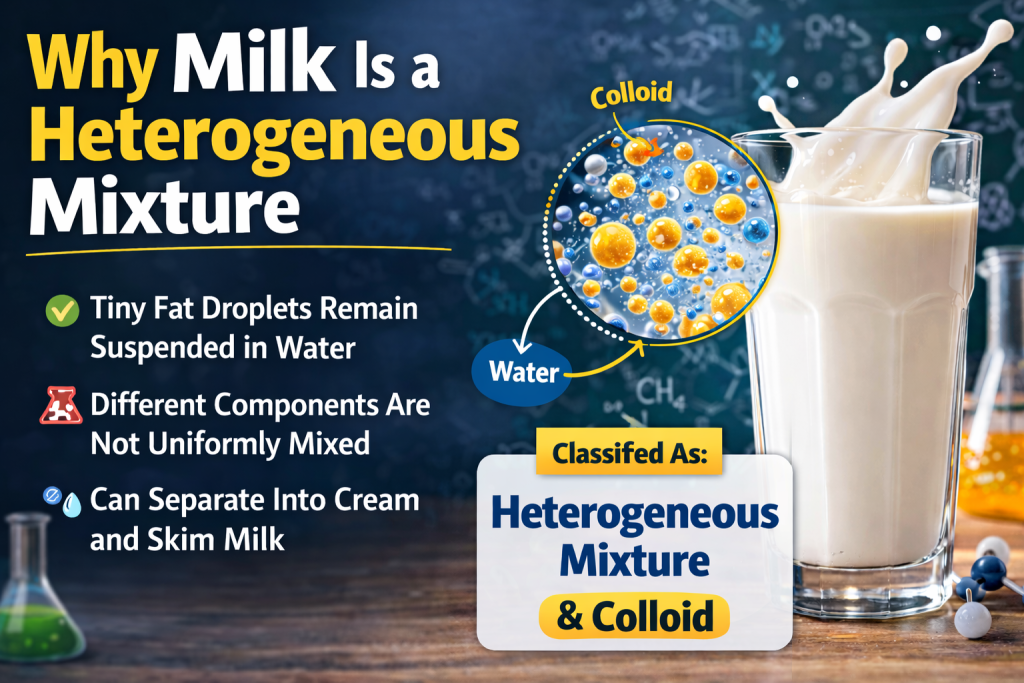
Milk contains fat globules dispersed in water.
These fat particles:
- Do not dissolve completely
- Remain suspended in liquid
- Can be separated through processes like centrifugation
Because the particles are not evenly distributed at the microscopic level, milk becomes a heterogeneous mixture.
Scientists classify milk specifically as a colloid.
What Is a Colloid?
A colloid is a special type of heterogeneous mixture.
In a colloid:
- Tiny particles are dispersed in another medium
- The particles are larger than solution particles
- They do not settle easily
Common colloids include:
| Colloid | Example |
|---|---|
| Emulsion | Milk |
| Foam | Shaving cream |
| Gel | Jelly |
| Aerosol | Smoke |
Milk is classified as an emulsion colloid, where fat droplets disperse in water.
Real-World Example: Why Milk Forms Cream
Have you ever noticed something interesting?
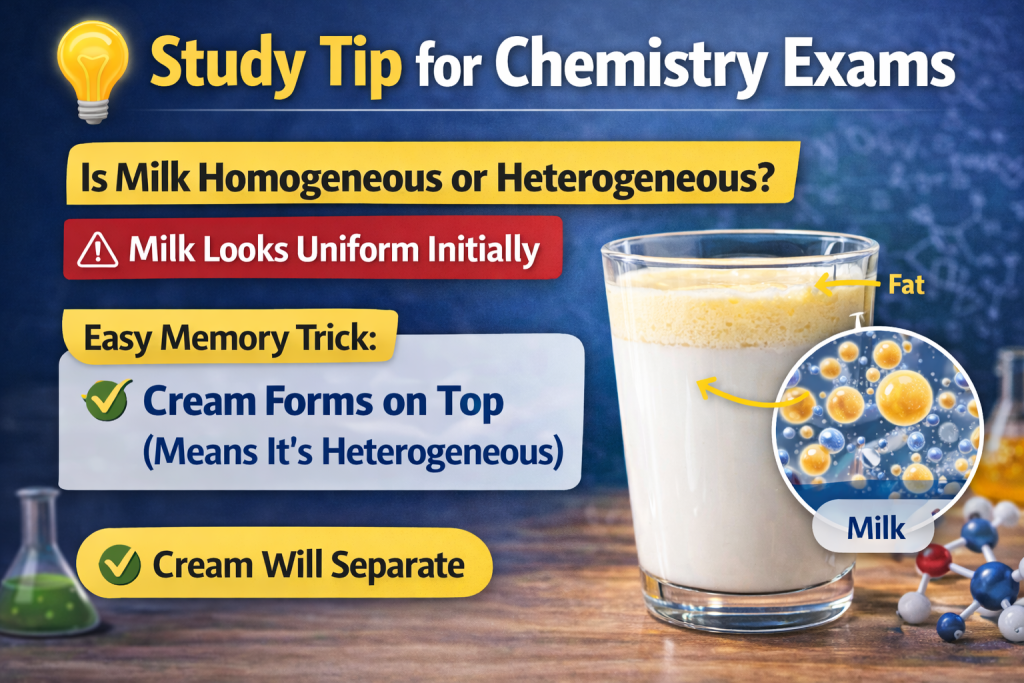
If milk sits undisturbed for some time, cream forms on top.
This happens because fat particles rise to the surface.
This behavior confirms milk is not a true solution.
In a solution:
- Particles dissolve completely
- Separation does not occur naturally
Milk behaves differently.
Its particles remain suspended but can separate under certain conditions.
The Science Behind Milk Structure
Scientists studied milk composition extensively.
According to research from the Food and Agriculture Organization (FAO) and National Dairy Council, milk contains approximately:
- 87% water
- 3–4% fat
- 3.3% protein
- 5% lactose
- 0.7% minerals
Source:
Chennaineet
These components exist in different physical states, which confirms milk is a mixture rather than a pure substance.
Common MCQ Question (Exam Pattern)
Students preparing for exams often encounter this question.
Question
Milk is an example of a type of matter called?
- Solution
- Homogeneous mixture
- Heterogeneous mixture
Correct Answer
✅ 3. Heterogeneous mixture
Explanation of Each Option
1. Solution ❌
A solution is completely uniform at the molecular level.
Example:
- Salt dissolved in water
Milk contains suspended fat particles, so it is not a solution.
2. Homogeneous Mixture ❌
A homogeneous mixture has the same composition throughout.
Examples:
- Air
- Sugar water
Milk may appear uniform but is not truly homogeneous microscopically.
3. Heterogeneous Mixture ✅
A heterogeneous mixture contains different components that are not evenly distributed.
Milk fits this description because fat globules remain suspended in water.
Real-Life Uses of Colloid Science
Understanding why milk is an example of a type of matter called a heterogeneous mixture actually connects to real industries.
Several industries rely on colloid science.
Dairy Industry
Milk processing techniques include:
- Homogenization
- Pasteurization
- Cream separation
Homogenization breaks fat droplets into smaller particles, preventing cream separation.
Food Technology
Many foods behave like milk colloids.
Examples include:
- Ice cream
- Butter
- Mayonnaise
- Yogurt
Food scientists control particle sizes to improve texture and stability.
Pharmaceutical Industry
Medicine formulations also use colloids.
Examples:
- Drug suspensions
- Vaccines
- Protein solutions
Understanding mixture types helps scientists design stable medicines.
Study Tip for Chemistry Exams
Students often feel confused when answering:
“Milk is an example of which type of matter?”
A simple trick helps remember the answer.
Quick Memory Rule
Think about cream formation.
If a mixture can separate into layers over time, it is not truly homogeneous.
Milk eventually forms cream.
So it must be heterogeneous.
Best Practices for Remembering This Concept
When studying chemistry classification questions, follow these tips.
1. Look Beyond Appearance
Some mixtures look uniform but are not.
Milk is the perfect example.
2. Understand Particle Behavior
Ask:
- Do particles dissolve completely?
- Can they separate later?
If separation is possible, the mixture is likely heterogeneous.
3. Remember Colloid Examples
Common colloids include:
- Milk
- Fog
- Butter
- Jelly
Memorizing these examples helps solve many exam questions.
Related Chemistry Topics
To strengthen your understanding, explore related concepts.
Recommended reading:
- Classification of matter
- Difference between mixtures and compounds
- Homogeneous vs heterogeneous mixtures
- Colloids and suspensions
These topics build the foundation for higher-level chemistry learning.
Authoritative learning resources:
These educational platforms explain chemistry concepts clearly with diagrams and examples.
Quick Summary
Let’s recap the main idea.
- Milk contains water, fat, proteins, and minerals
- These components are physically mixed
- Fat droplets remain suspended in water
- This structure forms a colloid
- Colloids are classified as heterogeneous mixtures
✅ Therefore:
Milk is an example of a type of matter called a heterogeneous mixture.
Final Thoughts
Chemistry questions sometimes look simple but hide deeper concepts. Many students initially believe milk is homogeneous because it looks uniform.
But once you understand colloids and particle behavior, the answer becomes clear.
Next time someone asks:
“Milk is an example of which type of matter?”
You will confidently answer:
⭐ Heterogeneous mixture (colloid)
And that small concept builds a strong foundation for understanding mixtures, solutions, and material science in chemistry.