







Introduction
Largest countries in the world — largest countries in the world — if that’s the exact question you searched for, here’s the clear answer immediately.
Table Of Content
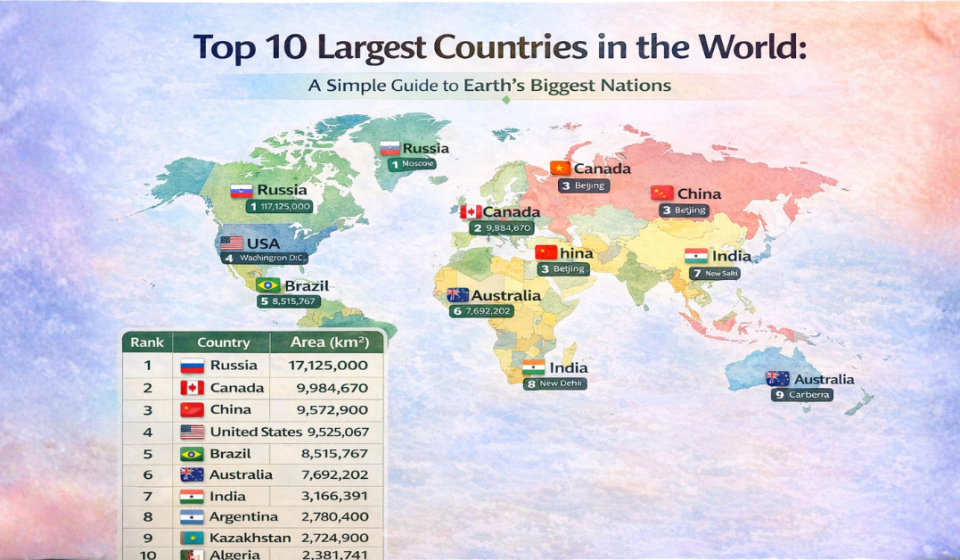
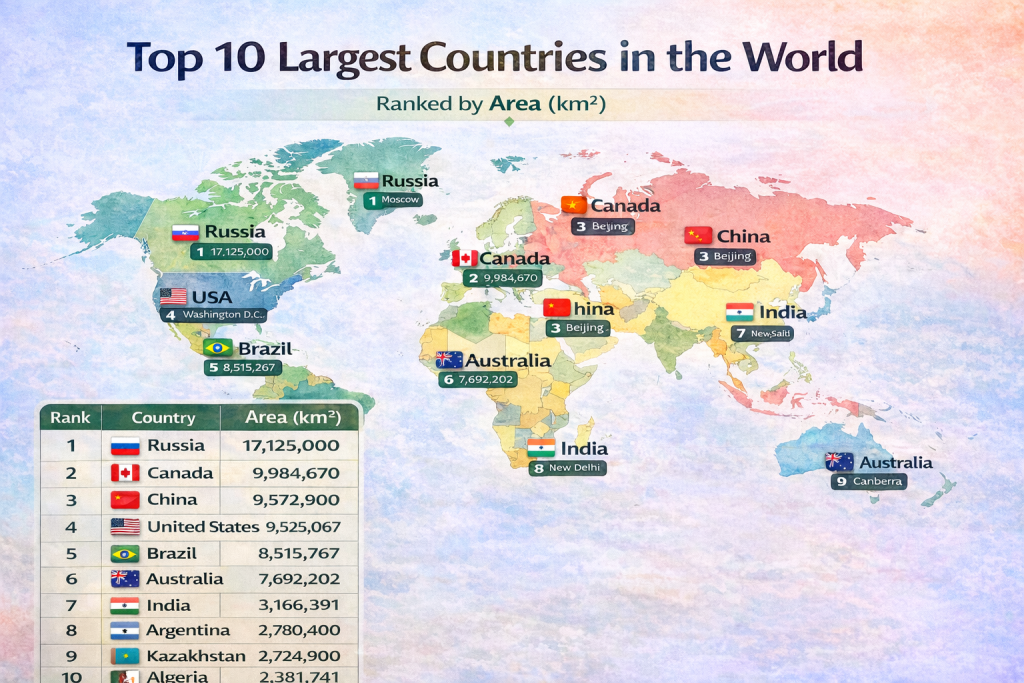
The top 10 largest countries in the world by total land area are:
- Russia
- Canada
- China
- United States of America
- Brazil
- Australia
- India
- Argentina
- Kazakhstan
- Algeria
These nations dominate the planet’s landmass and play major roles in global geography, economics, and environmental diversity.
When looking at a world map, these countries seem large due to their size but most are large because they have access to many different types of natural resources, climates, and ecosystems, as well as geopolitical significance because of their geographic locations. Students search this…
You can explore more learning resources here:
Key Highlights 🌍
Before diving deeper, here’s a quick overview of the top 10 largest countries in the world.
| Rank | Country | Area (km²) | Capital City |
|---|---|---|---|
| 1 | Russia | 17,125,000 | Moscow |
| 2 | Canada | 9,984,670 | Ottawa |
| 3 | China | 9,572,900 | Beijing |
| 4 | United States | 9,525,067 | Washington, D.C. |
| 5 | Brazil | 8,515,767 | Brasília |
| 6 | Australia | 7,692,202 | Canberra |
| 7 | India | 3,166,391 | New Delhi |
| 8 | Argentina | 2,780,400 | Buenos Aires |
| 9 | Kazakhstan | 2,724,900 | Astana (Nur-Sultan) |
| 10 | Algeria | 2,381,741 | Algiers |
📊 These numbers are based on geographic estimates collected by global organizations such as the United Nations Statistics Division and international geographic surveys.
Understanding the World’s Land Distribution
To understand the largest countries in the world, it helps to look at Earth’s geography first.
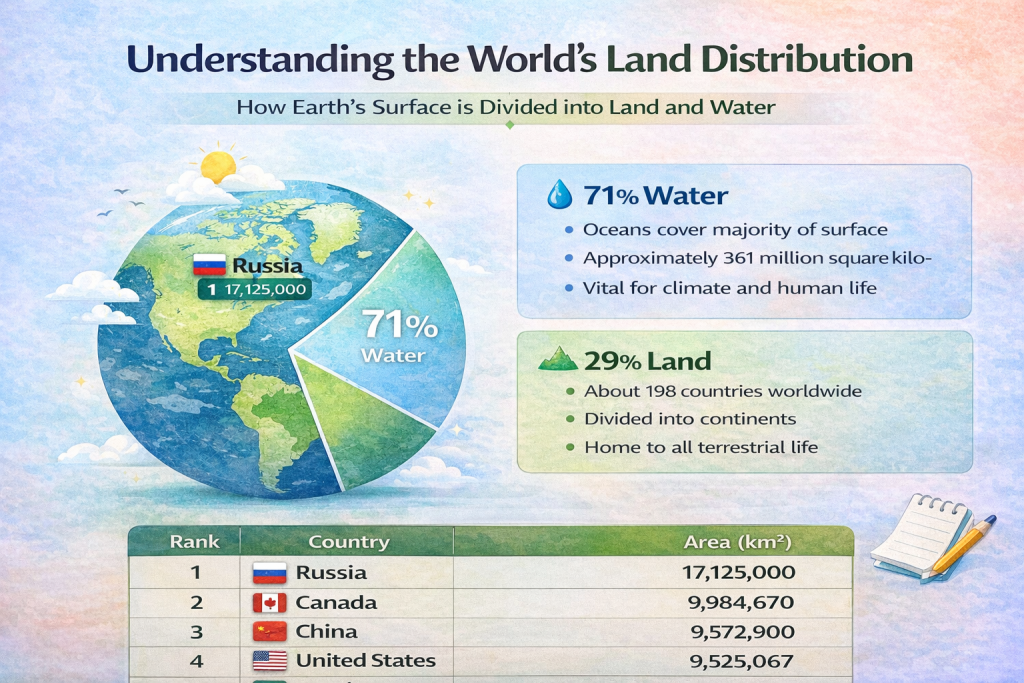
Earth’s surface is divided into:
- 71% water
- 29% land
That landmass is divided into about 198 countries worldwide.
Geographical boundaries delineate the physical extent of a nation. They are visible indicators of the total area of a country and how extensive the land mass encompasses. The size and shape of certain national borders naturally change through geological processes (e.g. tectonic plate shifting and land displacement) or by the result of human activities (e.g. war or revolution) over time. Therefore, it may be observed that the geography of nations can be subject to change significantly over time.
This is why experts periodically update the rankings of the top 10 largest countries in the world.
Top 10 Largest Countries in the World (Detailed Explanation)
Let’s explore each of the largest countries in the world and what makes them unique.
1. Russia – The Largest Country in the World
Area: 17,125,000 km²
Capital: Moscow
Russia is by far the largest country in the world, covering more than 11% of Earth’s land area.
It stretches across two continents:
- Europe
- Asia
Because of this vast size, Russia has 11 different time zones.
Interesting facts:
- Home to the world’s largest forest, the Siberian Taiga
- Contains enormous oil and natural gas reserves
- Experiences extremely cold climates in many regions
Russia’s massive size plays a major role in global politics and energy supply.
2. Canada – The Second Largest Country
Area: 9,984,670 km²
Capital: Ottawa
Canada ranks second among the top 10 largest countries in the world.
Despite its huge area, Canada has a relatively small population compared to many countries.
Why?
Large portions of Canada are covered by:
- Arctic regions
- Dense forests
- Frozen tundra
Canada also contains about 20% of the world’s freshwater supply, according to global environmental studies.
3. China – Third Largest Country
Area: 9,572,900 km²
Capital: Beijing
China is the third largest country in the world and one of the most influential economies globally.
China’s landscape includes:
- Deserts
- Mountains
- Rivers
- Plains
It is also the most populous country on Earth for decades, although recent estimates suggest India has slightly surpassed it.
China’s size contributes significantly to its agricultural and industrial capabilities.
4. United States of America – Fourth Largest Country
Area: 9,525,067 km²
Capital: Washington, D.C.
The United States ranks fourth among the largest countries in the world.
The country features diverse geography, including:
- Rocky Mountains
- Great Plains
- Deserts
- Forests
- Coastlines
Because of its size and resources, the United States has become one of the largest economies and technological leaders globally.
5. Brazil – Largest Country in South America
Area: 8,515,767 km²
Capital: Brasília
Brazil is the largest country in South America.
It contains one of the planet’s most important ecosystems:
🌳 The Amazon Rainforest
The Amazon:
- Produces significant oxygen
- Supports millions of species
- Plays a major role in global climate regulation
Brazil’s massive land area supports agriculture, biodiversity, and natural resources.
6. Australia – The Smallest Continent and Sixth Largest Country
Area: 7,692,202 km²
Capital: Canberra
Australia is unique because it is both:
- A country
- A continent
Despite being one of the largest countries in the world, much of Australia consists of deserts.
Yet it remains famous for:
- Unique wildlife
- Rich mineral resources
- Vast coastal ecosystems
7. India – Seventh Largest Country
Area: 3,166,391 km²
Capital: New Delhi
India ranks seventh among the top 10 largest countries in the world.
Although smaller than the countries above it, India has an enormous population and rapidly growing economy.
India’s geography includes:
- Himalayan mountains
- River plains
- Tropical forests
- Deserts
India’s land area supports over 1.4 billion people, making it one of the most densely populated major countries.
8. Argentina – Eighth Largest Country
Area: 2,780,400 km²
Capital: Buenos Aires
Argentina is the second largest country in South America.
It includes diverse landscapes such as:
- Andes Mountains
- Pampas grasslands
- Patagonia region
Argentina is known for agriculture, particularly beef and grain production.
9. Kazakhstan – Ninth Largest Country
Area: 2,724,900 km²
Capital: Astana (Nur-Sultan)
Kazakhstan is the largest landlocked country in the world.
Despite its massive area, much of Kazakhstan is made up of steppe and desert regions.
The country also has large reserves of:
- Oil
- Uranium
- Natural gas
10. Algeria – Tenth Largest Country
Area: 2,381,741 km²
Capital: Algiers
Algeria is the largest country in Africa.
Much of its territory lies within the Sahara Desert, the largest hot desert on Earth.
Despite its desert environment, Algeria remains rich in natural resources such as oil and gas.
Why the List of Largest Countries Can Change
You might wonder why geographic rankings sometimes change.
Earth is constantly evolving.
Factors that influence country size include:
- Tectonic plate movement
- Coastal erosion
- Political boundary changes
- Land reclamation projects
Although these changes are usually small, they can slightly affect the rankings of the largest countries in the world over time.
Real-World Importance of Large Countries
Being among the top 10 largest countries in the world provides several advantages:
Natural resources
Large countries often have vast deposits of minerals, forests, and freshwater.
Climate diversity
A bigger land area allows multiple ecosystems and agricultural zones.
Strategic influence
Large territories often lead to greater geopolitical influence.
For example:
- Russia’s energy reserves
- Canada’s freshwater resources
- Brazil’s rainforest biodiversity
These resources impact global environmental and economic systems.
Internal Learning Resources
If you’re exploring more educational topics, you may also find these guides helpful:
- Which of the following needs a proof?
- Longest phase of mitosis
- Derivative of a fraction
You can explore more learning resources here:
Final Answer
The top 10 largest countries in the world by area are:
- Russia
- Canada
- China
- United States
- Brazil
- Australia
- India
- Argentina
- Kazakhstan
- Algeria
These countries occupy the greatest land area on Earth and play important roles in global geography, economy, and environment.
Conclusion
When you look at a world map, it’s easy to notice the largest countries in the world, but their importance goes far beyond size.
Large nations influence:
- Climate systems
- Global resources
- Economic development
- International politics
Understanding the top 10 largest countries in the world helps you see how geography shapes the modern world.
And the next time someone asks which countries dominate Earth’s landmass, you’ll know exactly how to answer.