






To learn how atoms form chemical bonds in chemistry one needs to understand the concept of valence electrons. There is one question that is often asked in beginning chemistry, what is the number of valence electrons in hydrogen.
Table Of Content
- Understanding Valence Electrons
- Importance of Valence Electrons
- Hydrogen in the Periodic Table
- Basic Properties of Hydrogen
- Electron Configuration of Hydrogen
- Step-by-Step Explanation
- Step 1: Identify the atomic number
- Step 2: Write the electron configuration
- Step 3: Determine the outermost shell
- Step 4: Count the electrons in the outer shell
- Final Answer
- Additional Notes
- Subshell Structure of Atomic Shells
- Importance of Hydrogen’s Valence Electron
Hydrogen is the simplest element on the periodic table and is involved in many different types of chemical reactions and compounds. By looking at hydrogen’s electron configuration and its atomic structure we can determine how many valence electrons it has.
Valence electrons are the outermost shell of the atom and are responsible for forming bonds and determining whether the atom is chemically reactive or not.
If you want more chemistry explanations and solved science questions, you can explore helpful resources at chennaineet.
Understanding Valence Electrons
Atoms consist of electrons arranged in shells or energy levels around the nucleus. These shells are labeled as:
- K shell (1st shell)
- L shell (2nd shell)
- M shell (3rd shell)
- N shell (4th shell)
Each shell can contain different subshells such as:
- s
- p
- d
- f
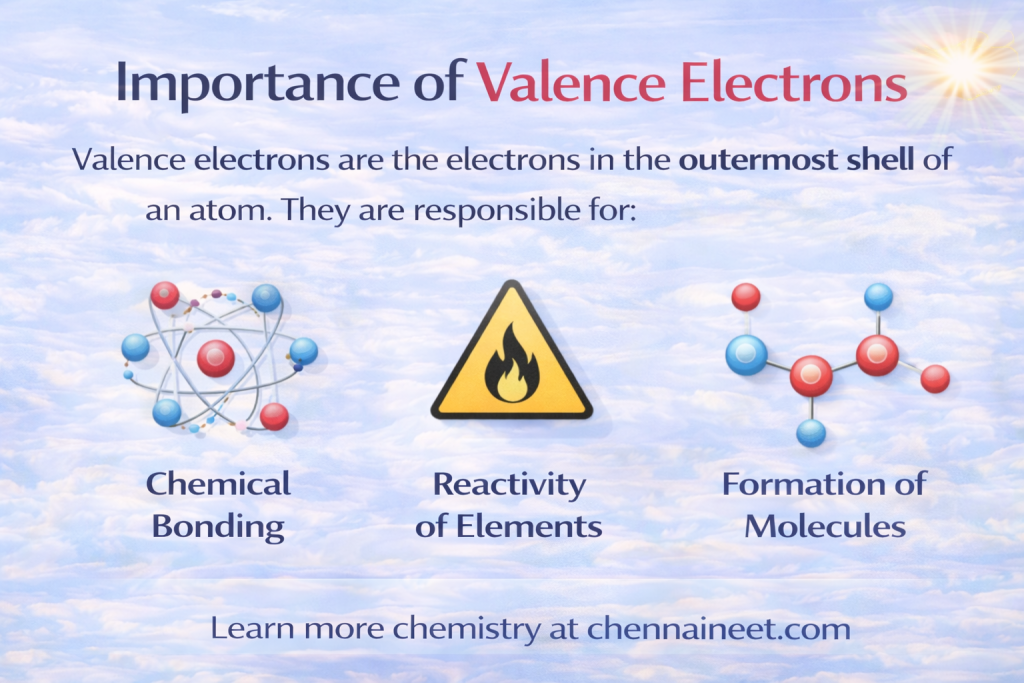
The outermost shell of an atom is called the valence shell, and the electrons present in this shell are called valence electrons.
Importance of Valence Electrons
Valence electrons determine:
- Chemical bonding
- Reactivity of elements
- Formation of molecules
Hydrogen in the Periodic Table
Hydrogen is the first element in the periodic table.
Basic Properties of Hydrogen
- Atomic number: 1
- Symbol: H
- Number of protons: 1
- Number of electrons: 1
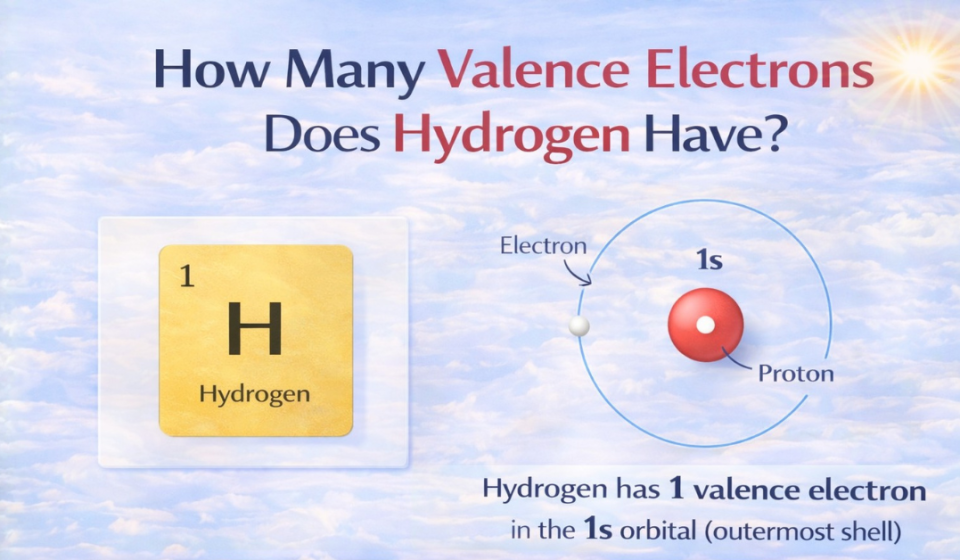
Since hydrogen has only one electron, it occupies the first energy shell (K shell).
Electron Configuration of Hydrogen
Electron configuration shows how electrons are arranged in shells.
For hydrogen:
Electron configuration = 1s¹
This means:
- The first shell (1s orbital) contains one electron.
Since this electron is in the outermost shell, it is the valence electron.
Step-by-Step Explanation
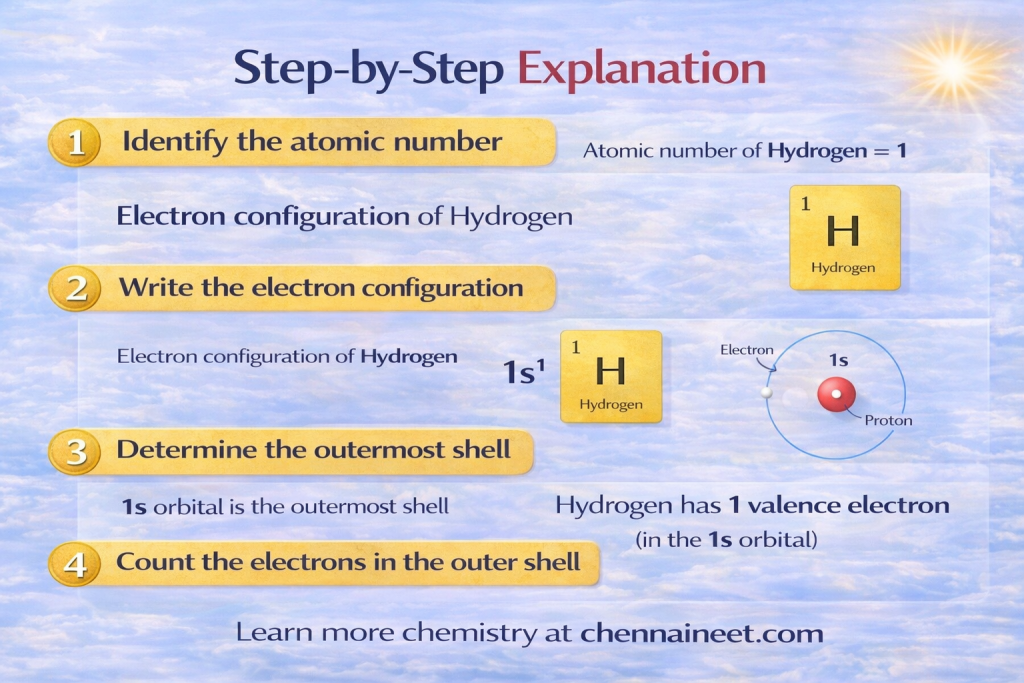
Step 1: Identify the atomic number
Hydrogen has an atomic number of 1, meaning it contains 1 electron.
Step 2: Write the electron configuration
Electron configuration of hydrogen:
1s¹
Step 3: Determine the outermost shell
The 1s orbital is the outermost shell in hydrogen.
Step 4: Count the electrons in the outer shell
There is only one electron in the 1s orbital.
Therefore, hydrogen has one valence electron.
Final Answer
Hydrogen has 1 valence electron.
This electron is present in the 1s orbital, which is the outermost shell of the hydrogen atom.
Additional Notes
Subshell Structure of Atomic Shells
Different shells contain different subshells:
- K shell: s
- L shell: s, p
- M shell: s, p, d
- N shell: s, p, d, f
The total number of valence electrons is the number of electrons present in the outermost shell.
Importance of Hydrogen’s Valence Electron
Because hydrogen has one valence electron, it can:
- Form single covalent bonds
- Participate in many chemical reactions
- Form molecules such as H₂, H₂O, and CH₄
Understanding valence electrons helps explain chemical bonding and molecular structure.
For more chemistry explanations and exam preparation materials, visit chennaineet.