






Introduction
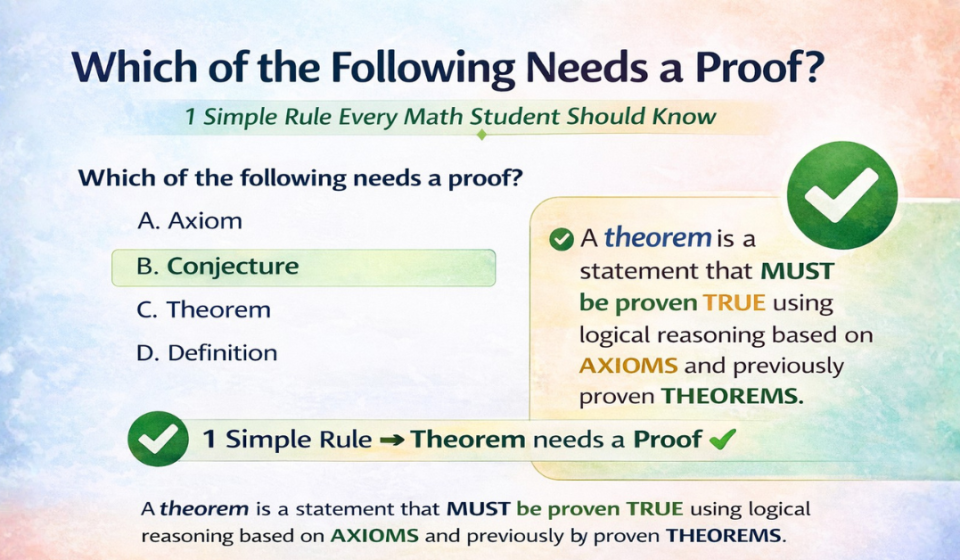
Which of the following needs a proof?
Table Of Content
- Introduction
- Quick comparison
- 1. Axiom (Accepted Without Proof)
- 2. Definition (Meaning of a Term)
- 3. Conjecture (Statement Waiting for Proof)
- 4. Theorem (Requires Proof)
- 1. Computer Science
- 2. Engineering
- 3. Cryptography
- Remember this sequence
- Question
- Solution
- Correct Answer
- Mistake 1: Choosing Axiom
- Mistake 2: Choosing Definition
- Mistake 3: Confusing Conjecture and Theorem
- 1️⃣ Understand concepts, not just answers
- 2️⃣ Study mathematical structure
- 3️⃣ Practice proofs
- 4️⃣ Use diagrams and examples
If you’re searching for this question, you’re likely preparing for a mathematics exam or trying to understand a basic concept in geometry or logic. Let’s answer the question immediately.
👉 The correct answer is: Theorem.
A theorem is a mathematical statement that requires proof using logical reasoning, axioms, and previously proven results.
In contrast:
- Axioms are accepted as true without proof
- Definitions explain the meaning of terms
- Conjectures are statements believed to be true but not yet proven
Many students feel confused when they first encounter the difference between these concepts. If that sounds familiar, you’re not alone. Understanding the difference between axiom vs theorem vs definition is one of the foundations of mathematics.
This guide breaks it down in the simplest way possible so you can remember it for exams and actually understand how mathematical logic works.
Key Highlights 📌
Here’s the quick answer and concept overview:
- Question: Which of the following needs a proof?
- Correct answer: Theorem
Quick comparison
| Mathematical Term | Needs Proof? | Description |
|---|---|---|
| Axiom | ❌ No | Accepted truth |
| Definition | ❌ No | Explains meaning |
| Conjecture | ❓ Not yet | Statement awaiting proof |
| Theorem | ✅ Yes | Proven statement |
Once you understand the difference between axiom vs theorem vs definition, many math concepts suddenly become much clearer. more information NCERT Physics
Understanding Mathematical Statements
Mathematics is not just about numbers. It’s also about logical reasoning and structured knowledge.
Every mathematical theory is built like a building:
- Definitions give meaning to terms
- Axioms provide starting truths
- Theorems are proven statements derived from those truths
This structured approach is what makes mathematics reliable and universal.
According to the American Mathematical Society, mathematical proofs ensure that results are logically valid and universally accepted.
Source: AMS
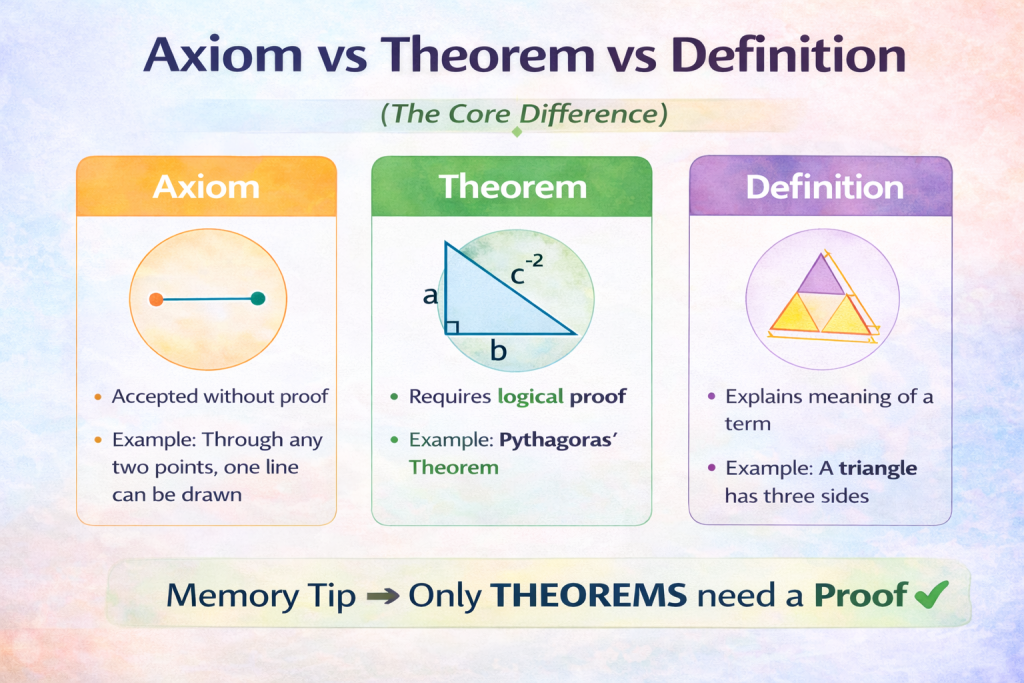
Axiom vs Theorem vs Definition (The Core Difference)
Many exam questions rely on understanding the difference between axiom vs theorem vs definition.
Let’s break them down clearly.
1. Axiom (Accepted Without Proof)
An axiom is a statement assumed to be true without proof.
These statements serve as the foundation of mathematics.
Example:
Through two distinct points, exactly one straight line can be drawn.
This statement is accepted as true in Euclidean geometry.
Why no proof?
Because axioms are starting assumptions.
They cannot be proven using earlier statements because they come first.
2. Definition (Meaning of a Term)
A definition explains what something means.
Definitions do not need proof because they simply describe a concept.
Example:
A triangle is a polygon with three sides.
This is not something you prove.
It is simply the agreed meaning of the word triangle.
Definitions help mathematicians communicate clearly.
3. Conjecture (Statement Waiting for Proof)
A conjecture is a mathematical statement that appears true but has not been proven yet.
Example:
Goldbach’s Conjecture
Every even number greater than 2 can be expressed as the sum of two primes.
This conjecture has been tested for millions of numbers but still lacks a formal proof.
Once a conjecture is proven, it becomes a theorem.
4. Theorem (Requires Proof)
Now we reach the most important concept.
A theorem is a statement that must be proven using logical reasoning.
This answers the question:
👉 Which of the following needs a proof?
The answer is:
✅ Theorem
Example:
Pythagoras’ Theorema2+b2=c2
This theorem required mathematical proof before it was accepted.
Why Proof Is Essential in Mathematics
You might wonder:
Why not just assume statements are true?
Because mathematics requires certainty and logical consistency.
Proof ensures:
- Statements are logically valid
- Results work universally
- Mathematical systems remain consistent
Without proofs, mathematics would become unreliable.
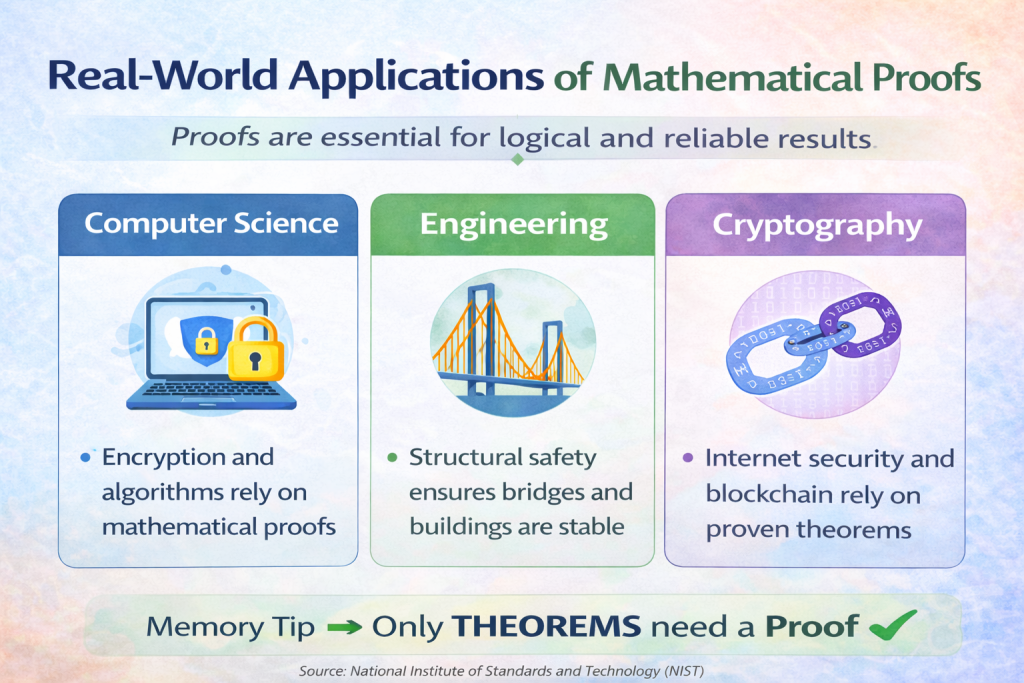
Real-World Applications of Mathematical Proofs
Mathematical proofs might seem theoretical, but they influence real-world technologies.
1. Computer Science
Algorithms rely on proven mathematical principles.
Sorting algorithms, encryption systems, and data structures all depend on mathematical proofs.
2. Engineering
Structural engineers use proven formulas to ensure bridges and buildings remain stable.
Without proven theorems, structures could fail.
3. Cryptography
Modern internet security relies heavily on mathematical proofs.
For example:
- RSA encryption
- Blockchain algorithms
These systems depend on proven number theory results.
According to the National Institute of Standards and Technology (NIST), mathematical proofs underpin many cryptographic protocols.
Source: NIST
Simple Memory Trick for Exams
Students often mix up axiom vs theorem vs definition during tests.
Here’s an easy trick.
Remember this sequence:
Definition → Axiom → Theorem
Meaning:
- Define terms
- Accept basic truths
- Prove new statements
Another simple rule:
👉 Theorems always require proof
Example MCQ Explanation
Let’s look at the typical exam question.
Question
Which of the following needs a proof?
A. Axiom
B. Conjecture
C. Theorem
D. Definition
Solution
- Axiom: accepted without proof
- Definition: explains meaning
- Conjecture: not proven yet
- Theorem: requires proof
Correct Answer
✅ C. Theorem
Common Mistakes Students Make
When answering this question, students often confuse terms.
Here are common errors.
Mistake 1: Choosing Axiom
Students think axioms require proof.
They do not.
Axioms are accepted starting points.
Mistake 2: Choosing Definition
Definitions simply explain meaning.
They are not statements needing proof.
Mistake 3: Confusing Conjecture and Theorem
A conjecture becomes a theorem only after proof.
Best Practices for Learning Mathematical Logic
If you want to master mathematical reasoning, follow these strategies.
1️⃣ Understand concepts, not just answers
Memorizing answers helps temporarily, but understanding concepts helps long term.
2️⃣ Study mathematical structure
Focus on how definitions, axioms, and theorems connect.
3️⃣ Practice proofs
Learning simple proofs strengthens logical thinking.
4️⃣ Use diagrams and examples
Visual explanations help reinforce mathematical ideas.
Internal Learning Resources
If you’re studying mathematics and science topics, these related guides can help deepen your understanding:
- Longest phase of mitosis
- Z value for confidence intervals
- Derivative of a fraction
You can explore more educational explanations here: chennaineet
Final Answer
The correct answer to the question:
Which of the following needs a proof?
is:
✅ Theorem
A theorem must be proven using logical reasoning based on axioms, definitions, and previously proven theorems.
Conclusion
Mathematics is often described as the language of logic. Once you understand how concepts like axioms, definitions, conjectures, and theorems fit together, the subject becomes much easier to navigate.
The key takeaway is simple.
A theorem requires proof.
Everything else supports that proof—definitions clarify terms, axioms provide starting points, and conjectures raise questions waiting for answers.
When you see this exam question again, you won’t hesitate.
You’ll know the answer instantly.