





In biology and biochemistry, students often learn about biopolymers such as proteins, nucleic acids, and carbohydrates. These molecules are essential for life and are formed by linking together smaller units called monomers. This raises an important question often asked in biology classes:
Table Of Content
- Understanding Polymers and Biopolymers
- Examples of Biopolymers
- Understanding Lipids
- Concept of Dehydration Reaction
- Step-by-Step Explanation: Why Lipids Are Not Polymers
- Step 1: Understand polymer structure
- Step 2: Examine lipid structure
- Step 3: Identify the absence of monomers
- Step 4: Understand structural limitation
- Final Answer
- Additional Notes
- Functions of Lipids
Why are lipids not considered polymers?
Although lipids are large and complex biological molecules, they differ from true polymers in their structure and formation process. Lipids include substances such as fats, oils, waxes, and certain vitamins, and they play an important role in energy storage and cell structure.
Understanding why lipids are not classified as polymers helps students better understand biomolecules and their functions. If you want more educational explanations and solved biology questions, you can explore useful resources at chennaineet.
Understanding Polymers and Biopolymers
A polymer is a large molecule made up of repeating smaller units called monomers. These monomers are chemically bonded together to form long chains.
Examples of Biopolymers
Biopolymers are natural polymers produced by living organisms. The three main types include:
- Polynucleotides – polymers of nucleotides (DNA and RNA)
- Polypeptides – polymers of amino acids (proteins)
- Polysaccharides – polymers of sugar molecules (carbohydrates like starch and cellulose)
In these molecules, monomers repeat many times to form a long chain structure.
Understanding Lipids
Lipids are a group of biological molecules that contain hydrocarbon chains and are generally insoluble in water.
Examples of lipids include:
- Fats
- Oils
- Waxes
- Steroids
- Fat-soluble vitamins (A, D, E, and K)
Most lipids are made from:
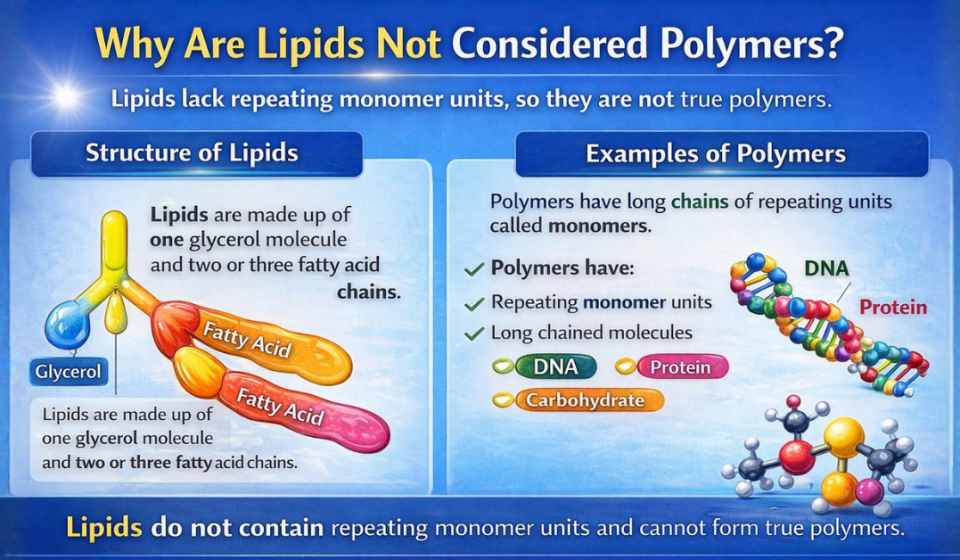
- One glycerol molecule
- Two or three fatty acid chains
These components combine through a chemical reaction called dehydration synthesis.
Concept of Dehydration Reaction
In a dehydration reaction, two molecules combine to form a larger molecule by removing:
- One hydrogen (H) from one molecule
- One hydroxyl group (OH) from another molecule
This produces one molecule of water (H₂O).
This process is common in biological molecule formation.
However, the structure formed in lipids does not produce long repeating chains of identical monomers, which is a key feature of polymers.
Step-by-Step Explanation: Why Lipids Are Not Polymers
Step 1: Understand polymer structure
A polymer consists of repeating monomer units that link together to form a long chain.
Examples include:
- Amino acids forming proteins
- Nucleotides forming DNA
- Glucose forming polysaccharides
Step 2: Examine lipid structure
Lipids are formed from:
- One glycerol molecule
- Two or three fatty acid chains
This structure does not involve repeating identical monomers.
Step 3: Identify the absence of monomers
Since lipids do not have repeating monomer units, they cannot form a true polymer chain.
Step 4: Understand structural limitation
Unlike polymers, lipids have a fixed structure.
For example:
- One glycerol molecule attaches to two or three fatty acids
- This structure cannot extend indefinitely like polymer chains.
Final Answer
Lipids are not considered polymers because they do not contain repeating monomer units.
Instead, lipids are formed when glycerol molecules combine with fatty acids, creating structures such as fats and oils. Since there are no repeating monomer units forming long chains, lipids cannot be classified as polymers.
Additional Notes
Lipids are extremely important biological molecules even though they are not polymers.
Functions of Lipids
Lipids play several important roles in living organisms:
- Energy storage
- Formation of cell membranes
- Insulation and protection
- Hormone production
Examples of lipid molecules include:
- Triglycerides
- Phospholipids
- Cholesterol
For instance, cholesterol is an example of a lipid that does not contain repeating monomers.
Understanding the structure of lipids helps students learn how cells store energy and build membranes.
For more educational explanations, solved biology questions, and exam preparation resources, visit chennaineet.