






Different representation of numbers, whether through definitions or images, allow students to see the value of numbers through the areas of how numbers are arranged and what digits are present in a number.
Table Of Content
The Generalised Form is a way to represent a number as a collection of its digits multiplied by their associated place value to give students a better understanding of how a number is built up by groups of ten (units), hundredths (tens), thousands (hundreds) and so on.
For example, 39 can be expressed as the sum of 30 (10 x 3) plus 9 representing the digit 3 as being ‘in the tens place’ and the digit 9 everything.
If you are learning place value concepts or preparing for exams, you can explore more math explanations at chennaineet.
What is the Generalised Form of a Number?
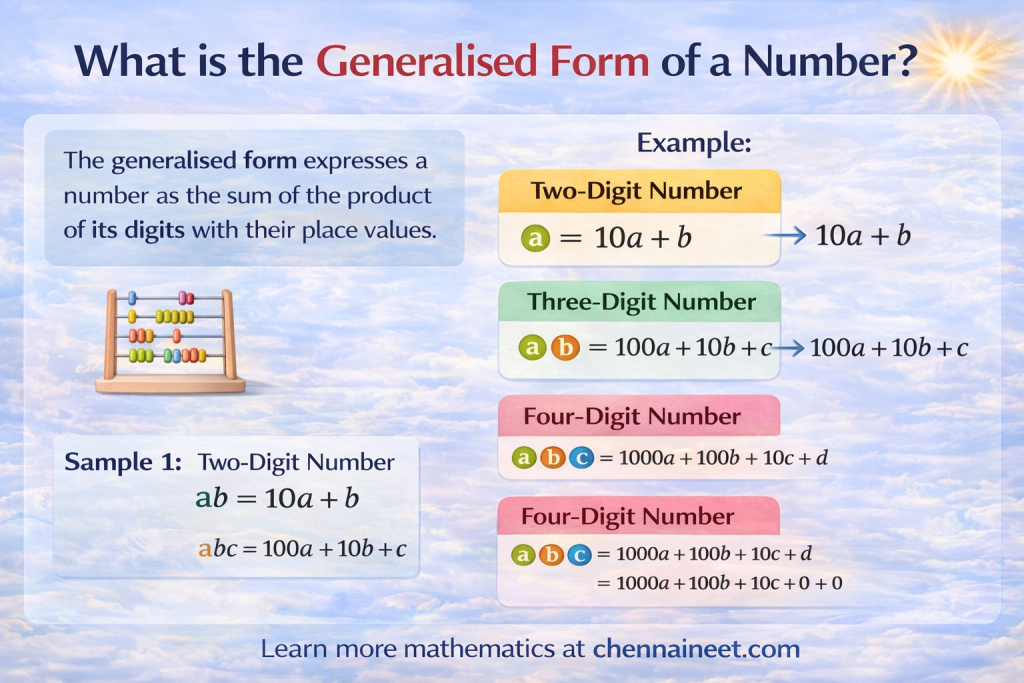
The generalised form of a number is the expanded representation using place values of digits.
Example
For a two-digit number:
ab = 10a + b
Where:
- a → digit in the tens place
- b → digit in the ones place
Similarly, for a three-digit number:
abc = 100a + 10b + c
And for a four-digit number:
abcd = 1000a + 100b + 10c + d
This representation shows the value contributed by each digit.
Step-by-Step Solution
We will convert each given number into its generalised form.
Step 1: Two-Digit Numbers
1. 39
39 has:
- 3 in the tens place
- 9 in the ones place
So,
39 = 10 × 3 + 9
2. 52
52 has:
- 5 in the tens place
- 2 in the ones place
So,
52 = 10 × 5 + 2
Step 2: Three-Digit Numbers
3. 106
106 has:
- 1 in the hundreds place
- 0 in the tens place
- 6 in the ones place
So,
106 = 100 × 1 + 10 × 0 + 6
4. 359
359 has:
- 3 in the hundreds place
- 5 in the tens place
- 9 in the ones place
So,
359 = 100 × 3 + 10 × 5 + 9
5. 628
628 has:
- 6 in the hundreds place
- 2 in the tens place
- 8 in the ones place
So,
628 = 100 × 6 + 10 × 2 + 8
Step 3: Four-Digit Numbers
6. 3458
3458 has:
- 3 in the thousands place
- 4 in the hundreds place
- 5 in the tens place
- 8 in the ones place
So,
3458 = 1000 × 3 + 100 × 4 + 10 × 5 + 8
7. 9502
9502 has:
- 9 in the thousands place
- 5 in the hundreds place
- 0 in the tens place
- 2 in the ones place
So,
9502 = 1000 × 9 + 100 × 5 + 10 × 0 + 2
8. 7000
7000 has:
- 7 in the thousands place
- 0 in the hundreds place
- 0 in the tens place
- 0 in the ones place
So,
7000 = 1000 × 7 + 100 × 0 + 10 × 0 + 0
Final Answer
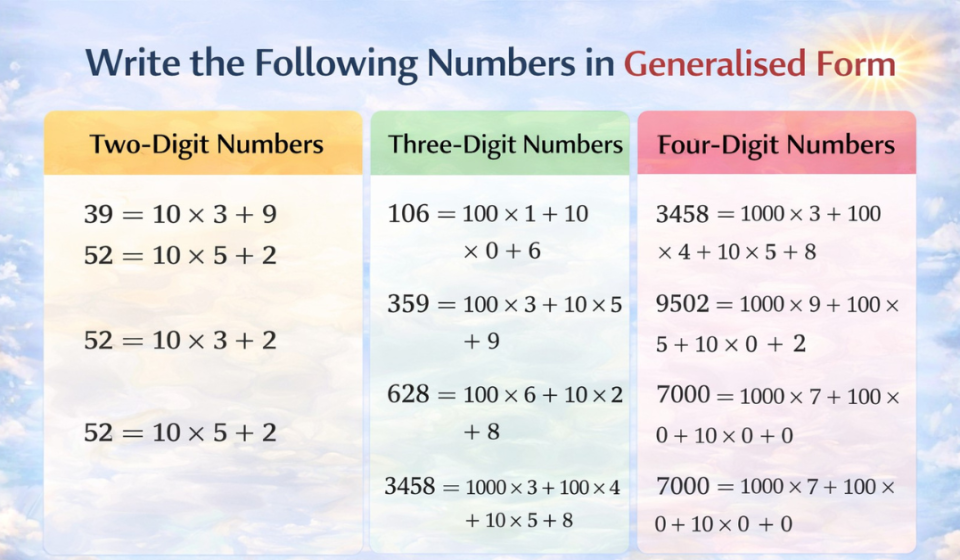
The generalised forms of the numbers are:
- 39 = 10 × 3 + 9
- 52 = 10 × 5 + 2
- 106 = 100 × 1 + 10 × 0 + 6
- 359 = 100 × 3 + 10 × 5 + 9
- 628 = 100 × 6 + 10 × 2 + 8
- 3458 = 1000 × 3 + 100 × 4 + 10 × 5 + 8
- 9502 = 1000 × 9 + 100 × 5 + 10 × 0 + 2
- 7000 = 1000 × 7 + 100 × 0 + 10 × 0 + 0
Additional Notes
Understanding the generalised form of numbers helps students learn the concept of place value clearly.
Generalised Forms
- Two-digit number:
10a + b - Three-digit number:
100a + 10b + c - Four-digit number:
1000a + 100b + 10c + d
Where:
- a, b, c, d are digits from 0 to 9.
This method is widely used in number system problems, algebra, and mathematical reasoning.
For more math explanations and solved examples, visit chennaineet.